
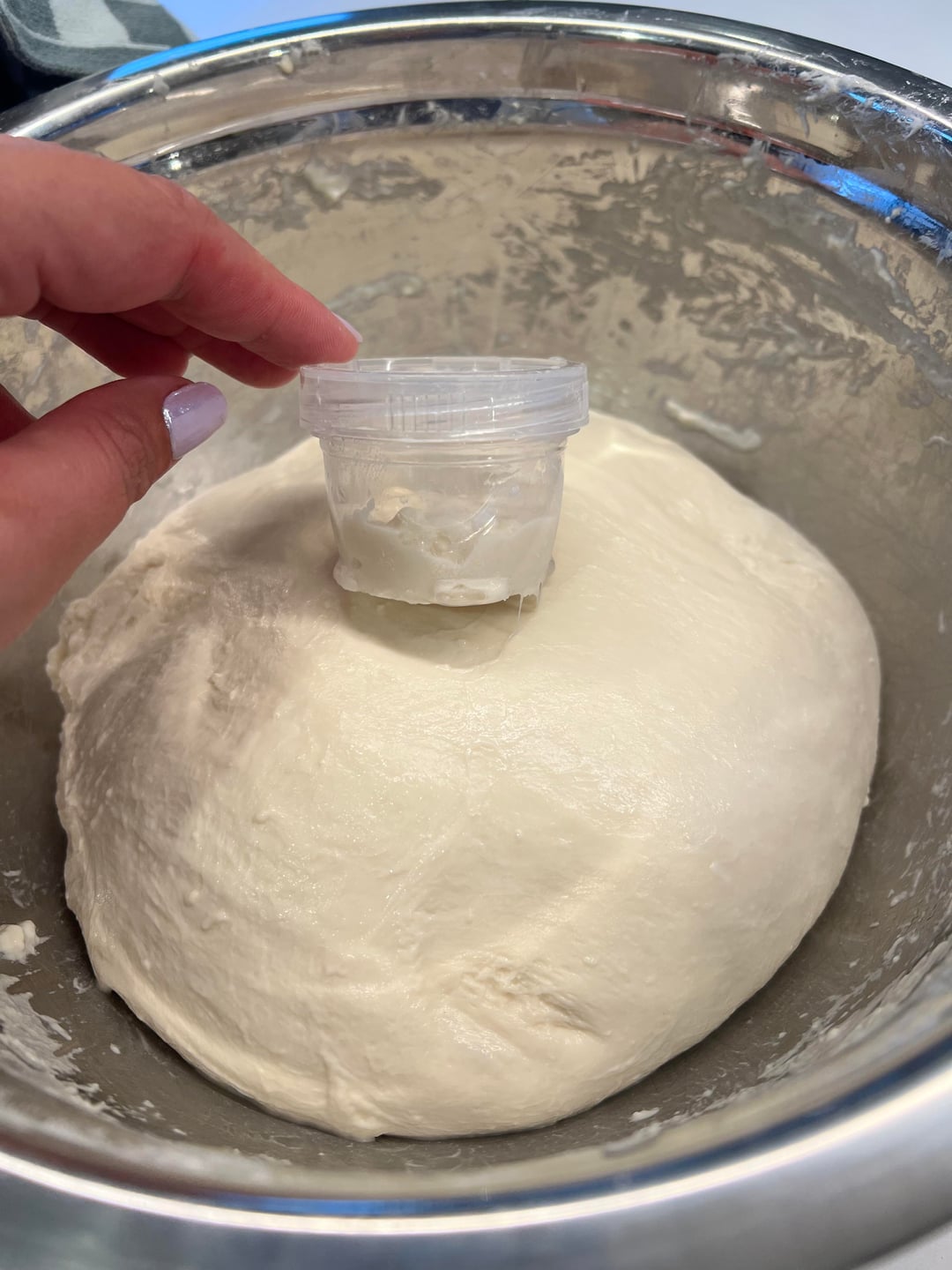
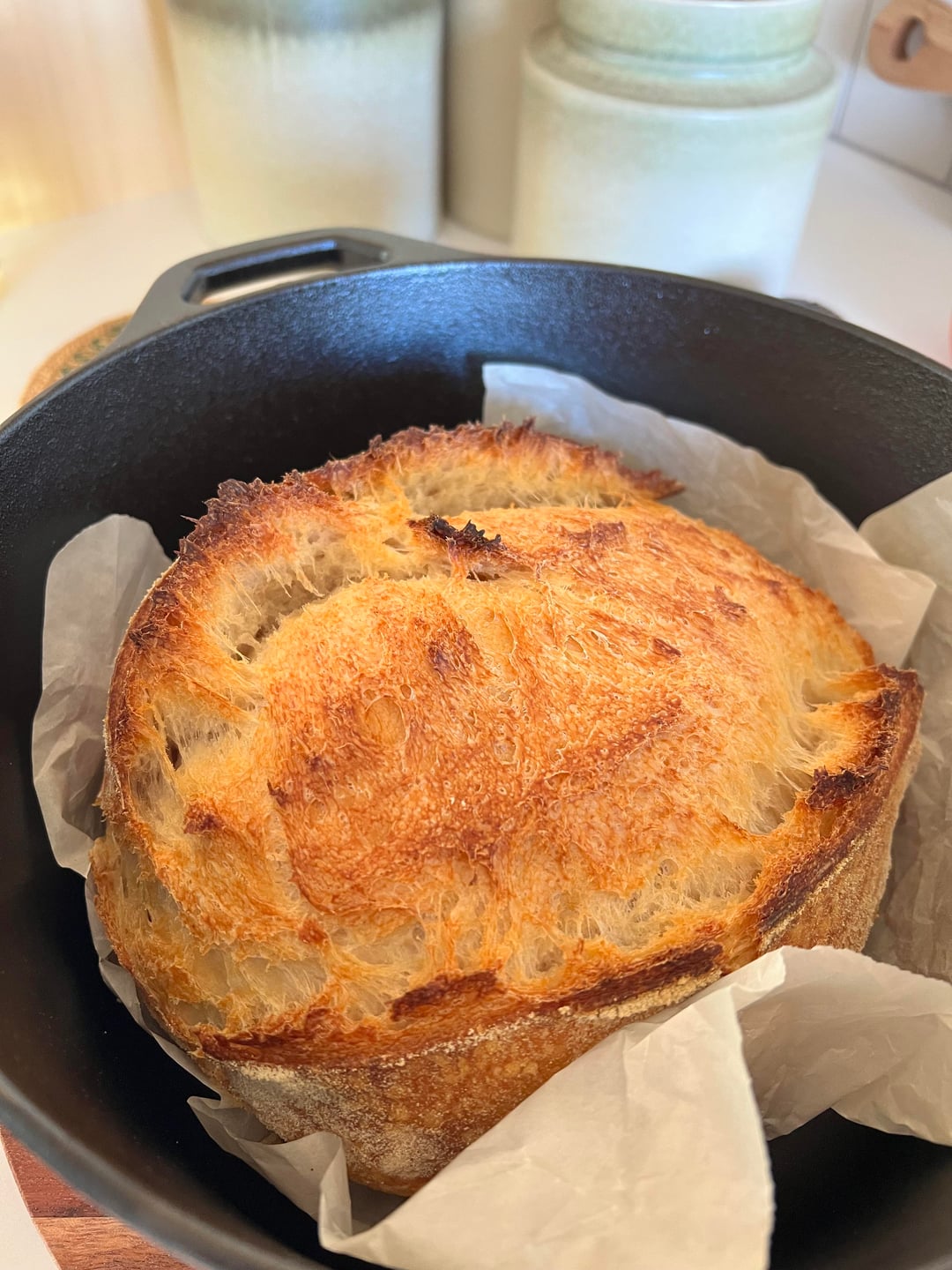
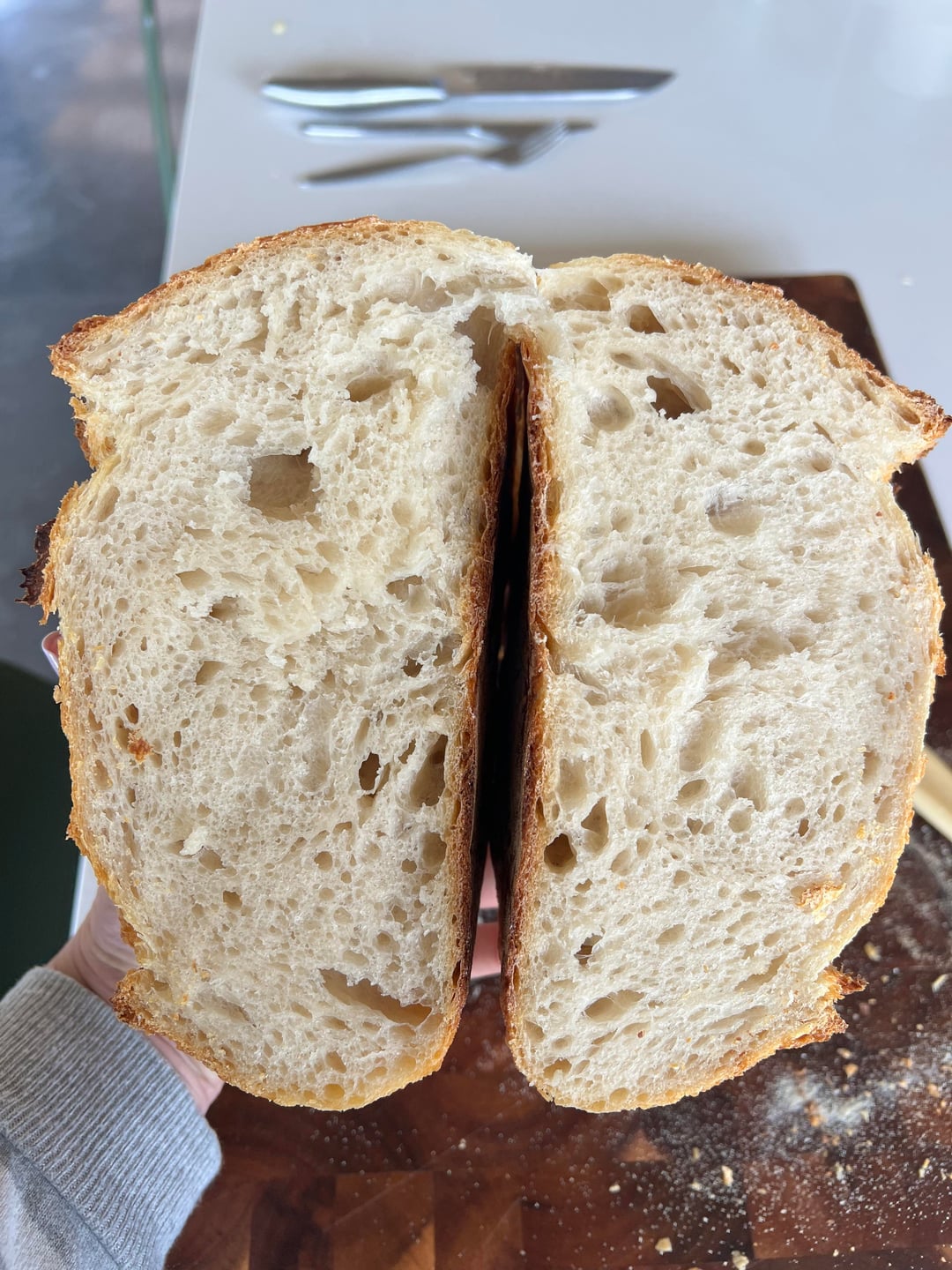
I can’t even remember where I saw this tip so I can’t credit the person – I think it was on Tik Tok but it has changed the game for me!
All you need to do is add a small amount of dough to a small container once you’re done mixing ingredients (before any stretch and folds). Once this doubles in size, you’re ready to shape! You sit the little container in your dough so it has the same conditions and is rising at the same rate. I meant to take more photos during the process but completely forgot. This is right at the start.
I’ve been baking sourdough since the first lockdown in 2020 and this is easily the best way of knowing when the dough has risen enough. You want your dough to double, but when you’re knocking the air out with stretch and folds each time it gets confusing! For beginners, it can be so hard to know what to look for – even for someone with a little more experience if the weather changes or you use a differently shaped bowl than usual.
For this loaf I’m away on holiday so everything is different. I would have stopped proofing probably an hour or two earlier if i weren’t using the using the little container to measure and was worried it would be overproofed, so I must be always slightly underproofing my dough. That would explain why it’s usually a little gummy – this time the crumb is perfect and I cut it warm. Please judge my cutting though – the only serrated knife around was a fish knife.
Anyway, I’ve seen a few posts recently of people unsure about over/underproofing – I hope this helps you!
My method: (2 loaves)
1kg all purpose flour
600g water
Mix and leave for 30 min
Add 50g water and 23g salt
Take a small amount of dough and add to a tiny container. Sit the container in the dough while it proofs.
4 stretch and folds at 30 minute intervals
Can’t remember how long or the room temp but finished proofing when the container dough had doubled in size.
Shape into ball, rest for 10 min, shape again.
and put in fridge overnight.
Bake at 250°C for 30 min with lid on and at 200°C for 20 with lid off (I kept forgetting to set timers so it cooked for longer than that this time).
by premgirlnz
14 Comments
Do you leave it open or sealed?
Glad you are having success with this but it won’t work for everyone:
– Depending on the temp of your dough/ kitchen, a lot of doughs will overproof if doubled.
– Depending on the starting temp of your dough vs where it rests during bulk ferment, the temp of your aliquot jar and the temp of your dough can be very different and bulk at different rates. For example, if you start with 70F dough temp and place your dough in the oven with the light on to bulk (lets say its 80F in there), your aliquot will be 80F in minutes, and it may take your dough hours due to the difference in mass. This would mean your aliquot would be done way faster than the dough.
– Most of the time the BF process calls for folds only in the first 2-2.5 hours. There is usually no measurable rise at this time, so you’re not changing the volume by folding. If you need folds after the dough has started to inflate something else is wrong in your process.
Like I said, glad it works for you, but “this is the best method and always works” is not the best advise for a beginner.
The best thing for a beginner to do would learn how to keep track of dough temp and learn what percent rise works best for their dough temp. There’s a chart for this from The Sourdough Journey.
This looks fantastic!! Amazing job
The small container doesn’t always match the big one though…
Only speaking for myself here, but the game changer was putting my dough in a juice pitcher so I could easily see how much it rises.
Same theory as the small container, but you can see your whole dough.
Also, I’ve found with the flour I use, 50-60% rise turns out better than doubling.
How much starter and when do you add it?
I don’t see a starter included in your ingredients??
Aliquot method
This is the Aliquot Jar method and yeah, it works fantastic. I use a little jar with straight sides and have it marked for different volume rises…30%, 50%…etc
I also recommend using cambro containers for your bulk fermentation. They’re the food industry standard and have measurements on them so it’s easy to track your dough’s rise.
I use a milk bottle and measure the volume increase of the whole dough.
Skip the hassle of using a whole separate container. I just put my dough in a tall, straight-walled (not tapered) tupperware. Since the cross-sectional area stays constant over it’s height, you can get an accurate volume measurement just from the height. so wait until the height in container doubles (or whatever your preferred factor). Many of these containers already have volume gradations on the side, so its easy to be precise too. If you’re using a sticky sough you can give a spritz of PAM or a quick wipe with the neutral oil of your choice to aid in release.
This is called the aliquot method.
The problem is that the small piece of dough is much more sensitive to temperature changes, so it will not always be necessary or entirely accurate.
The best thing is to get a transparent container with straight walls and measure when the big dough has doubled its size during bulk fermentation.
I made rye sourdough the other day. It was late after I finished the S&Fs, so I put the dough in the Cambro and stuck it in the fridge. I was worried it would take forever to bulk proof, since refrigeration would slow it down. Next morning I put it in the oven with the light on and stuck in a measuring cup of boiling water. I forgot to measure the dough temp, but when I did, 2 hours later, it was 64. Checked the temp hourly and in 3 hours it was 77. It averaged 73 for the 5 hours it took to rise ~65%. So it took about 3 hours longer by retarding the BF. The loaves turned out great. Recipe from [grantbakes](https://grantbakes.com/sourdough-deli-rye-bread/) I’m now committed to using The Sourdough Journey’s fermentation guide to keep me from underproofing my dough.
https://preview.redd.it/i0yhbv0e5n7g1.jpeg?width=3024&format=pjpg&auto=webp&s=cee171526520ce8fefaf6a3b586f213d0ce8d11c
i use this method and my bread turns out perfectly every single time