
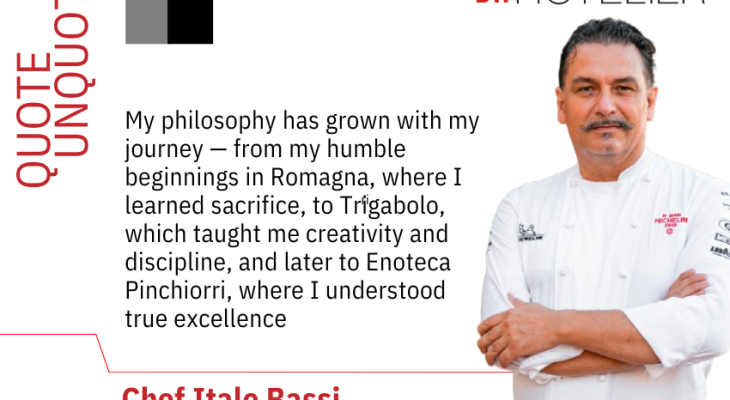
Chef Italo Bassi grew up in Romagna, Italy’s culinary heartland, nurturing a love for flavours that would define his global career. After early Riviera stints, he refined his craft at Ferrara’s iconic Trigabolo under Igles Corelli before rising to prominence at Florence’s Enoteca Pinchiorri, where he helped reclaim its third Michelin star in 2003. By the time he launched his Confusion restaurants in Verona and Porto Cervo in 2015, Bassi was already celebrated for precision, creativity and a disciplined respect for tradition.
Today, his signature dishes — from rigatoni with pork ragu to a pitch-perfect Amatriciana — reinterpret classic Italy with contemporary finesse, positioning him as one of the cuisine’s most influential modern ambassadors.
During his India tour, hosted by the International Institute of Culinary Arts (IICA) New Delhi for a masterclass under the 10th Week of Italian Cuisine, Chef Bassi spoke with BW HOTELIER about his culinary philosophy, innovations in Italian gastronomy and the opportunities he sees in India’s evolving dining landscape. Excerpts:
How would you describe the evolution of your culinary philosophy over the years?
My philosophy has grown with my journey — from my humble beginnings in Romagna, where I learned sacrifice, to Trigabolo, which taught me creativity and discipline, and later to Enoteca Pinchiorri, where I understood true excellence. Japan added precision and a new aesthetic sensibility. Today, my cuisine balances solid technique, deep respect for ingredients and expressive freedom. I don’t chase trends; I let tradition evolve with coherence and sensitivity.
How do you approach the interplay between technique, creativity and ingredient integrity?
Technique is the foundation; without it, creativity becomes improvisation. Creativity gives identity to technique, but the ingredient remains the true protagonist — its freshness, story and season guide everything. I see myself as a conduit, intervening only as much as needed to enhance, not overshadow. Respect, discipline and sensitivity shape every dish I create.
What ingredients excite you the most and why?
I’m currently very interested in Indian spices – their complexity and cultural depth are remarkable. What fascinates me most is their potential when used with restraint, adding warmth and nuance without overpowering the dish. Since my cuisine relies on balance and ingredient centrality, the challenge is finding that point where Indian spices enrich rather than dominate. When that happens, a compelling dialogue between two strong culinary cultures emerges.
How do you balance classical Italian roots with global inspirations in your cooking?
My foundation remains deeply Italian — technique, balance and memory — but the world has shaped its expression. Japan taught me spiritual respect for ingredients, attention to detail and purity of flavour, while my travels added subtle nuances rather than layers. My constant challenge is to preserve the true Italian soul while integrating global influences that enhance rather than alter it. It’s an ongoing conversation between home and the world.
What does “innovation” mean to you in the context of Italian gastronomy today?
For me, innovation isn’t about impressing at all costs; it’s about evolving without betraying your roots and giving new meaning to lifelong gestures. It begins with a quality ingredient and builds a contemporary narrative around it. Innovation means changing when necessary, not when convenient. With today’s aware diners, it’s not about special effects—it’s authenticity, the courage to do less but do it better, and the confidence of a cuisine that needs no disguises.
What qualities do you believe define a modern chef-leader in today’s global F&B landscape?
A modern chef-leader must blend heart, vision and discipline. Cooking alone isn’t enough—you must build a team, share a method and inspire enthusiasm, leading by example rather than authority. Experience has taught me the strength of humility and the importance of continual learning. A chef also carries cultural responsibility: to protect tradition while guiding it into the future with sensitivity and openness.
Having cooked for diverse cultures, how do you adapt your menus for different markets while preserving your signature style?
Every market has its own gastronomic language, and my role is to listen. I don’t treat Italian cuisine as dogma; I bring my interpretation of Italy and harmonise it with the cultures I encounter. Asia taught me balance and aesthetics, the Middle East hospitality, and Europe loyalty to the product. Adapting doesn’t mean diluting – it means understanding the context and integrating it into my identity while keeping my signature intact.
What differences or opportunities have you observed in the Indian dining landscape, and how does it influence the way you design experiences here?
India offers extraordinary cultural, aromatic and technical richness. I found an open, curious audience that recognises the truth of a dish. Its spices, fermentations and bold ingredients constantly inspire me. Working here pushed me to explore new balances and sharper contrasts. India compels professional growth because it places you before a living, millennia-old culinary tradition.
What direction do you see contemporary Italian cuisine taking over the next decade?
I hope Italian cuisine doesn’t follow trends. Its strength lies in identity — the depth of flavour, the primacy of the product and its ties to memory and territory. I believe the future should be one of continuity: preserving who we are without chasing fleeting aesthetics or forced fusion. Italy doesn’t need reinvention, only refinement. True progress is not change for its own sake, but protecting what is essential.
What are your current projects or culinary ideas that you’re most excited about exploring next?
I’m at a stage where I want to consolidate my work while exploring new international projects. I’m drawn to formats that blend haute cuisine with cultural dialogue, grounded in respect and authenticity. I’m developing experiences that reflect my story—technique, Italy, the East, memory and the future — creating spaces where guests embark on a journey, not just taste a dish. I also want to keep training young chefs, because the real legacy isn’t a menu, but knowledge.
Dining and Cooking