
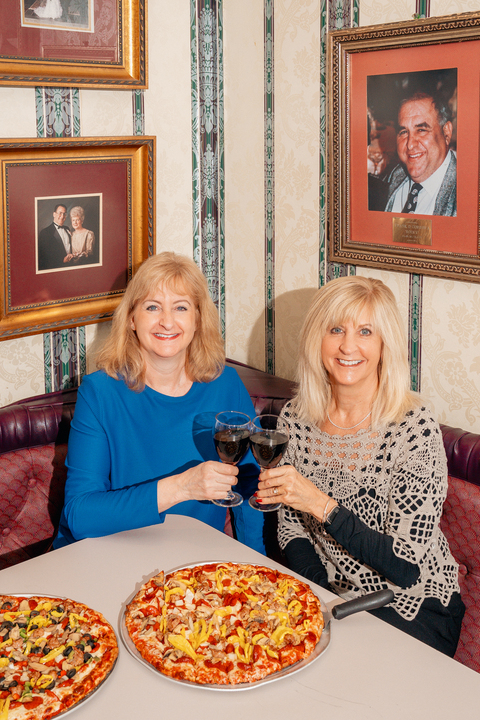
An out-of-state visitor and her husband recently asked a German Village tour guide, “What would you say is the one food that best defines Columbus?” With barely a pause the guide replied, “Pizza.” The couple laughed. It was the same answer they had been hearing all weekend.
Over the past two decades, Ohio’s capital city has made waves on the food front, becoming a destination city for epicures. A San Francisco magazine recently listed Columbus among “America’s most thrilling food cities.” Today, there’s no shortage of upscale restaurants offering everything from eggplant togatsu over sumac yogurt to sweet potato chaat with fried kale to a five-course “tour” featuring torched sea bream with ponzu jelly.
But this is the Midwest. Even those who hunger for the occasional $188 Wagyu steak with truffle fries and a $299 bottle of Right Bank Bordeaux will eventually come down to earth and crave a simple pepperoni pizza. And Columbus, once crowned the Pizza Capital of the U.S.A. by Pizza Today Magazine, is home to some of the best to have ever originated in the New World.
Our favorite game-day meal has its origins in West Asia and Europe. Varieties of baked bread with toppings have been traced back thousands of years. Persian soldiers in the 6th century BCE carried into battle flatbreads with cheese and dates perched atop their shields. Ancient Greeks ate a flatbread called plakous, often topped with cheese, garlic, herbs and onion.
Archaeologists at Pompeii were excited a few years ago to find a fresco depicting what looked like a modern-day pizza. On closer inspection, though, experts determined it probably was a simple focaccia, seasoned with herbs. Most of today’s pizza fanciers would certainly demand more from their favorite dish than air-filled bread and olive oil.
Ingredients of the modern pizza began coming together in Naples and Sicily about 400 years ago, after Spaniards from the Americas introduced tomatoes to that region. But it wasn’t until 1830 that the first pizzeria opened, in Naples. Further recipe refinements were still to come. And by the early 1890s, Italians were going crazy for their oven-baked flatbread topped with mozzarella cheese, tomatoes and other savory ingredients.
It took no time at all for pizza to “jump the pond,” arriving in New York with Italian immigrants as early as 1894. But it would be another 40 years before it found its way to Columbus
In 1929, a young Pete Carrova, who had emigrated from Sicily with his parents, and his wife Philomena, originally from Naples, opened a little cafe on West Goodale Street. The area, known then as Flytown, was already home to many Italians who had recently come to Columbus looking for work.
Pete named his eatery TAT (pronounced as three initials) after the brand-new coast-to-coast air-train passenger service, Transcontinental Air Transport. Columbus was TAT’s main hub, and Pete was fascinated by it. He loved watching the Ford Tri-Motor passenger planes flying overhead on their way to or from the new Columbus airport.
At first, TAT (the restaurant) served spaghetti, other pasta dishes and fried chicken. Then, five years after opening his little restaurant, Pete added pizza to the menu, having learned from his mother how to make it. Thus, TAT became the first restaurant in Columbus to offer pizza.
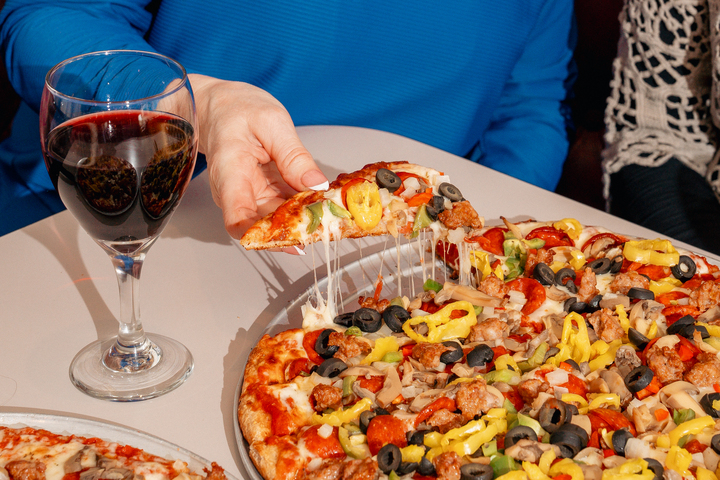
Pete’s son Jimmy described that first TAT pizza in 2015 as a product of the Great Depression. He said it had a thicker crust and was baked in large pans. Tomatoes, herbs—and often anchovies—were spread on top. Cheese wasn’t always available in those days, so it was sometimes simply left off.
Pete was successful, but the construction of I-670 soon forced him to move his business to the East Side, where seven-year-old Jimmy often worked the cash register while standing on a wooden crate. Jimmy eventually joined the business fulltime, overseeing various moves and expansions until he and his family settled on one location in 1981—a former Patriot Steakhouse at James Road and Livingston. Jimmy died in 2021, leaving TAT to his widow, Dolores, and daughters Marianne Corrova Kirkbride and Michelle Corrova.
BROUGHT TO YOU BY

Under Jimmy’s watchful eye, TAT’s pizza evolved over the decades. Today, it largely fits the description of “Columbus-style.” “We make our own dough, which we spread thin,” Marianne said. “We then slice provolone for the top, mix fresh garlic into our tomato sauce and bake it all in a top-of-the-line Blodgett stone oven.” A dusting of corn meal keeps the dough from sticking to oven shelves. When it comes out, the “pie” is then cut into strips for serving.
It all adds up to a taste that had the Corrovas overseeing the production and delivery of up to 600 pizzas on some Friday nights. And today, TAT is as busy as ever. “Our pizza business has actually increased since COVID,” Michelle added. “Even if our dining room isn’t full, we’re doing plenty of carryout and DoorDash.”
The folks at Massey’s Pizza concede that TAT served the first pizza in town. But in the spirit of friendly competition, they enjoy boasting that they opened the first pizzeria. Their slogan: “Columbus Discovered Pizza in 1950.” Like TAT, Massey’s has a long pizza pedigree. It was started by James Massey, who had learned how to flip pies at a restaurant called Romeo’s (no connection to today’s Romeo’s Pizza restaurants).
In 1962, Massey sold his business to Guido Casa, who kept the Massey’s name. It went through other ownership changes until being bought by brothers Dave and Jim (or “Jed”) Pallone in 1999. Today, Massey’s has a cult following among pizza lovers, with 13 locations in Central Ohio and one in Pauley’s Island, South Carolina.
Chief Marketing Officer Rich Folk has been with the company for 25 years. And he’s quite proud of the following Massey’s has attracted. He also insists that Massey’s is one of the few places where you can get authentic, Columbus-style pizza.
So, what does that mean? “Columbus-style pizza starts with a very thin crust—almost cracker thin,” Folk said. ”You then add mozzarella or provolone cheese, a slightly sweet, tomato-based sauce and toppings (usually pepperoni) that cover the entire crust. Then you dust the bottom with corn meal and slip it into a deck, or ‘shelf-style’ oven.” When the pizza has baked, it is cut into small squares or rectangles. Many call it “tavern cut.” Others call it “square cut” or “party cut.”
And Folk has a theory about that. “Pizza has been popular for years in bars and taverns, where it’s common to share your food with friends,” he explained. “By cutting it into more pieces, there’s more opportunity for sharing pizza than with the usual ‘pie’ slices.”
No one really knows how Columbus-style pizza got started. But Folk says it wasn’t unusual for a lot of the older pizzeria owners to play golf together and swap ideas about their favorite food. Eventually, the local pizza community had these unwritten Columbus-style “rules.”
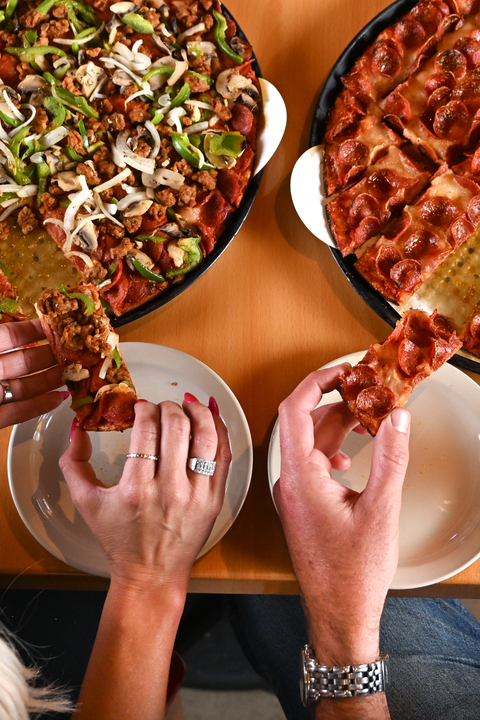
Columbus really has no shortage of old-style pizzerias. Rubino’s, on East Main Street in Bexley, dates back to 1954. And while “Rubino’s” sounds like a thoroughly authentic Italian name, it was actually a Jewish boxer from New York, Ruben Cohen, who started the popular carryout with a friend. Cohen hired two young men, Frank Marchese and Tommy Cully, to make the pizzas. Using Cohen’s own recipe for pies with a cracker-thin crust, Rubino’s found success early on.
Cohen sold “Rube’s” to Marchese and Cully in 1988; Frank’s son, Jim, then had a successful run with it; today, Jim’s daughter Julie is in charge. “My father is the man,” she proudly said. “But he’s 76 now, so I’ve been running the show in his absence.” And she insists that employees follow the original recipe to a “t.” “With aged provolone,” she added, “and aged Romano sprinkled on top of that when it comes out of the oven.”
Like most Columbus-style pizzas, the ones from Rubino’s are cooked on a bed of corn meal and then cut into strips or squares. The one small difference is the sauce. As Julie says, “Not at all sweet. Kinda tangy. You can taste the herbs in it.” Julie expects to continue running Rubino’s just as it has been for three generations.
And then there’s the biggest name in Columbus pizza, Donatos. From one pizzeria on Thurman Avenue in the early 1960s, Ohio State sophomore Jim Grote started a chain that today numbers about 180 locations spread over a dozen states. Some may quibble over the Donatos method of oven baking—on a conveyor belt instead of on shelves—but everything else about their version has “Columbus” written all over it.
Today, you’ll find hundreds of pizzerias across Central Ohio, including 50 or so with the name “Donatos.” And though today’s pizza lovers are more accepting of other varieties, it appears Columbus-style is here to stay.
Not long before his death in 2023, Massey’s co-owner James Pallone gave his thoughts on why pizza remains so popular. “It’s a great equalizer,” he said. “Food snobs love it; the working guy loves it. Everybody loves to talk about pizza.”
And some even enjoy writing about it.
Want to read more? Check out our print publications, (614) Magazine and Stock & Barrel. Learn where you can find free copies of our newest issues here!
Dining and Cooking