
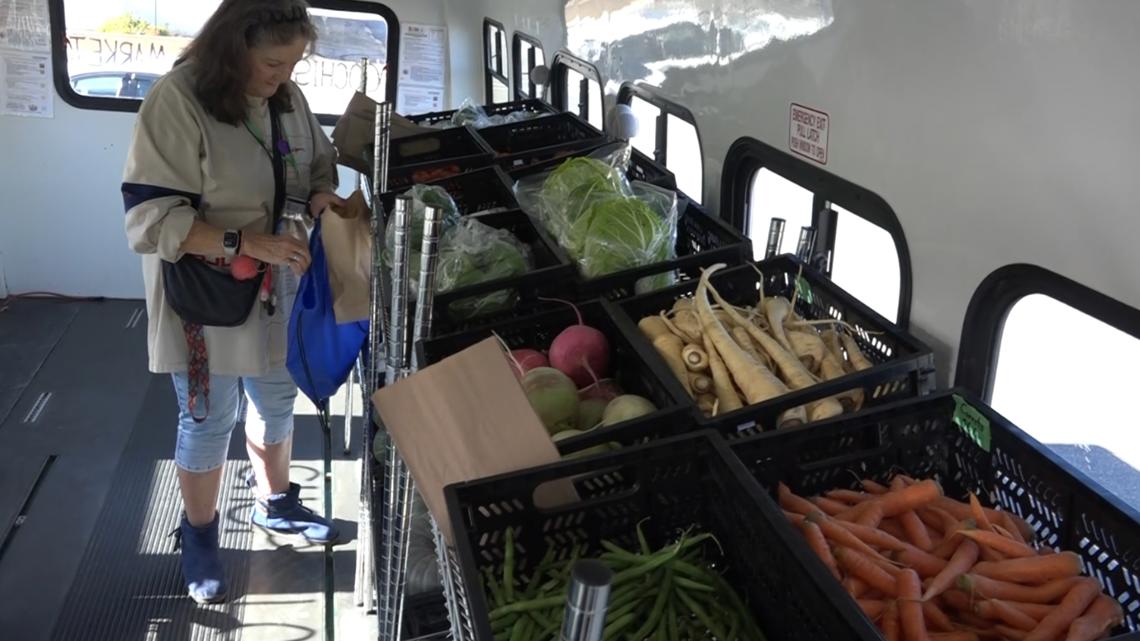
Sixteen patients use a grant-funded debit car to purchase $20 dollars of locally grown produce each week.
BENSON, Ariz. — A rural Arizona community is taking the “food is medicine” motto to heart.
And early results show some promising signs.
“I think our patients who are really committed have enjoyed it,” said Cindy Tapia, Benson Hospital Manager of Essential Services. “This is just a pilot program. But we do see this going bigger. “
Produce RX Program Includes Farm Co-Ops
More than two dozen local farmers and the Benson hospital are finishing the pilot program for “Produce Prescriptions.” Sixteen patients with diabetes and cardiovascular disease use a grant-funded debit car to purchase $20 dollars of locally grown produce each week.
“I’m eating more vegetables and experimenting with cooking more,” said participant Wendy Barie who estimates she eats 50% more fresh food. Perhaps most importantly, Barie said she has cut out processed sugars.
“I’ve discovered dates! They’re marvelous,” Barie said. “I had not eaten them before. It’s like eating sweet custard.”
Midway through the program, 9 of 13 participants tested and showed blood pressure improvement. Average blood sugar levels also slightly decreased. Two participants lost weight. Tapia said she will conduct another round of tests at the end of the month to see final results.
“We want this to grow to be a community project, not just for one specific group,” Tapia said.
‘Let’s take this to legislatures’
Local farmer John Benedict said the concept of produce prescriptions is not new. Benedict is working with the Arizona Department of Agriculture to provide feedback on the program.
“Typically, where people are doing produce prescriptions, you are tackling the health aspect but is it affordable? And if you can make it affordable, that’s why you do the mobile market because people struggle with transportation,” Benedict said.
For now, he is putting his own money into the program as an investment, but he believes produce prescriptions can be a profitable model of healthcare.
“If the whole goal is to get people off pills and eat more produce, let’s work with large retailers, let’s get these into clinics and Walgreens,” Benedict said. “Let’s take this to legislatures, let’s see how we can get this covered with AHCCCS (the state’s low-income health program).”
High-Quality Fruits and Vegetables
Not all fruits and vegetables are created equal. And that is one reason why participants likely enjoy the program in Benson. Produce from farmers like Joe Marlow is typically sold at organic markets and discerning Tucson restaurants.
“These vegetables are dense with nutrition,” Marlow said. “What I tell people at my farmer’s market stands if they raise their eyebrows about prices is you can pay me now or pay your doctor later.”
One program participant told 12News she appreciates the ability to buy produce that is free of pesticides and chemicals.
The wife of another patient said her husband with diabetes is more inclined to eat healthier now that the hospital has offered this “prescription.”
“Over the past three months he has lost six and a half pounds, and his A1C is down quite a bit too. Much better numbers,” said Icie Grimes.
Price, proximity, production and policy
Benedict, who studied economics in college before moving to Arizona from New Jersey, said a successful low-income produce RX program should hit four targets: an affordable price, close proximity, quality production, and smart government policy.
Whether the experiment taking place in Cochise County provides lessons that state leaders want to incorporate into preventative healthcare policy remains to be seen.
For now, Tapia said she is determined to work with the farming community to keep the program going in the community where she grew up.
“We want patients to enjoy this. That it’s not something they have to eat, but want to eat,” Tapia said. “And hopefully this is replacing some of the sugars, processed foods they typically eat, and eventually they become healthier and healthier.”
Dining and Cooking