
Recipe for Disaster is Slate’s column about the things recipes get wrong—and how to fix them. If you’ve noticed a recipe annoyance, absurdity, or outright lie, file your complaint here and we will investigate!
I posit that the greatest part of Christmas is the cookies: dozens of deeply colored, fanciful confections laid out onto silver trays and festive plates, tucked into portly tins that pop open, and stacked onto tiered cake stands to whimsical effect. Some modern innovations, some living family heirlooms, cookies in great numbers have the unique ability to leave one feeling gobsmacked. It’s the overwhelming variety, the sheer army of them that make Christmas cookies such a spectacular treat. Which is why it’s a damn shame that these days, we seem to be overcomplicating them beyond all recognition.
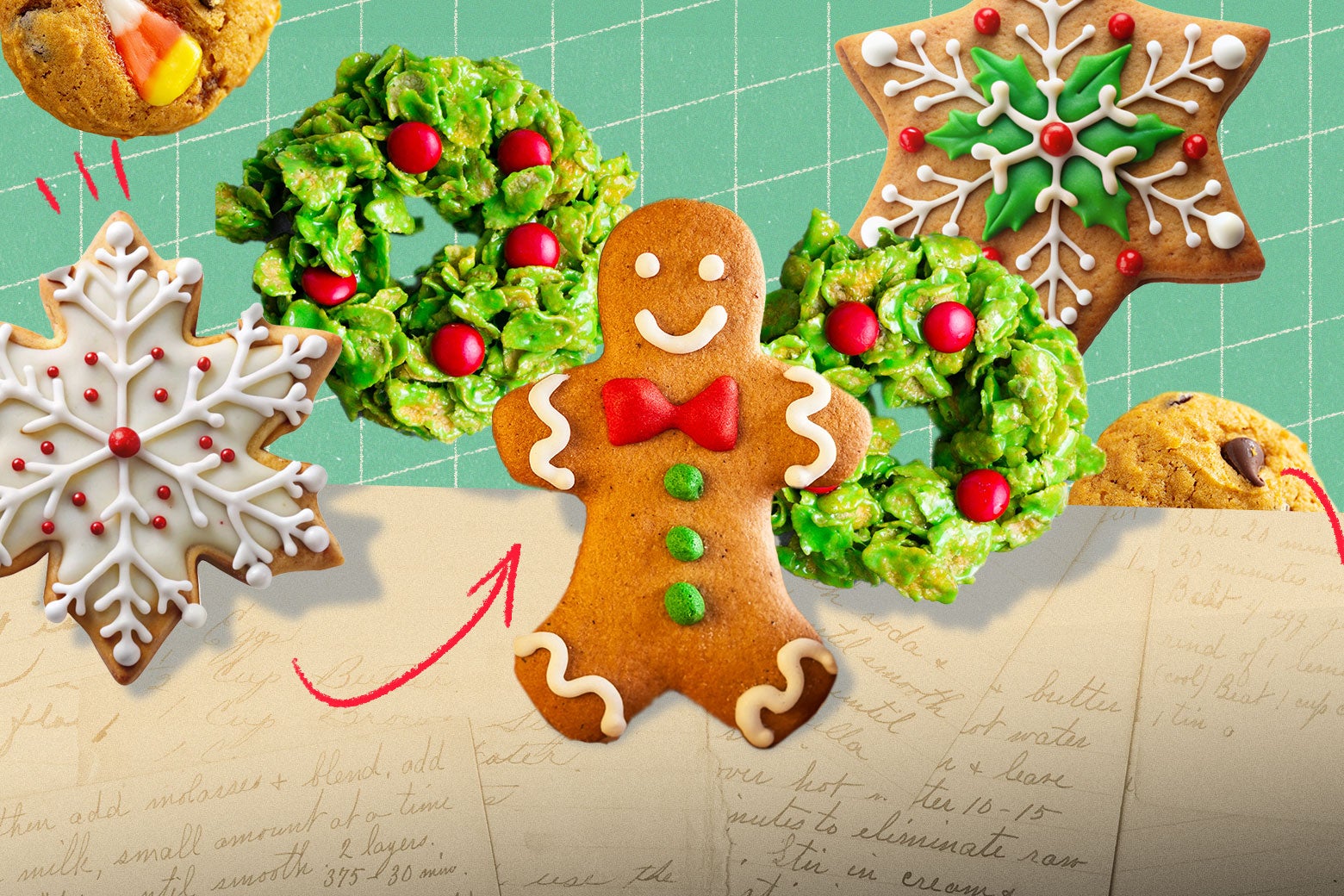
Did you see those “mortadella” cookies New York Times Cooking was pushing recently? God, do they look awfully fleshy and unappealing. (Please, NYT, don’t do bresaola next.) Then we’ve got viral TikTok chocolate chip cookies that are praised for their gooey, pull-apart soft centers but are mostly just underbaked. And everywhere people are scooping shovelfuls of candy and icing to make some Pinterest-worthy decorative cookies that you just know don’t taste as good as they look. It’s too much! I’ve even heard that the fuss, the unnecessary gimmicks and gildings, are turning people off from quietly baking a simple batch or two at all. So, to preserve the good name of our most cherished confection, I spoke with some bakers about common recipe pitfalls to avoid, as well as ideas for truly enhancing the product and experience. And lo, I bring unto you the four tenets for making spectacular Christmas cookies.
Ditch the Candy
A baker and author friend in New York City, the great Natasha Pickowicz, tells me flatly: “Candy does not belong in cookies. Any candy you’d buy in a gas station is not good in a cookie.” I tend to agree: Candy and cookies don’t mix. Have you had a Keebler M&M’s cookie lately? It’s vacuum dust glued together with candy shells. Even a good M&M’s cookie is mostly M&M’s, and they look more appetizing than they actually taste (a theme I’ll address later).
Candy is simply too overpowering. It’s a blunt object that will promptly bludgeon any nuance that a cookie might have offered. Cookies incorporating Reese’s, M&M’s, Butterfingers, Kit Kats, Twix, and Snickers are just too dull and deadened by these sugary, clunky, poorly made candies. And don’t get me started on gummies—the textures just don’t go. The spirit of Christmas simply isn’t candy. It’s honest, wholesome flavors: homemade fudge, chocolate, peanut butter, powdered sugar, snickerdoodles, gingery things, buttery shortbreads, and lemon bars.
That said, I do reserve a special place in my heart for one candy-studded cookie, the venerable peanut butter blossom. Farideh Sadeghin recently put out a video documenting the creation of peanut butter blossoms, and it was hard to feel anything but a gentle, heartfelt nostalgia for them. Smooth Hershey’s Kisses (essentially just a piece of chocolate) and soft peanut butter cookies are a winning combination, and the various flavors of Kisses, like mint, candy cane, and snickerdoodle, continue to excite the form.
But when it comes to candy, you should start and stop at peanut butter blossoms. Candy is Halloween; Christmas is cookies. When the two are forced to merge, it’s a real nightmare.
Rebel Against Royal Icing
Contemporary Christmas cookie recipes are rife with fiddly frostings and icings, and it’s true that these are what make decorative varieties really pop, at least visually. Icing gives a colorful animation to form snowmen, Christmas trees, candy canes, snowflakes, and even little Santa faces, but the trouble is, “royal icing”—the most classic sort—itself doesn’t contain much flavor. It’s a dry, sugary paste that’s purely ornamental—or it should be.
“Royal icing is disgusting,” says Pickowicz. “Actually, any icing on a cookie is a turnoff to me. I’d rather have a cookie dusted with powdered sugar any day.” Royal icing is simply powdered sugar, egg whites, and water. It’s edible, but just barely, hardening enough to ensure that your green Christmas trees and striped candy canes maintain their appearance. But it really doesn’t belong on food that people are actually meant to eat. It’s another age-old cooking rule put into baking practice: If the garnish isn’t edible, get it off your plate. Icing’s purpose is essentially war paint, and you wouldn’t lick war paint, would you?
But if your recipe demands royal icing, there’s a way to sneak some flavor into it. “If you must make a flat icing,” explains Pickowicz, “it needs something bracing or tart to make it punchy and balanced. I like vinegars for this. If it’s just serving a cosmetic purpose, it doesn’t belong on your cookie.” In the past, she has used things like cherry vinegar, which not only adds eccentric flavor but also naturally dyes the icing. Smart! Vinegars and natural extracts work twofold in terms of adding taste and natural color.
If I had to argue against myself here, I’d say, “Hey, lighten up, jerk. Children love decorating Christmas cookies.” My niece and nephew have been doing it for years, and I can tell how proud they are just to make something. If what brings you joy is decorating cookies with your son, daughter, niece, nephew, dog, A.I. girlfriend, etc., ignore the cookie snark here. If you’re really interested in flavor, however, ditch the icing. Iced cookies look festive, but flavor-wise, they’re never better than a cookie that’s been cleanly and well engineered. Which brings me to my next point …
Expand Your Baking Beyond Borders
Cookies are a worldwide treasure, so assemble your Christmas cookie selection as a smorgasbord of various cultures.
For an example of what this looks like in practice, I turn to an esoteric tradition hailing from the rustic confines of western Pennsylvania and eastern Ohio: the wedding cookie table. Effectively, it’s a dessert station that replaces the wedding cake. The story goes that—instead of purchasing an expensive cake—poor immigrant families in this part of the country commissioned their families to bake hundreds (sometimes thousands) of cookies and serve them at weddings: Czech kolaches, pizzelles and torcettis from Italy, Spanish polvorónes, Hungarian butterhorns, Portuguese biscoitos, lady locks (aka clothespins) from Austria, sesame cookies with history in Vietnam or Malaysia, all of them sharing a space stacked on the same, elongated dessert table at a wedding.

Tim Brinkhof
A Disgusting New Holiday Cookie Represents a Chilling Corporate Trend. Don’t Bite.
Read More
Or take a page from Pickowicz and bake things like shoyu peanut cookies or spicy peanut butter cookies with Sichuan peanuts. There’s nothing inherently “Christmas” about these treats, no, but they’re the type of thing that whacks you across the face when you eat them. I don’t think it’s controversial to say that these sorts of cookies are far superior to those royal iced Santa’s hats with red and green dye (mmm, dye).
Look, you can have the type of cookie spread that looks like Christmas, with lots of icing and festive colors. Or you can have a cookie spread filled with festive flavors and inspiration from across the world. The former is commercial holiday nonsense, while the latter is a proper celebration.
Embrace the Cookie Table Ethos
The Dangerous Message Hiding in Karoline Leavitt’s Face
The Party of “Parental Rights” Just Took a Terrifying Step Toward Stripping Mine and Putting My Child’s Life in Danger
Having been raised in Western Pennsylvania, I’m obviously fond of what the cookie table represents: thriftiness, community, cultures and families coming together, and homespun spectacle. Bonnie Tawse, author of The Belt Cookie Table Cookbook, a collection of cookie table recipes from all across Western Pennsylvania and Eastern Ohio, explains another aspect of what makes this tradition so special: “A cookie table is defined by family members baking together for the event, so there is the behind-the-scenes baking for hours, and the being together, and the plotting and planning and laughing. Then there is the actual choreography of the cookie table. There are eight to 10 dozen of each cookie going out. It’s not that we each bring a dozen.” In short, it’s a cookie potluck, with a little bit of low-key competition attached. (If you’ve ever heard the family of the bride talk about cookie tables, you’ll know what I’m referring to.)
What the cookie table teaches us is that when approached with whimsy and determination, cookies have the power to truly wow and astound. So consider making many different cookies—from straightforward and well-tested recipes!—and in great numbers. But don’t do it all yourself; commission your family members to participate. In our family, when the big day comes around, everyone brings cookies—usually a few days in advance—so they can be properly arranged on plates, on tiered trays, and inside tins. Before guests leave, they cram and jam as many cookies as possible into big Ziploc bags before journeying out into the chilly night air.
It’s a proper Christmas send-off. And one blessedly free of the Krampuslike imposition of luncheon meat.

Sign up for Slate’s evening newsletter.
Dining and Cooking