
Summary 
Farmers across Greece are protesting high costs, low prices, and delayed subsidies by blocking motorways and key roads, causing long queues of trucks at customs stations. The protests, fueled by anger over the Opekepe subsidy scandal, have led to clashes with police and are costing the economy millions of euros each day.
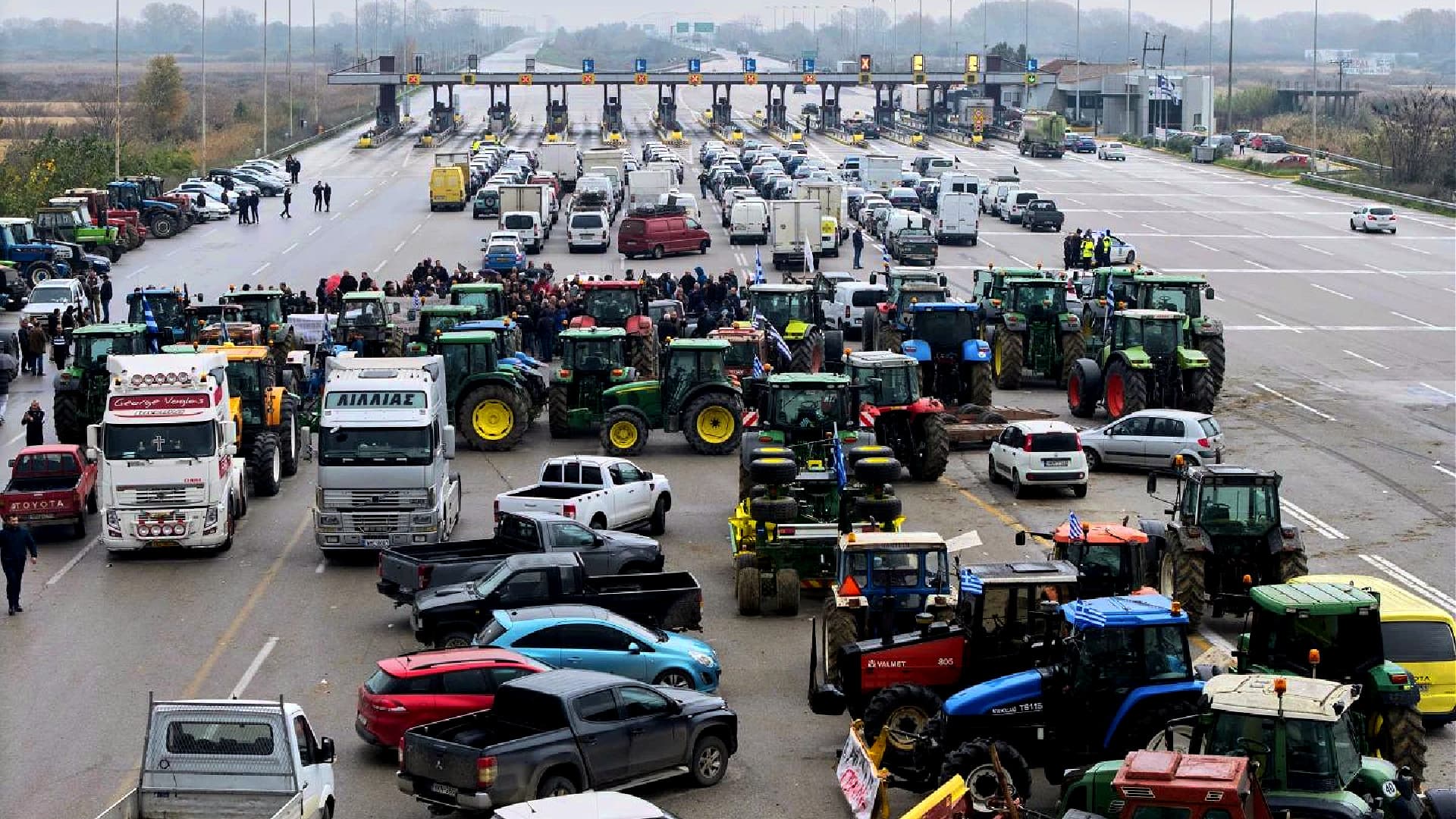
From Crete in the southern Aegean to the northern Evros region, motorways and key arterial roads across Greece have been blocked by farmers, livestock breeders, beekeepers and fishermen protesting high costs, low producer prices and delayed subsidy payments.
Columns of tractors have also cut off customs stations on the borders with Bulgaria and Turkey, creating long queues of trucks carrying goods waiting to enter the country.
In Heraklion, Crete, clashes broke out between local farmers gathered at the city’s airport and police forces attempting to remove them from the premises.
Among the farmers’ demands are full compensation for crops destroyed by extreme weather, access to tax-free diesel, and a fixed, low energy price.
Their primary demand, however, is the release of European Union-backed subsidy payments that have been delayed for nearly two months.
“We want solutions,” protesting farmers in Larisa said. “We are here to solve our problems and keep the Greek countryside alive.”
Farmers in northern Greece, including producers of Chalkidiki table olives, said advance payments they received were 35 to 40 percent lower than expected.
In Thiva, central Greece, olive oil producers from Pelion reinforced a roadblock with 50 tractors and pickup trucks to protest persistently low olive oil prices.
“A kilogram of extra virgin olive oil sells for €3.50 here, while producer prices have reached €8 in Albania and €9 in Italy,” the farmers said.
According to European Commission data, producer prices of extra virgin olive oil in early December slightly exceeded €4.50 per kilogram in Greece’s main producing regions, including Chania, Messenia and Laconia.
By comparison, Italian producers received around €7.50 per kilogram during the same period, while prices in Spain remained below €5.00 per kilogram.
The protests are also fueled by anger over the Opekepe subsidy scandal, in which millions of euros in agricultural funds were allegedly paid to non-eligible recipients.
“The real farmers will get all the money they are entitled to,” said Vice President of the Greek government Kostis Hadzidakis.
Prime Minister Kyriakos Mitsotakis said that problems “are solved through dialogue” and urged farmers to engage in a “rational discussion” with the government.
The farmers’ coordinating body rejected an invitation to meet Mitsotakis at the Maximou Building in Athens, instead demanding firm guarantees on subsidy payments. They warned blockades would continue through the Christmas period.
The protests are taking a toll on the economy. Estimates from the Piraeus Chamber of Commerce suggest each day of mobilization costs between €31 million and €45 million across all sectors.
While delayed subsidies and the Opekepe scandal sparked the demonstrations, farmers say deeper structural problems are at the root of the unrest.
Low producer prices and rising costs for fuel, fertilizers, pesticides and energy have created an increasingly hostile environment for farming.
Demographic challenges further complicate the outlook. About 65 percent of Greek farmers are over 55, with roughly 40 percent aged 65.
Estimates indicate the sector loses 0.3 percent of its capacity each year, and experts say around 200,000 young farmers will be needed in the coming years to keep Greek agriculture competitive.
Dining and Cooking