
Summary 
Panagiotis Tsiriotakis founded Acropolis Organics in Toronto to bring authentic Greek olive oil to North America, emphasizing family, heritage, and craftsmanship. The company has won multiple Gold Awards at the NYIOOC World Olive Oil Competition and focuses on organic farming practices to preserve the freshness and flavor of their olive oil. Tsiriotakis remains committed to his family’s legacy and hopes to pass it on to his son.
From Crete to Canada, Acropolis Organics has built its reputation on bringing the merits of Cretan olive oil to North America, with founder Panagiotis Tsiriotakis emphasizing the values of family, heritage and craftsmanship.
Making honest, high-quality olive oil is not just a job for us — it is who we are.- Panagiotis Tsiriotakis, Acropolis Organics
“I am the son, grandson and great-grandson of people who dedicated their lives to cultivating olives,” Tsiriotakis told Olive Oil Times. “I grew up on an island where olive oil was not just a product. It was our way of life and the main source of income for most families.”
Tsiriotakis initially envisioned a different career. After studying business and marketing, he moved from Crete to Canada, only to realize that what he had left behind was his true calling.
 Panagiotis Tsiriotakis (in the sunglasses) with the rest of the team behind Acropolis Organics
“Ironically, I never planned to follow in my ancestors’ footsteps,” he said. “But when I moved to Canada, I saw a market flooded with adulterated olive oils.”
“At the same time, I knew that in Chania we were producing incredible olive oil, with nearly 87 percent of it being sold in bulk to Italy, where it was rebranded and resold. That didn’t sit right with me. I realized I could not deny my roots or my destiny any longer.”
He founded Acropolis Organics in Toronto 21 years ago to bring authentic Greek olive oil directly to consumers.
The company sources olives from family groves in Vouves, near Chania in western Crete — home to one of the world’s oldest olive trees, believed to be more than 3,000 years old and still productive.
“It is a place full of history and soul, where the land and the trees have been connected to our family for generations,” he said.
 Panagiotis Tsiriotakis carrying an olive sack in Crete
The groves produce Koroneiki olives, Greece’s most widespread variety. “Koroneiki olives are small but powerful,” Tsiriotakis said. “They produce an oil that keeps its rich flavor and aromatic characteristics longer than any other variety, and they are packed with phenomenal antioxidants.”
An employee’s simple question — “Have you ever won an award?” — sparked the company’s entry into the NYIOOC World Olive Oil Competition.
“We had never competed,” he recalled. “I laughed and said, ‘No, but I know we can win.’ That moment pushed me to take the challenge, and we decided to enter the New York competition. And we won.”
Two Gold Awards in 2023 were followed by two more in 2024 and another in 2025, giving Acropolis Organics a total of five Gold Awards in three years at the world’s most prestigious olive oil quality contest.
Tsiriotakis said the NYIOOC honors are a powerful validation. “They help open doors, start conversations and give credibility to the hard work and tradition behind what we do. But for me personally, they are a validation of my family’s legacy.”
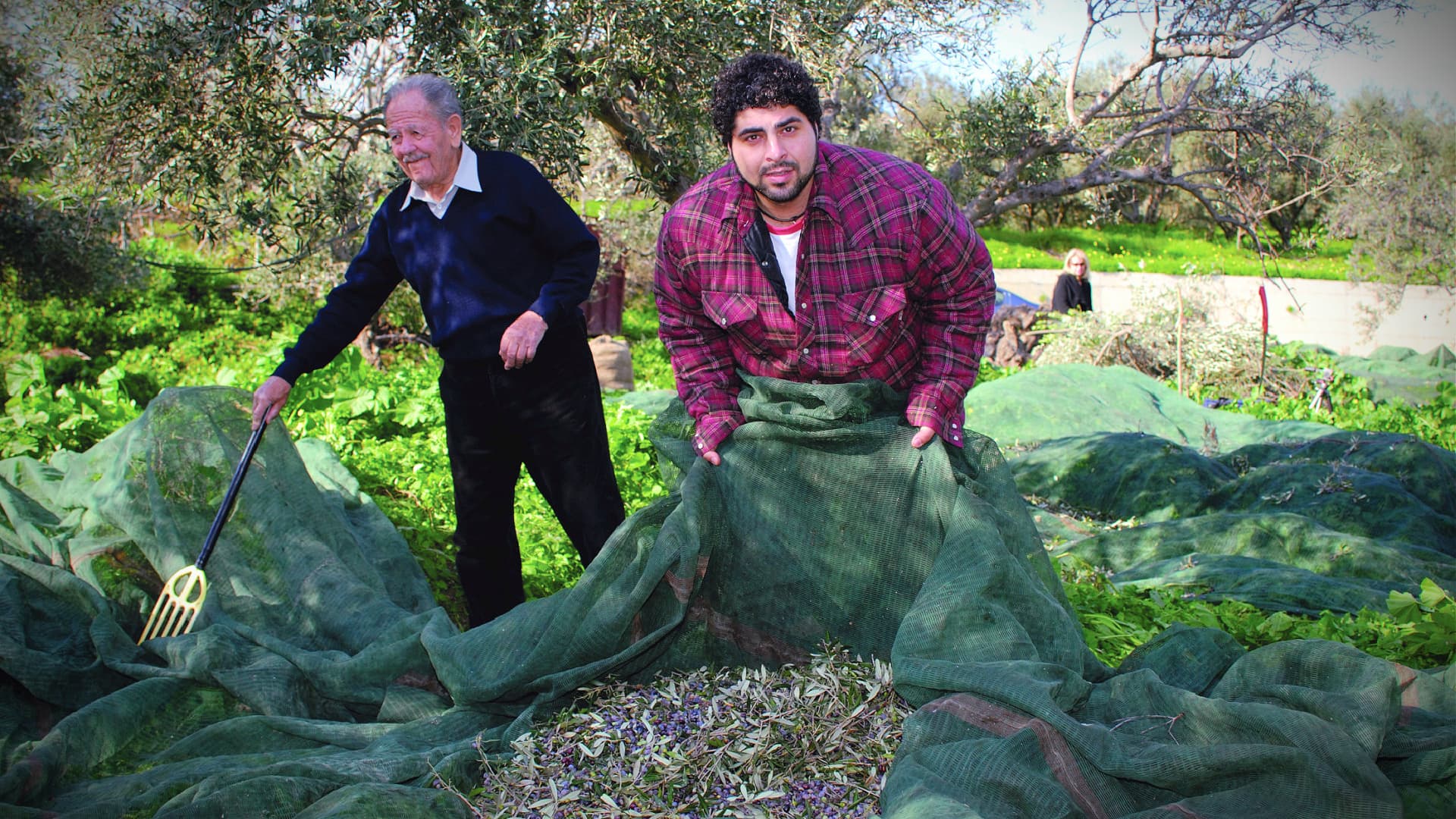
 Panagiotis Tsiriotakis harvesting olives
He credits his family in Crete for the company’s success. “My cousins in Crete are the real award winners,” he said. “When you shake their hands, you feel it — these are hands of people who truly work the land.”
The company uses no chemical treatments, relying instead on organic manure, pest traps and traditional pruning to maintain healthy trees. “Today they call it artisanal farming, but for us, it is simply the way we have always cared for our trees,” he said.
Olives are milled within six hours of harvest. “This is how we preserve the freshness, flavor and soul of our olive oil,” Tsiriotakis noted.
As the 2025/26 season unfolds, he expects a strong harvest — unlike most of Crete, where producers anticipate a significant drop in output due to climate and pest pressures.
“We have just started picking olives, and the first results are very promising,” he said. “A bit more rain would give us that extra boost.”
Canada’s olive oil market is still developing, he added. “There is a big gap in education. People here are often surprised when they taste authentic, fresh olive oil for the first time.”
 Tsiriotakis and family at a trade fair in Canada
Climate change, he said, has reshaped the reality of olive farming. “My grandfather never faced the kinds of problems we deal with today. His harvests were steady, prices stable and nature far more predictable.”
“Even the best producers face unpredictable weather, rising costs and unstable prices. Pests are a constant battle. Despite all this, we stay committed. Making honest, high-quality olive oil is not just a job for us — it is who we are.”
Acropolis Organics has helped raise awareness of Cretan olive oil across North America, but Tsiriotakis said his heart remains in Crete.
“I literally want to go back to my roots,” he said. “I want to take my tractor, head to the orchard and just drive between the olive trees all day. This is my therapy — no emails, no trade shows, just me, the trees and maybe a coffee.”
He hopes the family legacy will continue. “My half-Italian son is only nine, but he is already passionate about olive oil. I think the company’s future is in good hands — though I may have to fight him for the tractor.”
Dining and Cooking