
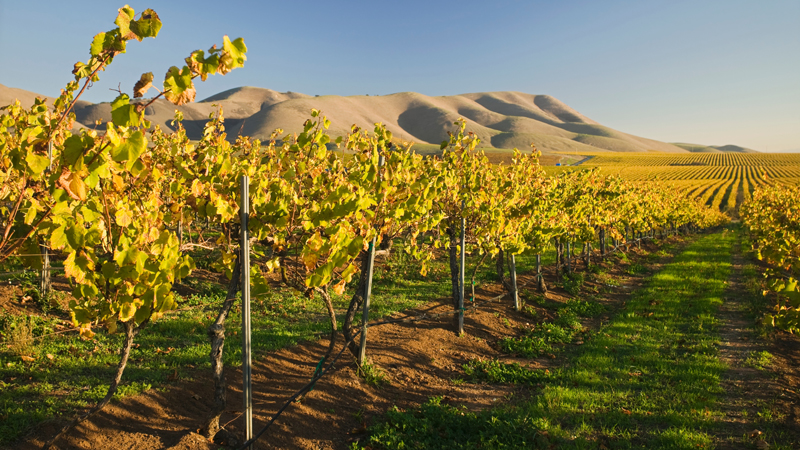
With the wine harvest in California now complete, it is becoming increasingly clear that a large portion of the state’s vineyards was left unharvested. US newspapers and news portals are reporting this widely. Speaking to the agricultural magazine Western Farm Press, Jeff Bitter, President of Allied Grape Growers in Fresno, said that in addition to the 40,000 ha (approx. 100,000 ac) cleared since last year’s harvest, another 20,000 ha (approx. 50,000 ac) were likely abandoned and left unharvested this year. The reason, he said, is that production costs are exceeding growers’ returns.
The Wall Street Journal (WSJ) quotes the Sonoma County Winegrowers, a regional trade group, which estimates that “about 30% of the grapes grown this season will not be sold.” Major buyers like Constellation Brands or Jackson Family Wines (JFW) reduced their grape purchases again in 2025. JFW’s Chief Operating Officer, Mitch Davis, told the WSJ that the company is also considering “clearing and replanting part of the approximately 14,000 ha (approx. 35,000 ac) of vineyard land it manages worldwide.”
Due to the crisis in demand, California’s 2025 harvest will therefore likely be historically low, after already reaching its lowest level in two decades in 2024 with only 2.9m tons. Stuart Spencer, Director of the Lodi Winegrape Commission, told the news agency AFP that he expects “a further decline of 400,000 tons” this year. Because clearing land is associated with high costs due to strict Californian environmental regulations, the land is now often simply left fallow. Lodi, where Zinfandel is primarily grown, is “surrounded by ghost plots littered with rotten grapes,” according to the AFP report.
Abandoned vineyards pose a significant threat of pests, such as leafhoppers, and diseases, like mildew, especially to active farms downwind. According to Western Farm Press, this risk has prompted a multitude of agricultural associations to support a bill recently signed by California Governor Gavin Newsom. The new law provides county agricultural commissioners the authority to impose civil penalties against grossly neglected agricultural operations. Fines are set at $500 per acre (approx. 0.25 ha), rising to $1,000 for non-compliance. SP
Dining and Cooking