
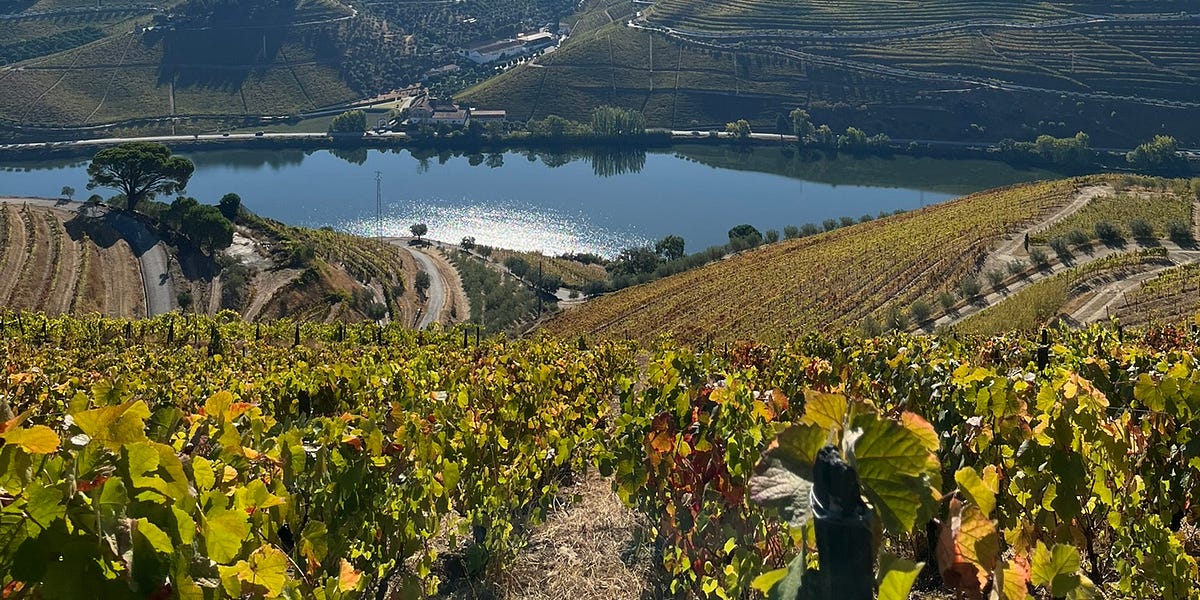
We’ve been misunderstanding Portuguese wine. Sure, we know and adore its fortified wines, Port and Madeira. And Portugal has a reputation for bargain wines, especially reds from the Dão and Alentejo and cheap, gulpable fizzy Vinho Verde.
In a recent visit, I was convinced the key to Portugal and its wines is their diversity. Not that Portugal’s diversity is a total surprise — the country boasts more than 250 native wine grape varieties, according to Wines of Portugal, the national promotional board. But we don’t think of Portuguese wines that way. The wines are typically blends labeled by region, rather than the single variety wines most Americans are used to. We’re more comfortable saying, “I’ll take a Cab” than “I’ll have a Dão.” It also doesn’t help that the grape names are largely unfamiliar to the casual American drinker.
But American tourism has surged in Portugal, a trend that began just before the pandemic and has continued since, as I wrote recently in my “Letter from Porto.” That means more Americans are trying Portuguese wine in situ, and, the winemakers fervently hope, looking to buy them once they return home.
When Americans do try Portuguese wines at home, they are often surprised at the quality for the price, says Julie Dalton, a Master Sommelier and wine director at The Post Hotel in Houston, Texas. She enjoys turning California Cabernet fans on to reds from the Douro Valley.
“These wines are fruit forward, powerful, can deliver a lot of alcohol and have just a slight rusticity to them,” Dalton says. “When I blind taste my guests on them, they’re always delighted with what the wine delivers but when I tell them the price, they almost don’t believe me. I’ve got one right now for $12 a glass and the only reason it doesn’t move more is because sometimes people don’t want to buy the cheapest glass of wine!”
At the invitation of Wines of Portugal, I visited eight wineries in four of Portugal’s seven wine regions over four days (and many, many hours in the back seat of a van; Portugal is much bigger than it looks on a map. The roads are well maintained, for which my spine is grateful.) At each stop it was clear that Portugal’s wineries are leaning in on the dual message of quality for value and rich diversity of their wines.
Here are my takeaways:
If you’re the type of wine lover who keeps track of how many different grape varieties you’ve tasted, you should be exploring Portugal’s wines. Touriga Nacional and Touriga Franca are the main red varieties, along with Aragonez, which is called Tinta Roriz in the Dão and the Douro. Confusing? Just remember that Aragonez and Tinta Roriz are Portuguese names for the Tempranillo grape you’ve enjoyed from Spain.
And it it’s been awhile since you’ve tried a Portuguese wine, you may be surprised at the quality.
“The quality level in Portugal has been going through the roof the last 20 years or so,” said David Baverstock, chief winemaker for the WineStone Group, a collection of five wineries owned by the José de Mello Group, a prominent industrial empire in infrastructure, healthcare, chemicals and banking. An Australian who came to Portugal two decades ago on a consulting gig and never left, Baverstock is best known for his work at Esperão winery. He’s been a big factor in the growth of Portugual’s wine industry.
“There was not much understanding of the grape varieties when I came here. We’re still doing blends, but we understand the ingredients better now,” Baverstock added as we tasted some WineStone wines at Ravasquiera, the group’s flagship winery in the Alentejo.
Then he sighed and said, “The U.S. market still prefers varietal wines.”
Perhaps to make the wines more recognizable, many wineries include Cabernet Sauvignon or Syrah in their blends, lending an international familiarity to the Portuguese character of the wines. And some are making single variety wines. WineStone makes a Cabernet Sauvignon called Moonstone exclusively for the U.S. market. At $12, it’s fine, if a bit sweet. Aside from the price, though, it could come from anywhere.
Alentejo has a dry, Mediterranean climate, though Ravasquiera is at the cooler, northern end of the region, which Baverstock said helps keep some freshness in the wines. Vinha das Romas, for example, is a refreshing blanc de noir still wine made from Syrah and Touriga Franca, a blend of international and indigenous grapes.
The Lisboa region north of the capital city is perhaps little known to American consumers. It enjoys a cooling maritime influence from the Atlantic, while a coastal mountain range protects the vineyards from the most troublesome ocean weather. Quinta da São Sebastião, founded in 1755 as a Franciscan monastery, produces 3 million bottles a year and exports 85 percent of those to 45 countries. They include a line called QSS Rare, made exclusively for the U.S. market, with some of the profits going to protect endangered species.
Winemaker Filipe Pinto said a better understanding of the grapes and vineyards gives more homogenous, even ripening, so he doesn’t need to rely on extraction and other manipulations in the winery, such as fining. That results in more natural and vegan-friendly wines, an example of the maxim that “wine is made in the vineyard.”
“Viticulture is the new enology,” he said, then looked surprised, as if he’d just thought of a new catchphrase. It’s good enough for me to quote.
At Casa Santos Lima, also in the Lisboa region, value meets quality. This is not your garagiste, artisanal winery, but a huge operation with vineyards throughout Portugal and a dizzying line of wines, many priced to sell around $10-$15 dollars. I twice listed Casa Santos Lima’s Confidencial red blend among my annual greatest values under $20 in The Washington Post. The wine only has one conceit: Confidencial means they don’t divulge the exact blend. My inner cynic wonders how much of it is Cabernet. I’m also a fan of their line called Lab (for Labrador retriever), designed to retail for $8, or $20 for a 3-liter box. The rosé tastes as if a strawberry and a raspberry had a litter of berries.
Thanks for reading Dave McIntyre’s WineLine! This post is public so feel free to share it.
Portugal has a reputation for sturdy, sometimes rustic reds. That’s changing, as more winemakers aim for finesse.
“Douro is a powerful region, and we like to work on the elegant side of that power,” said João Luís Baptista, head winemaker of still wines for Ramos Pinto. He achieves that with the Duas Quintas tinto, which retails for about $20, while he embraces the power with his premium (and more expensive) blends called Quinta de Ervamoira and Urtiga.
“Now that we know we can make great wine for the money, we need to show we can make wines as good as the grands vins of Bordeaux or Napa,” said Jorge Rosas, CEO of Ramos Pinto.
As good as the Ramos Pinto reds were, I was gobsmacked by the 20-year-old tawny Ramos Pinto port from the Quinta do Bom Retiro, with its creamy caramel texture laden with flavors of roasted hazelnuts and walnuts. Tasting it, I felt almost as if I was suspended in air, while life went on around me until the flavors finally faded and I rejoined the room.
“We sell wine, but we also sell time, one of the most precious things we can have,” Rosas said.
Elegance was on display at other Douro wineries on my itinerary, including Quinta dos Murças (now owned by Esporão), which in 1947 was the first winery to plant a vineyard in vertical rows down the steep schisty slopes rather than in the traditional terraces. Symington Family Estates produces an outstanding line of wines under the Vale do Bomfim label and Prats & Symington, a Bordeaux-Douro collab. I was especially enamored of Symington’s Comboio do Vesuvio 2022 ($20ish), a light, Beaujolais-like red that would be a terrific burger wine. And the Quinta do Ataíde Douro 2018 ($18) from the Douro Superior near the Spanish border was expressive with black olive, tea and sage with bright fruit and a dry finish.
At Quinta de la Rosa, Kit Weaver is a member of the seventh generation of the family that founded the winery in 1815 and started making unfortified table wines in the 1990s. Like Baverstock, who was their first winemaker for table wines, Weaver chafes at the perception many Americans have about Portugal’s wines.
“The danger for Portuguese wines in the United States is they tend to be painted with the same brush,” Weaver said. Quinta de la Rosa’s wines, currently made by Jorge Mureiro, include a single variety Tinta Cão. In general, the wines are in a fresh, juicy style that should appeal to fans of lighter reds. That’s definitely not the typical image of Douro wines.
Here’s where I confess to burying the lede: Portugal’s white wines are outstanding. The Douro Valley is justifiably known for its ports and its red wines made from the same grapes, but the current excitement is in whites. Most of the growth in whites is from newer vineyards planted on higher ground — typically after blasting through schist to create topsoil for planting — or in the Douro Superior.
“We push 40 degrees (celsius) here, but you get this incredible freshness and acidity,” Kit Weaver of Quinta de la Rosa says. “I think we are only beginning to push the envelope on white wines in the Douro.” Quinta de la Rosa’s whites, one from Gouveio and another a blend of Alvarinho and Viosinho, are floral and citrusy with a core of minerality from the schist soils.
Symington Family Estates scores with its Vale do Bomfim Branco 2024, a steal at about $14, with its flinty mix of lemongrass, white flowers, scrub and sage. Quinta da Fonte Souto 2023 from Alentejo ($30) is soft, ripe and round and should appeal to Chardonnay lovers.
But the real story of Portugal’s white wines is in Vinho Verde — just not the fizzy quaffs that have become so popular the last several years. Just look at a map: the Vinho Verde designation is in the Minho, the region that extends north from Porto to the Spanish border and Rias Baixas, the land of Albariño. Portugal’s Alvarinho (obviously the same grape) can be as exciting as those to the north, but at a lower price. The key is to look for wines labeled as Alvarinho, with the Vinho Verde designation relegated to small type or even to the back label.
The Vinho Verde subregion of Monção e Melgaço, nestled along the Spanish border and shielded by geography from the worst of the Atlantic Ocean’s rainy influence, is place to look for outstanding Alvarinho. Soalheiro leads the way with a broad selection of Alvarinhos, including some showcasing specific terroirs (granite) and styles (oak aged, old vines, sparkling). Soalheiro’s wines generally range from $15 to about $30 and are consistently delicious. Another I’ve enjoyed back home in the States is Quinta do Regueiro, whose Foral Alvarinho 2024 can be found online for $13. Fantastic value.
So when you’re thinking of Portuguese wine, think diversity, value, blends and elegance. And don’t forget the whites!
Porto is a good base for wine travel in the Douro and VInho Verde territory; there’s a solid tourist infrastructure in Vila Nova de Gaia, including The Yeatman, a luxury hotel owned by the Taylor Fladgate Group, and several other new hotels on either side of the river. Trains can get you from Porto to the Douro Valley wine country, which is stunningly beautiful.
In the Douro, several wineries have guesthouses. My group stayed at Quinta de la Rosa, on the outskirts of Pinhao, which also has a fantastic restaurant, Cozinha da Clara.
My trip was organized by Wines of Portugal, but several travel agencies specialize in organizing travel through Portugal’s wine regions. My sister raves about Jane Gregg at Epicurean Ways, a Charlottesville, Va.-based firm specializing in foodie trips to Spain and Portugal.
Letter from Porto
On my first visit to Porto in 2006, the Av. de Diogo Leite in Vila Nova de Gaia, along the southern shore of the Douro River, was a sleepy street with a few port houses, such as Sandeman and Calem, and a small, quiet restaurant where I dined on sardines and
Dining and Cooking