
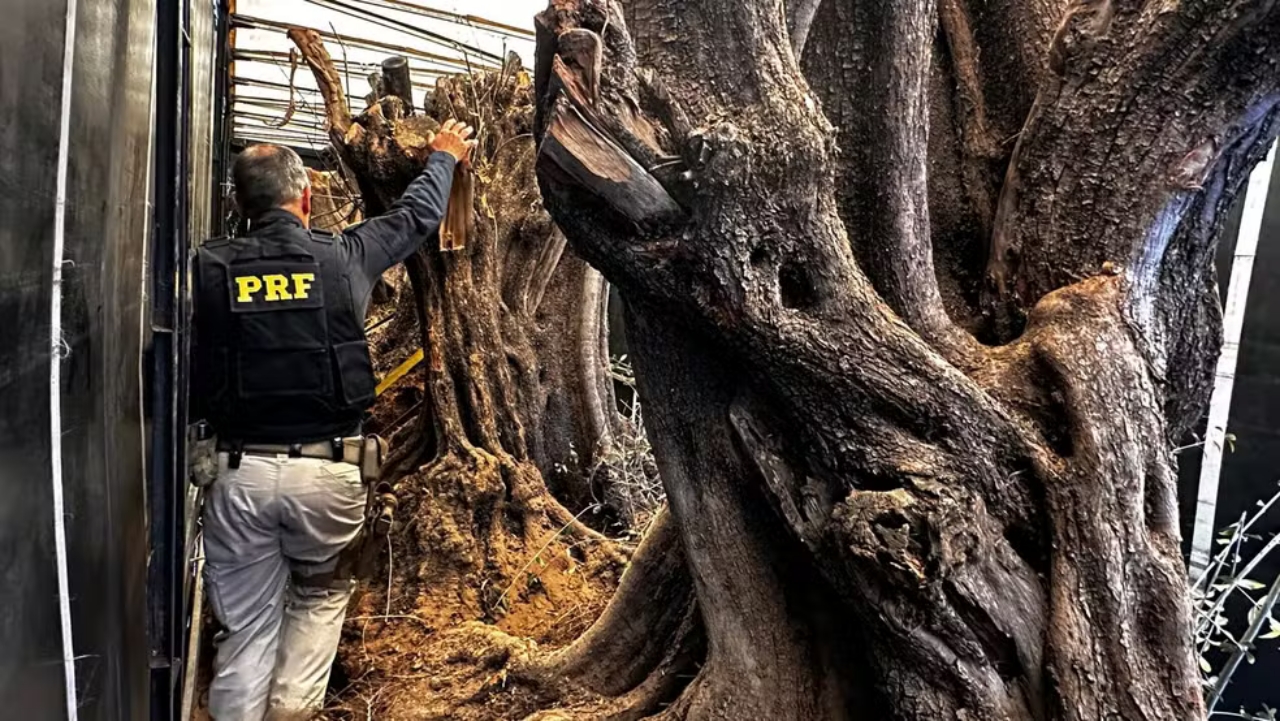
The illegal importation of ornamental olive trees from Argentina for ostentatious display in mansions, luxury condominiums, and large developments is generating apprehension and environmental concerns.
Centuries-old olive trees, smuggled from Argentina, have become coveted features in high-end landscaping projects in southern Brazil. They appear in mansions, luxury condominiums and large developments, with prices on the regular market around R $ 100 thousand per example.
The search for these trees is hampered by a prohibition: importation is banned due to risks to environmental and phytosanitary safety. The fear involves the entry of pests and diseases that do not exist in Brazil, associated with bacteria, which has led to smuggling becoming the focus of actions at the border.
From May of 2024, were seized 51 olive trees only in the Dionísio Cerqueira region, in the far west of Santa Catarina. The incidents were concentrated in Dionísio Cerqueira and also in Santo Antônio do Sudoeste, in Paraná, with seizures also recorded in Cascavel and Maringá.
— ARTICLE CONTINUES BELOW —
See also other features
The end of Mercado Libre’s shipping companies? Understand how the purchase of Kangu, extra shipping options, and direct lines to drivers could cut out intermediaries, change freight rates in 2026, and impact the income of independent carriers today.

Brazilian airlines have accumulated R$ 54,7 billion in losses amid an endless crisis and remain under market pressure due to dollar-denominated costs, fuel, and interest rates.

How much does a Mercado Livre delivery driver earn doing two routes a day, taking on three routes at the end of the year, using a Fiorino van, two cell phones, and an app to earn more and avoid a boss and a formal employment contract?

Ethiopian Prime Minister transforms Addis Ababa into the African Dubai, demolishes entire neighborhoods, spends tens of billions, attracts global billionaires, concentrates political power, and divides the country between pride, inequality, and forced evictions.

Each copy can cost up to R$ 100.
The smuggling gained notoriety due to the high value of the trees and their use for ornamental purposes. In the regular market, each specimen can reach [amount missing]. R $ 100 thousandThis fuels the demand for clandestine routes to supply high-end construction projects.
Enforcement has begun targeting this type of cargo due to the sanitary risk. The entry of uncontrolled plants can bring harmful agents that spread rapidly, affecting not only private gardens but also productive areas.
Actions have intensified on the border with Argentina, especially in areas where the movement of goods often occurs outside formal channels. The combination of demand and legal restrictions creates an environment favorable to illegal trade.
Importation of olive trees is prohibited due to environmental and phytosanitary risks.
The importation of olive trees is prohibited due to environmental and phytosanitary risks. The central issue is the possibility of introducing pests and diseases not present in the country, associated with bacteria.
This type of threat is not limited to the location where the tree is planted. A contaminated plant can serve as an entry point for problems that spread through nurseries, gardens, and agricultural areas.
With the ban, the legal way to purchase the product depends on a legitimate origin and documentation proving production and sale in accordance with sanitary requirements. The absence of this traceability increases the risk for the buyer and the surrounding environment.
Risk of losses for olive oil producers in Brazil
The main concern raised is the introduction of diseases. Contamination can impact native flora and also agriculture, directly affecting production chains.
There is a risk of losses for olive oil producers in Brazil, a growing market. Illegal olive trees carrying pests can contaminate healthy trees, increasing losses and requiring control measures.
There is also the possibility of the disease affecting other crops, such as citrus fruits, including orange e lemonThis broadens the scope of the problem beyond the olive oil sector.
Dry borders and shallow rivers facilitate illegal entry.
The Dionísio Cerqueira region has geographical characteristics that favor smuggling. There is an extensive strip of dry border and areas that are difficult to monitor.
The quoted passage includes approximately 30 km a dry border between Santa Catarina and southwestern Paraná. To the south, the Paraguaçu River It is described as narrow and shallow, which allows for the passage of goods.
The inspections take place at points of illegal crossings and also on highways. The work has the support of the military police of Santa Catarina and Paraná, the federal and state highway police, as well as the Federal Police.
Where do the seized olive trees go?
Part of the seized olive trees had their destination determined after authorization from… Ministry of Agriculture and Livestock (Mapa)The referral process aims to ensure controlled use of the plants, preventing untracked circulation.
The Federal Revenue Service allocated nine centuries-old olive trees public universities. They were four for State University of Santa Catarina (UDESC) e five for State University of Mato Grosso do Sul (UEMS).
The intended uses include landscaping, scientific research, and environmental education initiatives. The measure also reduces the risk of the material returning to the ornamental market through illegal channels.
Points to consider for those buying large trees.
Many buyers may not know the origin of the specimen they are purchasing, which increases the risk of irregular plants entering residential and commercial projects. In a high-value market, attention to provenance becomes crucial.
The guidance is to demand invoice with the number of National Seed and Seedling Registry (Renasem) from the nursery and identify the technical person responsible for the plant’s production. This check serves as a basic filter against irregularities.
The lack of these documents is a warning sign. When the seller does not provide proof, the chance increases that it is an illegal plant, with associated health and environmental risks.
Do you think the use of centuries-old olive trees in landscaping justifies the risks, or should native species be preferred? Leave your comment and join the discussion.
Dining and Cooking