
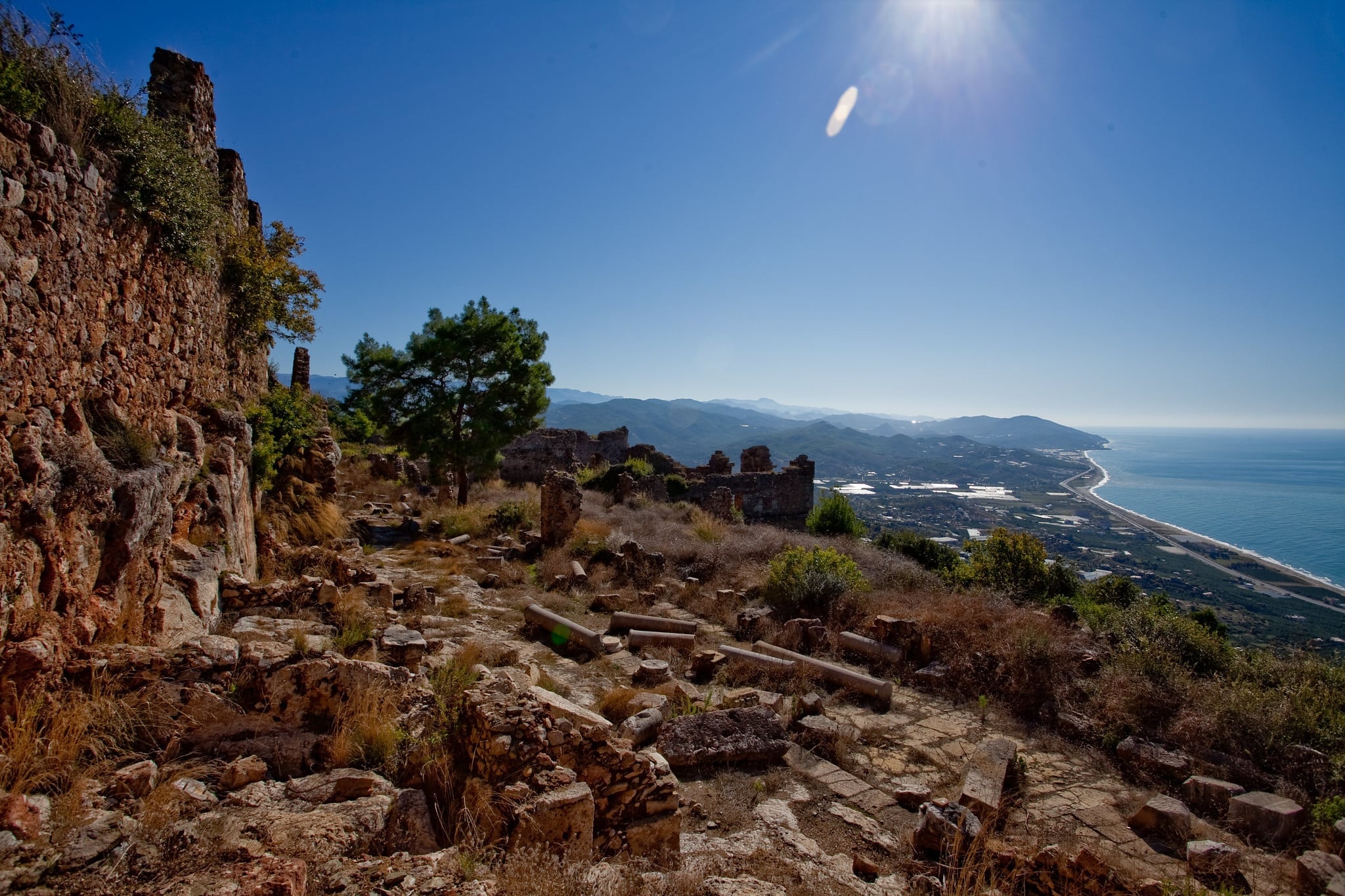
The ancient city of Syedra near Alanya, Turkey. Credit: Tero Maaniemi / CC BY-NC-ND 2.0
Archaeologists have uncovered more than 100 olive oil workshops at the ancient Greek city of Syedra, offering new insight into its economic importance in the ancient Mediterranean. The discovery highlights Syedra’s role as a major center for olive oil production, not just for local consumption but likely for export as well.
Located between the modern-day towns of Alanya and Gazipaşa on Turkey’s southern coast, Syedra has been the focus of ongoing excavations led by Associate Professor Ertuğ Ergürer of Alanya Alaaddin Keykubat University. The work is being conducted under the Ministry of Culture and Tourism’s “Heritage for the Future Project.”
Ergürer said archaeological teams have so far unearthed around 20 olive oil workshops during their digs, with over 100 identified throughout the city. He explained that the scale of production clearly exceeded the needs of the local population, suggesting that Syedra supplied olive oil to markets beyond its borders via nearby Mediterranean ports.
Unusual urban layout with olive oil workshops beneath homes
What sets Syedra apart, according to Ergürer, is the location of these workshops. Unlike typical ancient production centers, which were built outside urban areas, many of the workshops in Syedra are located directly beneath residential and public buildings. This unusual layout indicates that olive oil production was deeply integrated into everyday urban life.
A restored olive oil press used in antiquity is seen at the ancient city of Syedra, Alanya, Antalya, southern Turkey. pic.twitter.com/Ndwx8CXUrT
— Tom Marvolo Riddle (@tom_riddle2025) December 29, 2025
In 2024, researchers discovered a well-preserved workshop on the city’s southwestern street. Most of its original structures and storage vessels were found in place. The site was documented, conserved, and partially restored to help visitors understand how olive oil was produced in antiquity.
Syedra’s olive oil workshops show integrated economic life
Syedra, first settled in the 7th century BC, remained inhabited until the 13th century CE. The city features architectural remains from multiple historical periods, including the Greek, Roman, Byzantine, and Anatolian Seljuk eras.
Its upper town, situated 400 meters (1,312 feet) above sea level, includes structures such as a theater, bathhouse, council building, and streets lined with columns. Several cisterns and a water system provided infrastructure for the population.
Historical records indicate that Roman General Pompey held his final war council in Syedra in 48 BC before departing for Egypt. The city was praised by Emperor Septimius Severus in 194 CE for resisting Mediterranean piracy. Ancient inscriptions and coinage support Syedra’s historical significance across various eras.
Excavations at Syedra began in 1994. A cave used for Christian baptisms and numerous churches have also been discovered, adding to the site’s cultural depth. In 2011, underwater remains of the port were dated to the Bronze Age, suggesting human activity in the area nearly 5,000 years ago.
Dining and Cooking