
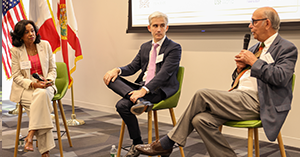
In ways large and small — from sweeping national nutrition policies to the tiniest
inhabitants of the human microbiome — our individual health and wellbeing depend on
the food we eat, the way we grow it and how it’s distributed in the community, experts
at the Second Annual USF French Business Forum explained in a series of conversations
looking both inward and outward into our relationship with food.
From French Consul General in Miami Raphaël Trapp sharing his surprise upon moving
to the U.S. that simpler, healthier items would be more expensive than highly-processed
food, to Hariom Yadav, the director of the USF Center for Microbiome Research, explaining
how colonies of microbes in the human gut drive a wide variety of physical responses
to food, the conversations explored the complex, complicated and captivating food
system that sustains us but also plays a leading role in the nation’s skyrocketing
healthcare costs.
France spends less per capita and a significantly smaller portion of its GDP on health care than the U.S., yet is considered a healthier nation. With lower obesity
rates, lower rates of cardiovascular disease and higher life expectancy, France’s
food culture and its focus on seasonal foods, cooking at home and shared meals with
family and friends was in stark contrast to an American food system built on convenience
and keeping costs low.
But the differences in national experiences around food also is playing out in the
growing field of microbiome research, as leading scientist dig deep to understand
exactly why modern food systems are suspected of being key drivers of illness and
what can be done to change the way Americans eat.
“It’s not just food as medicine, food is medicine,” said Xavier Avat, Moffitt Cancer Center’s executive vice president and chief business officer at Moffitt
Cancer Center, where nutrition is part of treating cancer patients so they can optimally
respond to treatment. “How many of you cook at all? Do you feed your family or feed
yourself? Do you cook to unwind, to relax? So, it’s as much as to nourish your body
as it is to nourish your soul. That’s one way of thinking of food Xavier Avat as medicine.”
The French Perspective
USF Morsani College of Medicine Christian Bréchot is the founder and director of the USF Health Microbiomes Institute, and leads the university’s efforts in microbiome research and its application to
human health, including projects on aging and disease. He joined USF in 2018 after
serving as president of the Institut Pasteur in Paris and CEO and General Director
of the French National Institute for Health and Medical Research. Earlier this year,
he joined with Emmanuel Roux, the founder of the 15th Street Farm in St. Petersburg, in publishing a new book on the interplay between the human microbiome and the modern food system. The Microbiomes
Revolution (a French edition is currently available and an English edition is forthcoming),
highlights that diet can be a major modulator of the gut microbiota, similar in impact
to some medicines.
“In France, everybody’s close to agriculture,” Roux noted.
“We forget that we are what we eat, there is no way around that,” he added.
Trapp, the French government’s diplomatic representative in Florida, told the more
than 100 forum attendees that was one adjustment he had to make when he moved to the
U.S. three years ago.
“Fresh markets (are) really convenient when you have a small country like France,
in tiny villages and in the core of different cities,” Trapp said. “It’s not like
the city here where the distances are so long that it’s really difficult to provide
food. Food production methods also have a real impact on the price of products. When
I got here, I was really surprised that fresh food is far more expensive than processed
food.
“Also, the power of (food industry) lobbies are much more powerful in the U.S. than
in Europe. And, of course, the impact of marketing.”
For Roux, whose 15th Street Farm is a community learning, cooking and gathering center,
there’s a simple way for people think about what they eat. “When you look at a food
label and you need a PhD in chemistry to understand it, get a PhD in chemistry but
don’t buy it,” he said.
The Mystery of the Microbiome
When we eat, we’re not just feeding ourselves but the trillions of microbial cells
in the human microbiome, Yadav shared with the audience. We are “more microbial than
human,” he added, explaining that the typical human has 23,000 to 24,000 genes but
the microbiome hosts some 300,000 genes. Those microbe genes can send messages to
every cell in the body, which is why scientists are focusing so much on the gut-brain connection in understanding metabolic diseases, high-inflammation as well as those of the brain
such as dementia or mood disorders.
“Diseases related to aging is also a target of the research,” Yadav said. “It’s not
about the numbers, it’s about the biology,” he said.
Liping Zhao, a Distinguished Professor and the Eveleigh-Fenton Chair of Applied Microbiology
at Rutgers University who is a frequent and longtime collaborator with USF researchers,
joined the forum, shared with the audience how he had personally rewired his microbiome
through nutrition focusing on high-fiber whole grains and fermented foods to lose
nearly 50 pounds. The weight loss helped him combat high blood pressure and high cholesterol
and led to his current research explaining “guilds” in the microbiome that play important
roles in disease development and progression. He’s since used his research to help
morbidly obese patients with difficult to address health issues, including a three-year-old
boy with Prader-Willi Syndrome who weighed nearly 100 pounds.
But exactly how those bacteria in the microbiome work, or don’t work, with each other
to affect health is where researchers are now focusing their energies, he said.
“Bacteria are not independent from each other, just like everybody is a member of
a social group,” he said, explaining the bacteria organize themselves in “guilds.”
“You need to find out who works with whom in the guild and what does the guild do.”
Feeding the Community for a Healthier Future
With about one in seven Florida residents suffering from food insecurity, any conversation
about food as medicine had to include an acknowledgement that not everyone has full
choice over what they eat. Today, the “food as medicine” concept ranges from specifically
tailored and delivered eating plans for some patients to how to address economic conditions
that leave many families vulnerable and picking food based on cost and convenience
as they work multiple jobs just to make ends meet.
“So, the translational scientists, the population scientists, the farmers, the people
working on real -world evidence, we all need to be rowing the boat in the same direction
to solve the same problem in an intentional way rather than orbiting in our own space
and doing our own science and then eventually maybe figuring out how they connect,”
said Karen Corbin, an associate investigator at the AdventHealth Translational Research Institute whose
research focuses on nutrition and metabolism.
In Orlando, AdventHealth is partnering with 4Roots Farm’s Culinary Health Institute to demonstrate the impact of high-nutrient foods on chronic illness through initiatives
like community kitchen classes and lifestyle interventions. AdventHealth also is involved
in supporting 4Roots’ efforts to increase access to fresh, local produce from its
farm — a bucolic 40-acre spread with high-tech growing systems near downtown Orlando
and in one of the city’s poorest neighborhoods — as well as local food relief organizations.
About 50 patients are in a pilot program where they receive both food and exercise
counseling and services, including $25 a week in fruit and vegetables.
“We love to get in the same kitchen with patients a dietitian a chef and a physician
talking about the effects of plant -based nutrition,” said Jay Groves, executive director of 4Roots Culinary Health Institute. “We always emphasize plant-based
nutrition and dietary fiber and its effect on the gut biome, inflammation and health
outcomes. So, getting that triad, if you will, into the kitchen with patients to educate
them about the benefits of plant -based nutrition and inspire them to get back in
the kitchen to learn new skills.”
USF Anthropology Professor David Himmelgreen, who leads the Center for the Advancement of Food Security and Healthy Communities, said policy changes that put an emphasis on addressing food insecurity are central
to the discussion of better health for Americans. “We know that diet quality is the
leading risk factor for death in the U.S.,” he said, adding that locally food banks
are currently experiencing a crush of demand due to inflation and the recent government
shutdown. “The economic burden is astronomical.”
USF’s Future of Foods Think Tank is one way the university has brought together its research and resources to partner
with the community, said Miranda Mattingly, associate director of the USF Research
Development Institute. The network has grown to 225 university, community and industry
partners in an initiative “designed to accelerate the local food system” and the translation
of research into the community.
Changing Production Dynamics Shaping the Future of Food
The recent focus on ultra processed food and the role it may have in health issues
is pushing for food companies to rethink their approach, said another panel of industry
experts whose work spans food production, the economics of health and the regulation
of food products. Industrial systems, though, are complex and require a new paradigm,
the panelists agreed.
Susie Hoeller, a Tampa attorney who has worked with global companies and the food
industry, said change is looming with a new Food and Drug Administration leadership
in Washington that’s focused on chemical additives and states — such as Louisiana
and Oklahoma joining ones like California which has been on the vanguard of food labeling
— who are pursuing new regulations to inform consumer what’s in their food.
“The chemical additives that are being allowed are going to be shrinking, shrinking,
shrinking,” she said.“The food industry is getting the message.”
“The chemical additives that are being allowed are going to be shrinking, shrinking,
shrinking,” Susie Hoeller said. “The food industry is getting the message.”
At Clextral in Oldsmar, innovation is being applied to making processed foods healthier
for customers while keeping companies profitable in a competitive industry with ingredient
supply chain challenges, said Sylvain Courbon, a regional sales manager.
“We do the ‘Cheetos’ but without the same ingredients, with more protein, more fiber
so that your snack habit becomes healthier,” he said. “We’re working with our customers
on recipe formulations that would bring more proteins, more fibers, reduced salt,
reduced sugar to try to make junk food a better junk food.”
Innovation is where strategy can meet public health demands, said Blair Lapres, a
public health economist with Tunnell Government Services who previously worked for the World Bank. Lapres shared his experience with the World
Bank in Croatia addressing the challenges of the “nutraceuticals” industry, including
those pushing products on to the market with unfounded health claims.
“If you regulate smartly, you will be able to develop an industry that has proven
some of the claims they make about their product and help push that to delivery of
nutrition and health outcomes for populations,” he said.
What’s the next frontier of the food industry? Lapres said personalized nutrition
that address health conditions through a person’s microbiome. The leaders in the field
have regulatory scrutiny and provide consumers with a better outcome.
“I do see it as a game changer, a way of managing the complexity of the microbiome
and of the patient in order to get a product to market that will solve your needs,”
he said. “There’s a lot of promise there.”
View event highlights
Dining and Cooking