
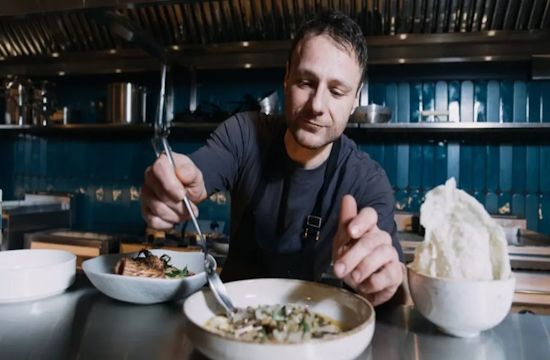
The case of Vasilis Hamam from Thessaloniki and London in Omonia. How the personal story of a chef creates the new “tasty” Athens
The phenomenon is no longer accidental; the cuisine of the “diaspora” is the new global trend. A number of chefs who grew up in one country with parents from another abroad cook inspired by their family memories. Vasilis Hamam at Zigoala is the protagonist of this movement, bringing with him a cuisine that is at the same time deeply personal.
For Vasilis Hamam, cooking did not start from culinary schools, but from his genes. His story is a map of the Middle East and Greece: his Palestinian grandfather, a refugee in Amman, Jordan, his Lebanese grandmother, his father who came to Greece to study, and his mother from Thessaloniki. This mosaic of experiences, later enriched by 24 years of life and work in London, is the foundation of his cuisine.
His tenure in landmark restaurants such as St. John, The Barbary, and Noble Rot shaped a culinary identity based on extreme honesty. At Zigoala, Hamam presents a modern Greek cuisine, which is, however, inspired by the neighborhoods of the Eastern Mediterranean.
Vasilis Hamam does not simply cook Greek food. He cooks through the filter of a person who grew up in Greece with diverse roots and has lived in the multicultural heart of London.
Serving a dish with three ingredients requires more confidence than a dish with ten preparations. This is the “London” element that Hamam brought to Athens.
On the other hand, this cuisine is not defined as fusion, but by the need to combine memories and references. His food is shaped by the principles he experienced as a child, adapted to the present.
The cooking of Vasilis Hamam marks a paradigm shift. It teaches us that gastronomy is a living language that unites the memories of Thessaloniki, Amman, and London. A cuisine that celebrates adaptation and proves that true deliciousness arises when people bring their roots to the table, wherever they are. Cooking memories – The case of Vasilis Hamam and the cuisine of the “diaspora.”
Dining and Cooking