
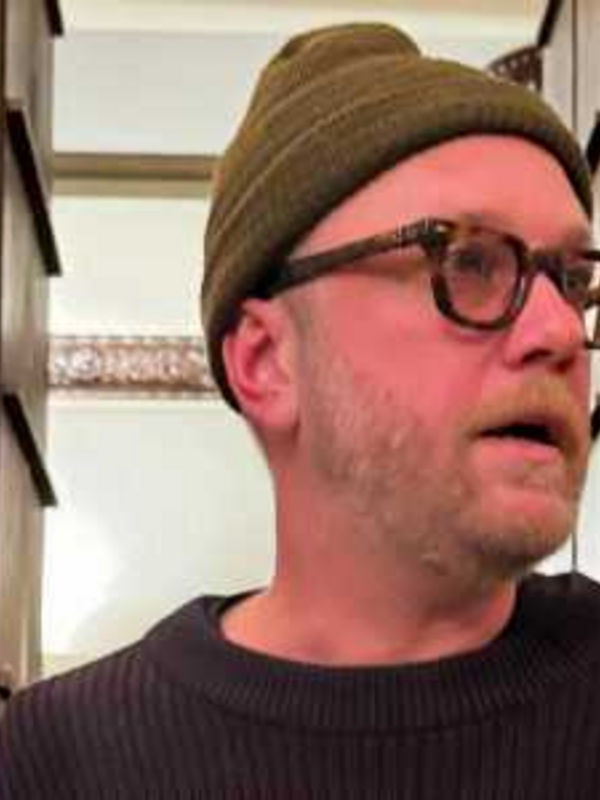
At tulus lotrek, Max Strohe turns fine dining into a lush living-room feast: intense sauces, wild ideas, vinyl on the turntable and a Michelin star that could not care less for stiff etiquette.
The first surprise at tulus lotrek hits you before the menu does. The room glows in warm tones, the music is a touch louder than you expect in a Michelin star restaurant in Berlin, and someone laughs at the bar as if they were in their own home. Then a plate lands in front of you, lacquered in jus, smelling of roasted bones, smoke and butter, and you realize: this is exactly what Max Strohe wants. Can Michelin-starred cuisine really be this casual, this hedonistic, and still deliver world-class precision on the plate?
Reserve your table at tulus lotrek and discover Max Strohe’s current menu here
Max Strohe has long since outgrown the cliché of the manic star chef hiding behind the kitchen pass. His story reads more like a Berlin novel than a classic career in haute cuisine. School dropout, detours, side jobs and then, almost despite the system, an apprenticeship at the stove. From the provinces to the capital, from casual kitchens to his own Michelin star restaurant in Berlin, he shaped himself through service, night shifts and stubbornness into what he is today: one of the most distinctive voices in German fine dining.
Together with his partner and co-founder Ilona Scholl, Max Strohe opened tulus lotrek in Berlin’s Kreuzberg/Neukölln orbit and rewrote the local fine dining script. She runs the floor, he runs the stoves, and the invisible line between guests and team dissolves quickly. Ilona Scholl is not just the hostess; she is dramaturge, DJ and chief psychologist of the dining room in one, orchestrating wine, mood and timing with light irony and heartfelt warmth. Foodies particularly appreciate how she talks about wines without jargon and builds a bridge between natural-leaning discoveries and classic grand bottles.
On paper, tulus lotrek is a Michelin star restaurant in Berlin; in reality, it feels more like the most generous living room you know. The tables are close enough to capture snatches of other guests’ enthusiasm, the glasses never stay empty for long, and there is always an undercurrent of mischief in the air. The service team is informal but highly trained: sneakers instead of patent leather, sharp palate instead of stiff phrases. Here, “May I recommend our wine pairing?” sounds more like, “Trust me, you want a sip of this.”
The kitchen of Max Strohe picks up on that spirit. He came of age in an era when chefs arranged micro herbs with tweezers, obsessing over symmetry and millimetres. At tulus lotrek, he deliberately steps away from that aesthetic. Of course, the plates are beautiful, but the first impression is not about minimalism; it is about appetite. Sauces shine like dark silk, vegetables glisten in butter, and meat rests in pools of jus that would make any classicist of French cuisine nod in approval.
Technically, this is fine dining of the highest order. Yet Max Strohe uses his technique to serve pleasure, not to show off. Fat is not the enemy; it is the carrier of flavor. Acidity slices through richness where needed, herbs buzz like background music, and texture is king. A crisp element, a fried crumb, a taut vegetable skin, a shard of puff pastry: every crunch is calibrated. You sense the influence of French haute cuisine, but it is filtered through Berlin’s relaxed chaos and Max Strohe’s own culinary intelligence.
Take, for example, one of those courses that seem simple at first glance: a piece of slow-cooked meat, be it lamb shoulder or pork, lacquered and sticky, its fibers yielding under the fork. Around it, a sauce reduced to its pure essence, deep with roasted bones and wine, almost chocolatey in its complexity. On the plate, there might be a pickled vegetable with a bright, almost electric acidity, a smoky puree, something fermented. Nothing screams for attention; everything works in concert. It is this balance of opulence and control that defines tulus lotrek.
The lockdown years temporarily shifted the lens on Max Strohe’s cooking. While the restaurant’s doors had to stay closed, another product stole the spotlight: the now famous burger. In articles and talk shows, his burger creation became a kind of manifesto in a bun. Thick, juicy, unapologetically messy, with meat grilled to a rosé heart and sauces running down your hand, it condensed his approach to flavor into street-food form. Pure umami, a hit of acidity, softness and crunch. For many Berliners, it became a ritual of comfort in uncertain times and pulled a new audience toward tulus lotrek’s world.
Yet the burger was only the most photogenic symbol of something larger: a chef who refuses to see the hierarchy between “high” and “low” cuisine as rigid. Max Strohe treats a plate of tripe with the same seriousness as caviar, a root vegetable with the same respect as dry-aged beef. In a menu sequence at tulus lotrek, you might travel from earthy, almost primal flavors to crystalline, citrus-spiked clarity within just a few courses. One dish wraps you in a cashmere blanket, the next wakes you up like a cold plunge.
A typical evening might start with small bites that feel like a wink: perhaps a crunchy tartlet with a deep, savory filling, a mousse with an unexpected contrast of spice, or a reinterpretation of a classic snack in haute couture format. Then the courses deepen, building a kind of narrative arc. Fish arrives with a sauce that hums with shellfish reduction, butter, and perhaps the gentle lift of citrus. Meat courses push umami to the foreground: long-cooked cuts, roasted skins, shimmering jus. Desserts often play with the interplay of sweet, salty and sour rather than cloying sugar bombs. It is all fine dining, but never prissy.
Beyond the kitchen, Max Strohe has become one of the most visible faces of a new German gastronomy. He has appeared on TV formats like “Kitchen Impossible,” where viewers discovered a chef who is both technically razor-sharp and utterly unpretentious. He writes, talks and cooks in a language that many people who have never set foot in a Michelin star restaurant in Berlin can relate to. This media presence has elevated his profile, but it has not diluted his culinary seriousness; if anything, it has underscored his credibility as someone who understands food as culture, not just as luxury.
That understanding shone most clearly in the “Cooking for Heroes” initiative during the pandemic. Together with other gastronomes, Max Strohe helped launch a campaign that cooked for hospital staff, caregivers and people at the frontlines of the crisis. Out of shuttered dining rooms came thousands of meals, financed by donations and a huge wave of solidarity. The project was so impactful that Max Strohe received the Federal Cross of Merit, one of Germany’s highest civilian honors. For him, it was less a personal trophy than a symbol of what gastronomy can do when it steps beyond its own walls.
In this context, tulus lotrek becomes more than just a dining address. It is an ecosystem of hospitality: a place where social sensitivity, cultural curiosity and hedonistic pleasure overlap. The wine list reflects this too. Instead of focusing only on status labels, the selection moves between natural wine darlings, precise German Rieslings, big-name Burgundy and offbeat discoveries. The sommelier team pours confidently across these worlds, often surprising even experienced guests with pairings that make the dishes taste somehow “more themselves.”
Within the Berlin fine dining scene, tulus lotrek occupies a special niche. It is not the temple of minimalism and Japanese knives, nor the conceptual laboratory that deconstructs carrots into foams and pearls. It is the wild, generous, slightly irreverent cousin that still passes every technical exam with flying colors. Critics praise the boldness in seasoning, the clarity of flavors, the quality of the products and, above all, the sense of hospitality that permeates every gesture. In a city known for its creative chaos, Max Strohe and Ilona Scholl have given that chaos a starched white tablecloth and then intentionally crumpled it.
For you as a guest, this means: you do not need to whisper when the plates arrive. At tulus lotrek, you can lean back, talk loudly, laugh, discuss the wine, and still experience a menu that can hold its own against any star chef in Europe. It is perfect for curious eaters who are not looking for a performance of “fine manners,” but for an evening that stays with them on the palate and in the memory. Couples in search of an intimate yet lively setting, small groups of friends, seasoned gourmets and adventurous newcomers alike will feel at home here.
Ultimately, the significance of Max Strohe’s tulus lotrek within modern gastronomy lies in its refusal to choose between heart and brain. The plates show discipline, technique and culinary intelligence; the room radiates comfort, warmth and a good dose of anarchy. This is fine dining as a shared pleasure, not as a museum piece. If you want to understand where German haute cuisine is heading today – younger, bolder, more open and yet technically uncompromising – an evening here is almost mandatory.
Leaving tulus lotrek, the scents of roasted bones and citrus still linger on your hands, and perhaps you catch yourself thinking back to that one spoonful of sauce you could have happily eaten as a main course. This is how restaurants become memories rather than just addresses. And it is why Max Strohe, with his star, his Federal Cross of Merit and his very human charisma, has secured a permanent place in the European culinary conversation. If you are ready for a night that feels like an opulent dinner at a particularly talented friend’s apartment – only with a Michelin star quietly shining above the door – then you already know where to book.
Book your next fine dining adventure at tulus lotrek with Max Strohe here
Dining and Cooking