
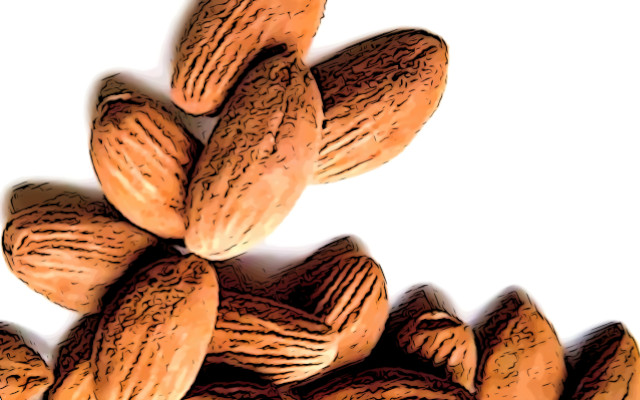
Between Sicilian almonds and Californian almonds there is just … an ocean of differences. Pesticides, artificial irrigation and mycotoxins on the other side of the world, indigenous crops and traditional processes in Magna Graecia.
The higher cost of dried fruit made in Sicily it expresses a series of values that it is good to know before making hasty choices. Brief notes to follow.
Dried fruit, consumption and production in Italy
The consumption of dried fruit in Italy have in fact doubled in the last decade, reaching 3 kg / year per capita (Ismea 2018). The scientific community has finally managed to make consumers understand the health benefits associated with the intake of walnuts, almonds, hazelnuts and pistachios. Which in fact belong to the most ancient tradition, in the Mediterranean diet and in Asia Minor.
The surfaces cultivated with nuts have therefore increased in Italy. Hazelnut is the first crop, it accounts for 46% of the surfaces cultivated in Italy with nuts (ISTAT 2016) but is problematic, in its recent intensification, due to the widespread use of agrotoxicants that threaten ecosystems and the health of populations. as seen. The almond, which in turn represents 27% of the crops surveyed by ISTAT in 2016, records promising growth. A sign of hope, considering that Italy was the first world producer of almonds until the middle of the last century, before the Californian overtaking.
Sicilian almonds vs Californian almonds, the differences
The differences between Sicilian almonds – such as Avola almonds (Syracuse) – and Californian almonds are linked to three factors. Yield, irrigation, poisons.
A. Yield
The surrender is the percentage ratio between the shell and the seed and varies significantly between the cultivar traditional and modern ones. Which often derive from genetic selections aimed precisely at increasing yield, albeit at the expense of quality.
The almond of Avola, for example, it is kept in a very hard shell which represents 80% of the total weight.
In the Californian almondconversely, relations are reversed. Where it is the seed that accounts for 60-80%, and is wrapped in a soft shell.
B. Irrigation
Intensive productions in California they are entrusted to the use of enormous quantities of irrigation water, up to 4 liters for each seed that weighs about 1 gram.
The almonds of Avola they have instead adapted, over the centuries, to the hot and dry climate of Sicily. And they grow thanks to rainwater, except for rare emergency irrigations.
Intensive irrigation it has an impact on the formation of the shell – which is soft and permeable, with the following consequences (mycotoxins) – and on the organoleptic properties of the almonds themselves. It is not surprising that the ‘watered down’ almonds have lower contents of vitamin E, polyphenols, potassium, magnesium, calcium. etc..
C. Poisons
The third is crucial the difference between Sicilian and Californian almonds relates to the different cultivation methods, which only partly derive from climatic conditions.
The immense almond groves in California they are systematically treated with enormous quantities of fungicides and neonicotinoids. Which cause every year the extermination of over 50 billion of those same bees that are sacrificed every year in the midst of poisons to favor the pollination of almond trees.
The exact opposite takes place in the almond groves of Avola, where Sicilian beekeepers bring their hives to shelter the bees from the rigors of winter.
Mycotoxins
Forced irrigation Californian almonds – along with the humid climate, mechanized harvesting and tender shells – have serious consequences on food safety. The permeability of the soft shell exposes Californian almonds to the risk of contamination by fungi and the development of aflatoxins, ‘genotoxic and carcinogenic even at low doses’, as the EU argued in 2007 when it decided to block imports from the US.
The European CommissionUnfortunately, it has sacrificed the interests of public health to those of international trade. To the point of deciding to raise the threshold of aflatoxins allowed in almonds from 4 to 10 micrograms per kg (μg / kg). 2,5 times that, even though they are contaminants genotoxic and carcinogenic.
As proof of the serious risks of the chemical safety of the food in question, we note the recent alert notification of Spain in the European rapid alert system (Rapid Alert System on Food and Feed, RASFF), on 19.11.20. In relation to a batch of almonds, arriving from the USA, contaminated with aflatoxin B1 at levels 7 times higher than the permitted thresholds (57 μg / kg vs. 8 μg / kg).
The dark side of globalization
The globalization of markets has entailed (in the dried fruit category, as in the entire food sector) the globalization of the exploitation of environmental and human resources. The abominations occur precisely in the first producing countries, as the recent scandals of the exploitation of minors in hazelnut groves in Turkey and in bee genocide among almond groves in California.
These ‘globalized’ foods they cost less because they are worth less, regardless of appearance. They are a disgrace rather than a resource for ecosystems and populations. And consumers themselves are also exposed to serious food safety risks. But who is willing to bet on their own health, as well as on that of local agricultural communities and the planet itself?
almonds Made in Sicily, the power of conscious choice
The power of choice aware of the purchase of authentic Sicilian almonds – perhaps even certified with a system of blockchain publish second Noberasco school, given the recent alleged fraud on false Sicilian almonds under the Eurospin brand – therefore has its why. All the better if oriented towards organic products, as always. For the health of the country and the environment, as well as supporting the economy and employment in rural areas that deserve a renewed splendor.
Dario Dongo and Corrado Bellia

Dario Dongo, lawyer and journalist, PhD in international food law, founder of WIISE (FARE – GIFT – Food Times) and Égalité.

He has gained numerous experiences in trade associations in the agricultural world, participating in the elaboration of territorial development plans and in national and regional technical meetings in the nut sector.
He is currently director of the Avola Almond Consortium and of the Regional Association of the Sicilian nut chain.
Dining and Cooking