
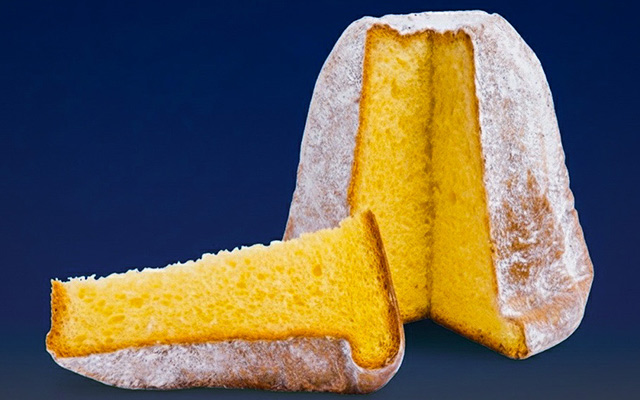
Il Verona pandoro It is among the most famous Italian leavened desserts, an emblem of the Christmas tradition and of Venetian confectionery excellence. soft structure, the vanilla scent and the characteristic star shape eight-pointed reflect a rigorous balance between craftsmanship, technical expertise and quality of raw materials. Production is based on a complex process, founded on slow leavening, selected ingredients and the mastery of the pastry chefs.
History and legends
The origins of pandoro are set within a broad historical framework, in which the Venetian food tradition is intertwined with the cultural influences of the Venetian Republic and the evolution of confectionery production techniques. Many historians believe that the earliest ancestors of pandoro can be found in the medieval sweets of the Venetian courts, reserved for celebrations and characterised by doughs rich in butter, sugar and eggs, ingredients which at the time represented a luxury and a sign of social status (Montanari, 2019). In this context, the nadalin, a Veronese dessert documented since the 13th century, considered the direct ancestor of the modern pandoro. Nadalin has a more compact structure, a similar flavor profile, and a distinctly festive feel, elements that have fueled its fame and continued success over time.
The real turning point comes in early nineteenth century, when Italian pastry making is renewed thanks to fermentation techniques more effective, to the greater availability of refined sugar and to the affirmation of aaesthetics of dessert which emphasizes softness and lightness. It was in this cultural climate that Domenico Melegatti, in 1894, registered the famous patent for the eight-pointed star shape, giving pandoro its modern and recognizable identity. The patent not only concerned aesthetics, but also a more innovative manufacturing process, capable of guaranteeing a regular leavening has always been soft consistency, traits that still define the product today (Gonzato, 2018).
During the twentieth century, pandoro consolidated its presence on Italian tables and established itself as the national dessert for the end-of-year holidays, along with panettone. It has cultural and territorial value, becoming one of the identity products of the region. Veronese tradition and contributing to its preservation as a gastronomic heritage. This combination of history, legend, and cultural recognition contributes to the allure of a dessert that, while constantly evolving, remains true to its roots.
Ingredients and production process
The Pandoro of Verona is the result of a complex production process and rigorous, in which the quality of the ingredients represents a determining element. At the base of the dough there is a strong soft wheat flour, capable of developing a robust gluten network, necessary to support the long leavening typical of this dessert. To this are added butter obtained exclusively from cow’s milk creams, sugar, eggs of category A and their yolks, mother yeast with the possible addition of brewer’s yeast and natural vanillaThe balance between these ingredients is essential to allow the dough to develop harmoniously and acquire a soft consistency and elegant fragrance.
La processing It is divided into several phases, each crucial to the final result. It begins with the preparation of the sourdough starter, which forms the basis of the fermentation. This is followed by an initial dough, to which butter and egg yolks are gradually added using a slow and carefully calculated emulsion technique. subsequent leavenings, particularly long, allow the dough to develop afine and regular alveolation, while the folds ensure elasticity and softness. The shaping in the star-shaped mold allows for a uniform cooking which enhances the golden color of the cake. Once baked, the pandoro is left to cool using methods designed to avoid compromising its structure.
Nutritional properties
Like many traditional winter desserts, pandoro is a high-energy food, intended for occasional consumption, typically around the Christmas season. On average, 100 grams of pandoro provides between 400 and 420 kcal, with the majority of energy coming from carbohydrates (55–60 grams) and fats (between 15 and 20 grams). Protein varies between 6 and 8 grams, while fiber varies between one and two grams.
Gastronomic uses
The Pandoro of Verona is appreciated first of all for its traditional form, simply dusted with icing sugar. Its delicate flavour helps it to combination with fresh fruit, chocolate sauces, citrus compotes, and dessert wines. Its soft texture and aromatic neutrality also make it very versatile in the gastronomic and professional fields. gourmet kitchen Pandoro is thus used as a base for Christmas tiramisu, zuccotti, semifreddo, or plated desserts. A light toasting enhances its fragrance and makes it ideal for accompanying creams and semifreddo.
Advice for buyers
For consumers who wish to choose a quality pandoro, it is important to pay attention to the list of ingredients, where the presence of butter and eggs as the only sources of lipids in the dough are the rule, while the natural flavors of vanilla are a sign of excellence. Visually, a well-made pandoro has a regular shape, a golden surface, and a soft but not dry texture. The aroma should be natural, with a balance between buttery and vanilla notes.
For professional buyers, in the international context, it is essential to turn to reliable producers who guarantee high food quality standards. In this context, the team of GIFT Great Italian Food Trade offers expert support in sourcing certified Italian suppliers, verifying production requirements, and providing export consulting. GIFT’s work facilitates dialogue with producers and enables buyers to identify customized solutions, reducing risks and enhancing opportunities in foreign markets.
Conclusions
Pandoro di Verona is a masterpiece that embodies history, technique, and gastronomic culture. Its evolution, from medieval courts to contemporary production, represents a journey of continuous improvement in which tradition and innovation coexist harmoniously.
The craftsmanship, quality ingredients, and rigorous production processes make this dessert an Italian icon destined to endure over time, confirming its central role in Christmas celebrations and in the diffusion of Italian gastronomic culture around the world.
Thanks to the commitment of producers, scholars, and industry professionals, pandoro continues to showcase Verona and its tradition, preserving the magic of a simple yet sophisticated dessert.
Dario Dongo
Cover Credit: Photo courtesy of Luca Fraccaro
Bibliography
Montanari, M. (2019). The Meatball Rest: A History of Cuisine and Nutrition (ISBN 13: 978-8806243087). Ed. Laterza, Bari

Dario Dongo, lawyer and journalist, PhD in international food law, founder of WIISE (FARE – GIFT – Food Times) and Égalité.
Dining and Cooking