
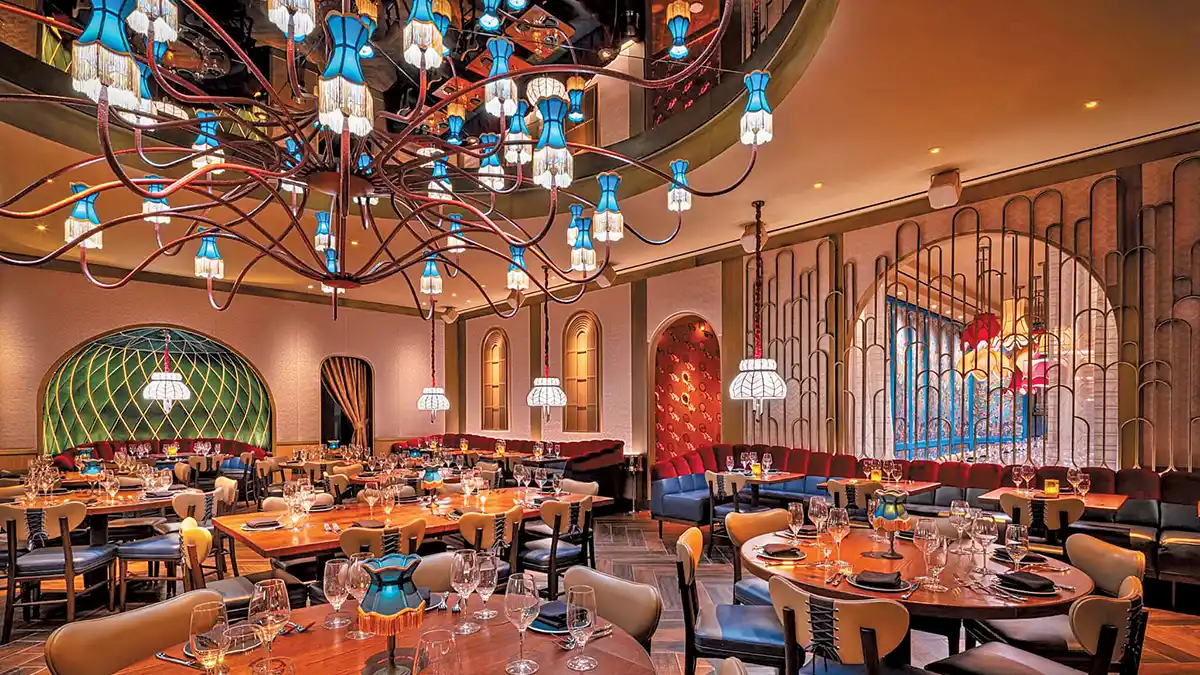
 The main dining area at Stanton Social at Caesars Palace, Las Vegas
Stanton Social Italian opened at Caesars Palace with a clear mission. It aimed to combine comfort, character, and creativity in a way that honored the original Stanton Social brand while giving guests something new to look forward to on the Las Vegas Strip. The restaurant arrived as both an evolution and a fresh start. It brought the shared-plate spirit of the Lower East Side original into a world where spectacle and flavor work side by side.
Chef Chris Santos built his name on dishes that encouraged people to share, talk, and linger. When he launched the first Stanton Social in New York in 2004, the concept stood out because it made dining feel social in a way that kept the energy high and the table moving. That spirit carried into this new version, but the focus shifted toward Italian cuisine shaped by New York’s long history of Italian American dining.
Santos said the move toward Italian was a natural next step. He explained that the heart of the brand always lived in bold flavor, warm hospitality, and dishes that sparked conversation. Italian cuisine, with its traditions and regional styles, offered a foundation that let him retain that identity while reaching a wider audience. “A menu becomes stronger when it respects the past and still plays with new ideas,” Santos added.
Guests arriving at Stanton Social Italian find a menu that blends memory and imagination. The Fritto Misto sets the tone as a crowd friendly beginning. It mixed calamari, shrimp, squash, and cherry peppers with arrabbiata sauce and preserved lemon aioli. It delivered color, crunch, and just enough heat to wake up the palate. The Heirloom Tomato Salad kept the flavors clean and bright with whipped burrata, balsamic vinegar, and basil pesto. The Hamachi Crostata offered a lighter, modern contrast with yellowtail, confit cherry tomato, red onion, basil, and lavash.
Terrence O’Donnell, Senior Vice President and General Manager of Caesars Palace, noted that these types of dishes fit perfectly within the resort’s dining portfolio. Caesars Palace has built a reputation for offering both luxury experiences and approachable favorites. “Our guests wanted something that felt exciting without feeling exclusive,” O’Donnell continued. “Stanton Social Italian gave us that balance.”
The pasta selections played a strong supporting role. The house-made Cavatelli Wagyu Bolognese became an early favorite. It paired hand shaped pasta with a rich sauce, fresh herbs, and parmesan. It offered comfort without losing refinement, which reflected the overall philosophy of the restaurant. Santos detailed that pasta had always been a personal focus for him because it allowed technique and nostalgia to work together on the same plate.
Tableside experiences heightened the sense of theater. Servers presented the Extra Crispy Chicken Parmigiana with San Marzano tomato sauce and mozzarella fondue poured warm over the dish. Flames rose during the service of the Choice Super Tomahawk, which featured Barolo braised short ribs and bone marrow ignited at the table. The room often paused to watch, and diners turned their attention toward the presentation before returning to their own conversations.
O’Donnell outlined how these performances helped shape the mood of the dining room. He emphasized that Las Vegas guests appreciated both the food and the show. “People love a moment they can share with others,” he said. “These touches made the experience feel alive.” Each element built toward a dining style that encouraged engagement, laughter, and a sense of community at the table.
Desserts reinforced this playful tone. The Limoncello Tiramisu, bright and layered with citrus mascarpone mousse, offered a lighter finish, while the Spumoni Milkshake introduced a more whimsical approach with pistachio mousse, cherry compote, brownie bites, mascarpone Chantilly, and an edible chocolate cup. These creations added a final lift to the meal.
As the restaurant settled into its new home, both Caesars Palace and Tao Group Hospitality saw it as a meaningful step in their ongoing partnership. The resort has become a playground for some of the biggest names in food and nightlife, and Stanton Social Italian contributed another layer to that identity. It stood beside restaurants from Gordon Ramsay, Bobby Flay, Guy Savoy, and others, each contributing something distinct.
Santos reflected on the collaboration with Tao Group Hospitality. He noted that the team understood his original vision and supported his desire to evolve without losing the core that made the brand successful. “A concept survives when it keeps adapting,” Santos continued. “This version still honored the heart of Stanton Social but brings a new personality with it.”
O’Donnell agreed. He pointed out that Caesars Palace aimed to deliver experiences that combined variety with excellence. By offering everything from celebrity chef restaurants to the Bacchanal Buffet, the resort created a full spectrum of dining possibilities. “We wanted something that felt social and modern but still grounded in strong culinary technique,” O’Donnell detailed. “This restaurant checked every one of those boxes.”
The opening also spoke to a broader trend in Las Vegas dining. Visitors no longer looked for meals that only impressed them. They wanted something that created memories. Social dining, shareable dishes, and bold presentations had become more than a novelty. They had become the expectation. Stanton Social Italian used that shift to build an atmosphere that felt warm, animated, and immersive.
Italian food also offered a universal appeal. Families, couples, and groups of friends could all find comfort in the flavors. Santos understood that this made the cuisine both approachable and versatile. He explained that his challenge was to add personality without losing the charm of familiarity. Tradition, he believed, only grew stronger when treated with care and curiosity.
As guests moved through the dining room, the atmosphere captured a blend of New York’s neighborhood comfort and Las Vegas’s electric pulse. Soft lighting, rich textures, and a lively soundtrack created a space that felt intimate but energetic. The room encouraged guests to stay, order another dish, share one more bite, and enjoy time with the people around them.
The restaurant’s success reaffirmed the power of evolution in hospitality. Concepts that once thrived in one city could find new life in another as long as they carried their essence forward. Stanton Social Italian did exactly that. It showed respect for its origins while embracing a larger stage.
Looking back at the opening, both Santos and O’Donnell carried a sense of pride in how the project came together. Santos concluded that the restaurant represented more than a menu or a space. It represented connection. It brought people together at a table filled with flavor, conversation, and a sense of shared experience that would continue long after the meal ended.
Dining and Cooking