
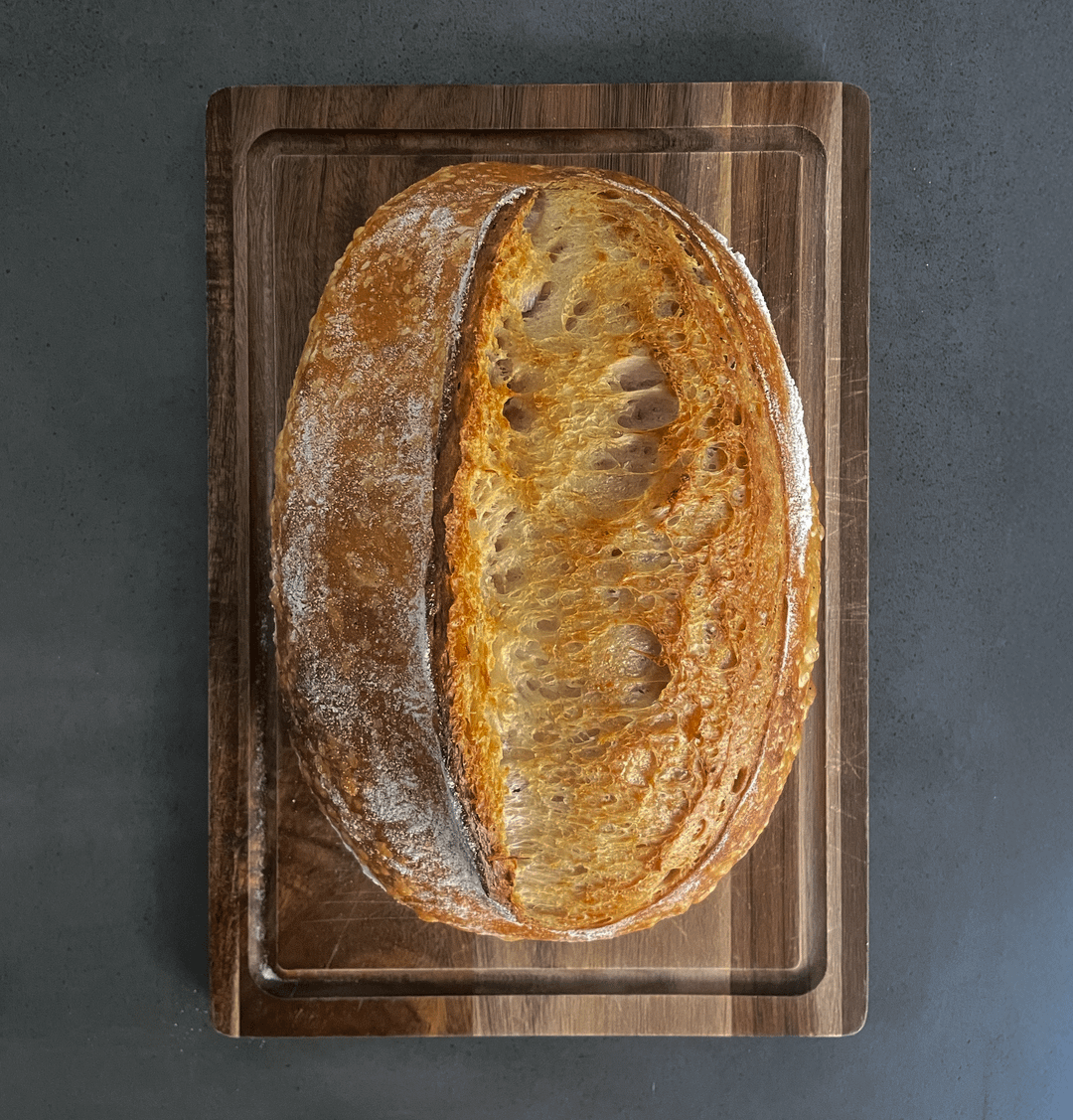
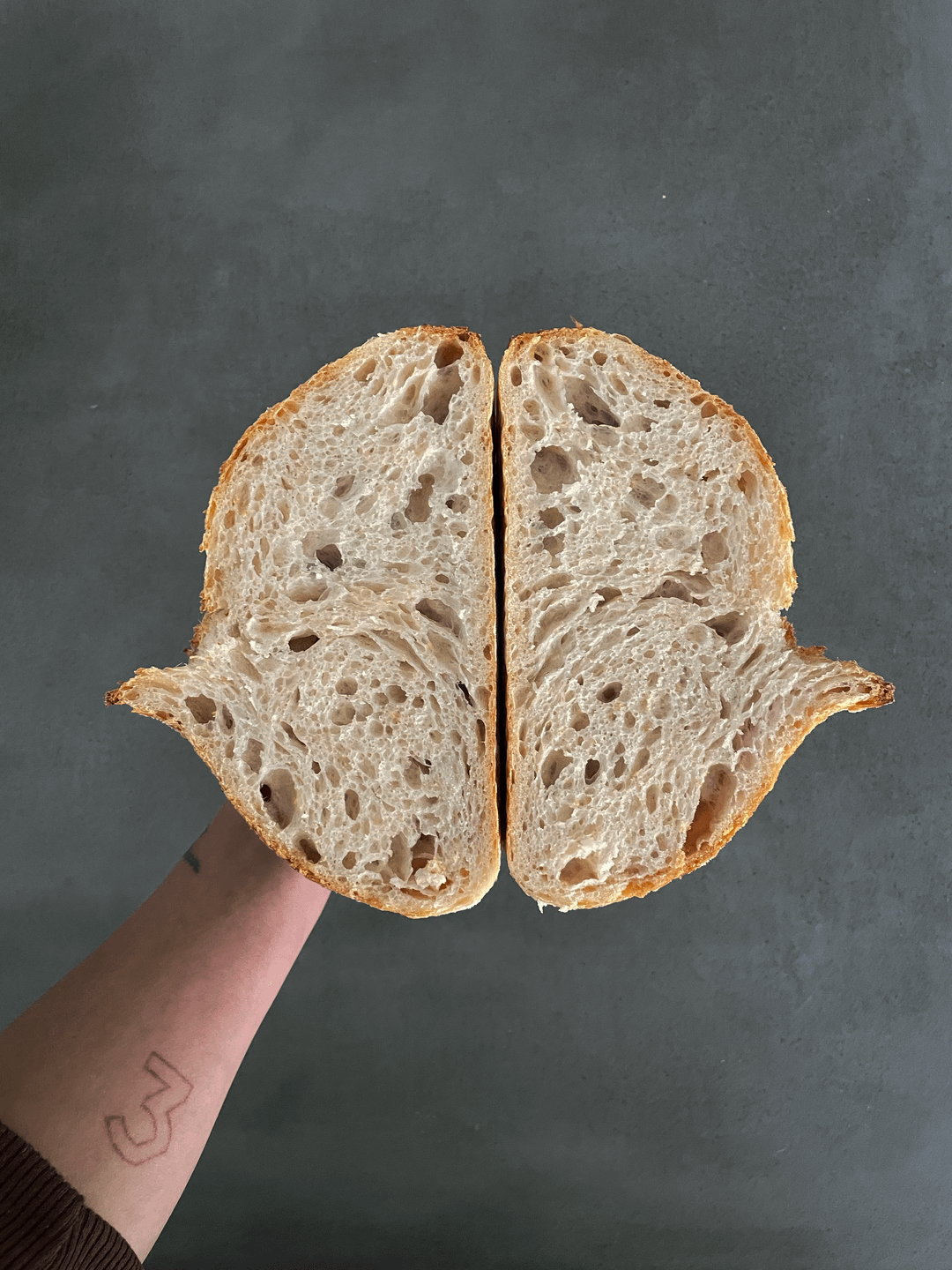
Hi! This is my very first Reddit post ever 😄
I’ve been baking sourdough for a little over 6 months now and would really appreciate some feedback.
I’m generally very happy with my loaves, but I feel like there’s still room for improvement, especially when it comes to oven spring. My loaves never get quite as “high” as I’d like them to be, so I’d love any thoughts or suggestions.
This is the recipe and process I used for the loaf in the photos:
Ingredients
- 110 g starter
- 340 g lukewarm water
- 500 g flour (450 g high-protein white flour, 50 g wholemeal flour)
- 10 g salt
Method
- 9:00 am – Feed the starter (wholemeal flour, 1:1:1 ratio). I keep it in a proofing/fermentation heat box at 27 °C.
- 1:00 pm – After ~4 hours, when the starter is just about to peak, I start a short 1-hour autolyse (flour + water).
- 2:00 pm – Add starter and salt, then knead for about 5 minutes. Rest for 30 minutes.
- 2:30–4:00 pm – Two sets of stretch and folds followed by two sets of coil folds, all 30 minutes apart.
- 4:00–6:30 pm – Bulk fermentation in the heat box at 25 °C.
- 6:30 pm – Pre-shape.
- 7:00 pm – Final shape, then a 30-minute bench rest.
- 7:30 pm–9:00 am (next day) – Cold retard.
Baking
Preheat the oven for 1 hour at 250 °C.
Bake the loaf straight from the fridge in a covered enamel roasting pan (not cast iron) at 230 °C with two ice cubes for steam for 25 minutes, then uncover and bake for another 23 minutes.
One extra note: the temperature in our kitchen fluctuates quite a lot, which is why I use a proofing/fermentation heat box, mainly for consistency rather than speed.
Any feedback, tips, or things you’d tweak to improve oven spring would be very welcome. Thanks in advance!
by Civil-Living-5558
14 Comments
No feedback, bread looks spectacular. Now get off Reddit and enjoy it.
Not sure if this is what you want to hear, or necessarily even something that would work for you, but I find I get my best oven spring in a cast iron dutch oven. I have a cast iron bread oven that also makes fantastic loaves but they are usually flatter even with the same batch of dough. For some reason the cast iron classic dutch oven shape really achieves great oven spring (for me). That being said, your loaf looks fantastic. 🙂
[removed]
It quite genuinely looks perfect. No notes. Good luck on your journey for more oven spring. If you find it post here so we can all learn what worked!!
That’s a lot of oven spring. Do you mean you want the loaf “taller,” or just more expanded in all directions?
Here are a few things that jump out to me:
1:1:1 feeding for your levain/ pre-ferment is not maximising the strength of your starter. Try at least 1:2:2, and for regular feedings as well.
Kneading only for 5 mins and only a couple folds after that long autolyse might be pushing your dough on the “extensibile” side of the “extensible vs. elastic” balance needed to achieve. If you want taller and less wide, this is something to look at.
However, your dough has nice strength and I would be chasing longer fermentation to maybe open up that crumb nicely and really see how much your starter can push open. That on it’s own might give you a bit more spring. If you’re like me and you like the way your dough handles now (so you dont want to cut bulk later), just let your loaf proof a bit in the banneton (in your warm place) before cold retard. I bulk to about 50% rise, shape, and let the rest go in the basket before fridge.
Perfect fermentation always comes first, then adjust smaller things later.
I don’t ever use ice cubes in mine. I just preheat it with the preheating of the oven for an hour, some people preheat for 30 minutes only, and when I open it I have to open it and lift it from the back so the steam doesn’t hit me in the face. I do spritz, only a little of water, my bread before I place it in the Dutch oven. I don’t think that really makes a big difference but it could. I believe moisture, from what I’ve read, will dissipate out from our bread while it cooks while enclosed in the Dutch oven so maybe I don’t need to spritz I just never have not spritzed.
I’ve recently gotten into cast-iron cooking, and I specifically looked for what’s called a double Dutch oven because the lid is flat and can be used as a frying pan, giving me two cooking tools in one. I find it especially handy for making biscuits, whether yeast or discard biscuits. I cook them using the bottom of the pan as the top (if that makes sense), and the preheated lid (used as the base) cooks the bottom of my biscuits perfectly without burning them.
https://preview.redd.it/rchm93213gbg1.jpeg?width=1125&format=pjpg&auto=webp&s=08479bb69d4abd9b30949cab25d6356700f9f5b6
That’s pretty tall.
Vital wheat gluten (VWG) is concentrated wheat protein that significantly improves dough strength, elasticity, and rise, making it great for sourdoughs with low-protein flours, whole grains, or add-ins like fruit, though too much can make bread tough. Adding VWG helps create a stronger gluten network to trap gas, leading to a better rise and a chewier texture, especially in recipes where the natural gluten struggles, like with rye, whole grain wheat, or AP flour. As long as you don’t have any sensitivity to gluten. We don’t so I use it in our bread, I use the lower end, 1 teaspoon. I mix it in with my flour really well before I combine anything else.
For sourdough, add 1 to 2 teaspoons of vital wheat gluten (VWG) per cup of flour, whisking thoroughly to distribute, but be mindful that too much can make dough tough; start with less, like 1 tsp/cup, especially with lower protein flours, and adjust hydration slightly upward as VWG absorbs more water, leading to better rise and structure. With the amount I use I’ve never had a tough bread come out.
Dammmmmmn. That looks amazing
The loaf looks amazing! I’m curious about the 3 tattoo? My first guess would be that you’re a Chance the Rapper fan. 😊
Your method is quite similar to mine. One thing you could try is replace the second stretch and fold with a lamination. Full proof baking has a good YouTube showing her process including a lamination. This builds structure which helps to get good spring.
Another thing to try, without Dutch oven , is pouring some boiling water in a pan after putting the loaf in, then switching off the oven (after its preheated to 250c) for 20 mins, then turning it back on to 230c for the remainder. This will prevent the oven from venting out the steam.
1. Such an amazing 1st post!
2. Thank you for the deets.
3. At what elevation do you live?
4. That loaf is baking perfection imo.
Have you tried using a stiff starter? It’s less acidic. The protein structure in the dough is stronger and holds more gas during baking potential giving you a better oven spring.