
“Moving into 2026, I foresee economic factors, rather than stylistic preferences or trends, being the main driver behind most wine-drinking decisions,” says Evan White, the wine director at Houston’s Bludorn. That sums up the industry perspective. There’s no denying tough times, as everyone from producers to the consumers attempts to navigate dire straits. Still, some bright spots, and looming opportunities, are emerging for smart players in wine.
1. The Bust Will Continue
There’s a reason that a small wine importer, New York City’s V.O.S. Selections, is the lead plaintiff in a Supreme Court case against the Trump administration’s tariffs. A 15-percent tariff is driving up costs from the European Union, which supplies 80 percent of imported wines, and U.S. importers are suffering. Volio founder Charles Lazzara says his Denver-based company has paused hiring and delayed investments. “Importers, distributors, suppliers, retailers, restaurants—there are so many jobs impacted because of these tariffs,” laments Marcelo Aguero, the CEO of Kobrand Wine and Spirits in Purchase, New York.
Higher prices on imported wines “might seem like a good thing for U.S. wines, but it eventually leads to price increases for domestic producers,” explains Schuyler Munroe, the lead sommelier at San Diego’s Callie. “[The] cost of production goods goes up, and distribution fees rise to counter increased taxes, all without talking about labor shortages with the current immigration policies. I foresee most prices going up 15 to 20 percent over the next year or two.” Meanwhile, the export market is shrinking. Retaliation against Trump’s tariffs crashed wine sales to Canada in the second quarter of 2025 by 91 percent.
Don’t miss the latest drinks industry news and insights. Sign up for our award-winning newsletters and get insider intel, resources, and trends delivered to your inbox every week.
Meanwhile, exports will further contract as European trade associations like the Unione Italiana Vini (UIV) push their governments for assistance to develop overseas markets other than the U.S. Although Italian producers lowered export prices in 2025 by 15 percent and French producers dropped them 26 percent, according to a UIV press release, imported wine prices across U.S. retailers still rose by five percent.
But Walker Strangis, the owner of Los Angeles retailer Walker Wine Company, says the real problem is the contraction in demand. “Even before the tariffs, there was a general, pervasive slowdown in sales, the exact cause of which no one has been able to identify. Non-alcoholic, ready-to-drink, THC, politics—the list of possibilities is endless. There are a great many headwinds.” Wine consumption has plummeted to a 60-year low, and California ripped out at least 38,000 acres of vines last year—seven percent of its acreage. Strangis’s prediction? “2026 will be the year of unintended adjustments.”
Or intended adjustments, depending on how you look at it. Buyers looking to ride out another bust year will get leaner and shop smarter. “For 2026, the defining trend could be intentionality,” says Jeff Cleveland, the general manager, sommelier, and partner at Milwaukee’s Birch. “After a few years of rising prices, uncertainty with importers’ and distributors’ portfolios, and unpredictable availability, we may want to move away from a ‘grab what we can’ mentality and build smaller, more purposeful wine programs. A thoughtful, streamlined list built with conviction gives a more personal experience and, ironically, might deliver better value.”
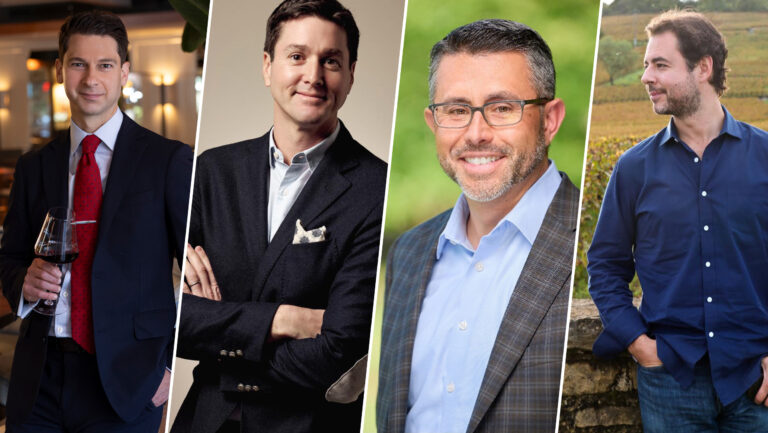 From left to right: Evan White of Bludorn (photo by Julie Soefer); Charles Lazzara of Volio Imports (photo courtesy of Volio Imports); Marcelo Aguero of Kobrand Wine and Spirits (photo courtesy of Marcelo Aguero); Walker Strangis of Walker Wine Company (photo courtesy of Walker Wine Company).
With buyers getting choosier, says Todd Brinkman, the wine director at Mendocino’s Harbor House Inn, wineries “will need to innovate to break through in 2026. A lot of brands will simply go away.”
That’s not necessarily a bad thing, says Strangis. “Some of it is healthy. What we’re seeing in Napa, for instance, suggests the domestic industry got out over its skis.”
2. We’ll Drink Less but Better
U.S. wine consumption has declined by nearly 20 percent since its pandemic-influenced peak in 2021. In a recent Wine Opinions survey, 47 percent of respondents who are drinking less say it’s due to rising prices. But that doesn’t mean consumers won’t buy wine in 2026; they’ll just spend with more discernment. “People are drinking less, but when they do buy a bottle, they are much more willing to pay for something quality, made in the right way, with something to say,” says Ryan Sipin, the consulting wine director at La Fête in Birmingham, Alabama.
Tracy Latimer, the lead sommelier at Fleurette in San Diego, concurs. “Our guests are happy to spend a little more for organic, independent, small-production wine instead of mass-produced, entry-level wines, against the grain of an economic downturn,” she says. “They are drinking less and ensuring that what they do choose to splurge on is of higher quality and value.”
Special-occasion restaurants will shape their programs to enable diners to sample better wines. “I think we’ll see more premier by-the-glass options, and perhaps smaller-portioned options so that guests can splurge on something special and make that glass count,” says Erin Lindstone, a sommelier at Barolo Grill in Denver.
Wealthy consumers are also favoring quality over quantity, says Eleven Madison Park wine director Adam Waddell. But they can strategize differently. “Rather than multiple bottles, many are opting for a single, exceptional selection,” he says. Recently, his team sold a $1,520 Château d’Yquem ‘Ygrec’ 1973 to a table that usually orders the standard $195 pairing but wanted to drink more moderately that night. “They were captivated by the story of this rare dry wine from the iconic Sauternes estate, and the opportunity to enjoy it with such impressive age made their evening unforgettable,” he says. “The sense of place, the people, and the history now matter more than ever, reflecting a renewed desire to enjoy wines that feel personal, memorable, and genuinely special.”
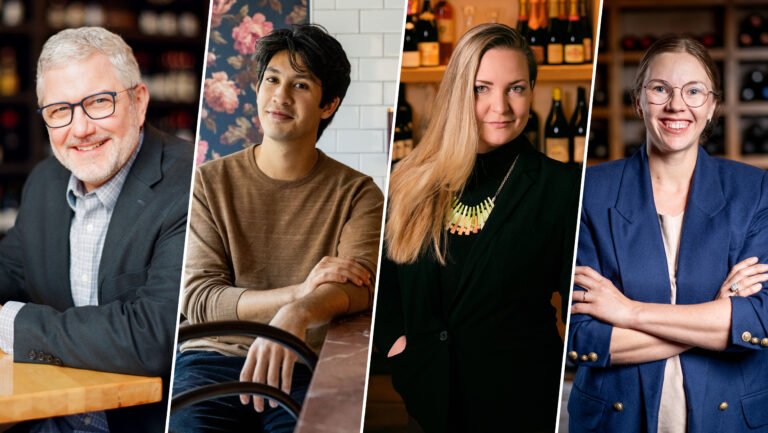 From left to right: Jeff Cleveland of Birch (photo by Aliza Baran); Ryan Sipin of La Fête (photo by Caleb Chancey); Tracy Latimer of Fleurette (photo by Words and Pictures); Erin Lindstone of Barolo Grill (photo by Joni Schrantz).
3. Classic European Wine Regions Will Make a Comeback
All this bodes well, ironically, for some European stalwarts. “Barton & Guestier [B&G] has seen the most traction in the $15 to $25 sweet spot, where value meets pedigree,” says Carlos Varela, the CEO of BGPL USA. “Appellation-driven wines like B&G M de Mangol Haut-Médoc, Saint-Émilion, and Crozes-Hermitage are outperforming in this range.”
It’s surprising to hear him mention appellations in Bordeaux, where the government is subsidizing the grubbing up of 75,000 vineyard acres. But he’s far from the only pro predicting the region’s rehabilitation. “Bordeaux is back, baby,” says sommelier Hannah Harrington of Smithereens in New York City. “After years of being overlooked by younger wine drinkers, we’re going to fall in love. Boomers will be saying, ‘I told you so.’”
This might sound shocking, given longtime concerns over Gen Z’s alleged rejection of wine—especially classics. But as Joaquín Torres, the director of wine at Hawai’i’s Kona Village, explains, “Bordeaux wines are showing signs of a comeback, thanks in part to the quality of recent vintages.” Prices are attractive, and producers are evolving. “Many have been willing to step outside appellation rules to respond to climate change and are embracing new techniques to produce environmentally sustainable wines that maintain quality and character.”
Bordeaux boosters include Cucina Alba wine director David Vogel; Johno Morisano, the co-owner of L’Arrêt in Paris and The Grey in Savannah, Georgia; Ashlee Slack, a sommelier at NYC’s Togyushi; and Alessandro Tupputi, sommelier at La Rei Natura in Piedmont, Italy. “The history and commitment to wine in that region is too storied,” says Morisano, “and the rumors of its decline are greatly exaggerated.” Tupputi predicts that “Bordeaux will become increasingly sought-after” because the appellation offers the best of both worlds: a new generation of winemakers and easy access to historic vintages.
Bordeaux’s rehabilitation is reflective of a broader dynamic. “For sommeliers and trade people, there is a trend toward rediscovering classic regions that have been adapting to the times,” notes Steven McDonald, MS, the wine director at Pappas Bros. Steakhouse in Dallas and Houston. He names Bordeaux, Champagne, and Piedmont. Noel Petrin, the director of procurement and training for the Crú Wine Bar & Bistro chain, adds Chianti to that list: “People associate Chianti with low intervention and health, and it usually hits a price point that is working now.”
Aldo Sohm, the wine director at New York City’s Le Bernardin and Aldo Sohm Wine Bar, predicts the rise of Rioja. “In the post-pandemic world, people are shopping more for classic brands with recognition,” he says. “These iconic wines bring new wine drinkers into the game. The easiest way for a young drinker to buy wines with age is with Rioja. These wines traditionally age for longer at the winery and are released much later, but are shockingly affordable and accessible.”
To wit, at New York City’s Shmoné and Shmoné Wine Bar, wine director Yonatan Chaitchik is seeing “a strong return of big, structured red wines, as people are craving depth and boldness again.” That’s good news for these regions. Seeing them revived, Richard Hanauer, a partner and wine director for RPM Restaurants, says, “One of the biggest trends that will roll into 2026 is that more and more guests are drinking nostalgically.”
 From left to right: Aldo Sohm of Aldo Sohm Wine Bar (photo by Nigel Parry); Yonatan Chaitchik of Shmoné Wine Bar (photo courtesy of Shmoné); Leilani Jacobs of Boulon Brasserie (photo courtesy of Leilani Jacobs); Richard Castner of Conrad Orlando at Evermore (photo courtesy of Richard Castner).
4. Fresh, Aromatic Whites Will Be the Order of Choice
A classic appellation worth special mention is Sancerre. The Loire Valley’s signature Sauvignon Blanc appellation has been popular for decades. Experts say there’ll be no letting up. “In 2026, the strongest trend we expect to continue is the growing demand for Sancerre,” says Leilani Jacobs, the bar manager at Tampa’s Boulon Brasserie.
“The ‘Sancerre effect’ has really taken the world by storm,” says Petrin. “Sauvignon Blanc remains on fire from all parts of the globe.”
If there’s trouble on the horizon for Sancerre, some argue it’s in the wine’s hefty price tag. “Its popularity has pushed it out of many by-the-glass price points,” says Richard Castner, the director of beverage for Conrad Orlando at Evermore. That leaves even more opportunity for other expressions of the grape. “Expect to see a surge of Sauvignon Blanc from Italy, Austria, and other parts of France—wines that deliver the same crisp, mineral-forward profile at more accessible prices.”
While overall wine consumption has decreased globally, $15 to $20 Sauvignon Blanc has grown by more than four percent over the past six years, notes Perris Fiori, the vice president of marketing for Ste. Michelle Wine Estates. “We are seeing an increase in appeal for white wine styles, such as Sauvignon Blanc, especially with the younger consumer, partly because these have a more refreshing, easy-drinking, light style.” New Zealand now ranks third among wine imports to the U.S., reports Charlotte Read, the general manager of brand for New Zealand Winegrowers. She chalks up the fact that it’s “showing strong momentum in a tough operating environment” for its top export, Sauvignon Blanc.
But crisp white’s appeal has legs beyond a single variety. “Guests are also asking for wines similar to Sauvignon Blanc when they want to branch out,” says Torrey Grant, the wine director for Manhattan’s Leonetta and The Derby Club. “We are having a lot of success with grapes like Albariño, Assyrtiko, and Vermentino—varieties with explosive fruit and crisp acidity.”
Fresh whites are a great bet domestically, too. “Looking ahead to 2026, I see distinctive white wines continuing to steal the spotlight,” says Chris Kajani, the president and winemaker at Napa’s Bouchaine Vineyards. “Our aromatic whites—Gewürztraminer, Riesling, Pinot Gris, and our Alsatian Blend—are racing off the shelves like never before. People are craving wines that are refreshing, compelling, and effortlessly food-friendly, and these varieties deliver all that with style.”
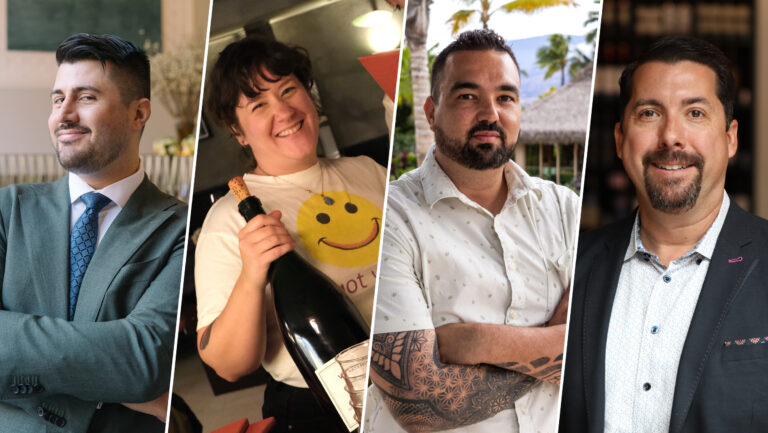 From left to right: Adam Waddell of Eleven Madison Park (photo by Setelin); Hannah Harrington of Smithereens (photo courtesy of Smithereens); Joaquin Torres of Kona Village (photo courtesy of Kona Village); Noel Petrin of Crú Wine Bar & Bistro (photo courtesy of Noel Petrin).
5. No- and Low-Alcohol Wine Will Mainstream and Gain Premium Status
Moderate alcohol is part of fresh white wine’s appeal. “Low-ABV wines are trending, driven by millennials and Gen Z,” explains Thomas Delasko, the general manager and sommelier at Via Sophia in Washington, D.C., “as health-conscious drinkers embrace moderation, favoring lighter styles for wellness and lifestyle alignment.” The Wine Market Council’s annual survey found that 24 percent of Gen Zers and 21 percent of millennials are changing their drinking habits to improve their moods, sleep, or energy levels.
But it’s not only younger drinkers who are going lighter. “Older adults are now looking at this genre,” reports Uriel Serrano, a sommelier at La Mar Cocina Peruana in San Francisco. “We see this a lot with our private events, as clients preselect non-alcoholic or low-alcohol options for their corporate team members. Guests in the dining room are also asking for lower alcoholic options.”
With the rise of zebra striping—alternating between alcoholic and non-alcoholic drinks—moderation, not abstinence, is the new normal, with 92 percent of consumers telling the research firm NielsenIQ that they buy both alcoholic and non-alcoholic labels. There’s no longer a hard line between the categories, and non-alcoholic beverages are mainstreaming.
While wine currently accounts for just 11.2 percent of all non-alcoholic beverages, both NielsenIQ and IWSR find its share growing apace. Castner calls it “the next category to expand rapidly.” But the story is as much about quality as quantity. “In the coming year, I expect low- and no-alcohol wines to make a decisive leap from novelty status into the premium wine conversation, driven by shifting consumer behavior and significant producer investment,” says Brian Huynh, the wine director at Rosewood Mansion on Turtle Creek in Dallas. “This is pushing the category into a new era where low-ABV or alcohol-free wines actually deliver texture, aroma, and balance, rather than feeling like substitutes.”
Rather than wringing hands over the rise of non-alcoholic drinks, traditional producers will see opportunity in the category, joining prominent players like Argentina’s Catena family (Domaine Elena de Mendoza); Germany’s Weingut Leitz (Eins Zwei Zero); and J. Lohr (Ariel), while importers such as Kobrand and Frederick Wildman & Sons also dive into the category.
Advances in production methods will help. Brands like St. Buena Vida, which uses aroma-capturing technology patented by Germany’s Solos, are “night-and-day better” than others, says Lindsey Peecher, the head of operations and retail strategy at Ley Line Labs and a sales consultant at the New York City shop Spirited Away. Solos is opening a California production facility launching in 2026, and the category is being touted as a life raft for vineyards. “One can look at the no- and low-alcohol product as an alternative beverage that these grapes can go into, so our farmers can continue to grow grapes,” said Ben Montpetit, the chair of the Department of Viticulture and Enology at UC Davis, on the Unfold podcast recently.
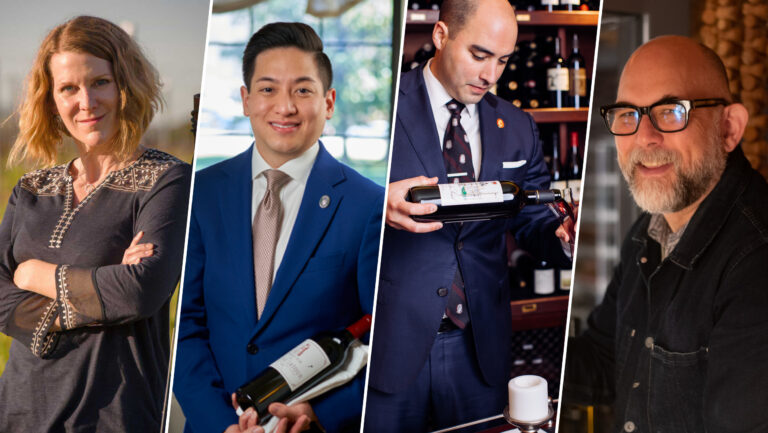 From left to right: Chris Kajani of Bouchaine Vineyards (photo courtesy of Bouchaine Vineyards); Brian Huynh of Rosewood Mansion on Turtle Creek (photo by Kevin Marple); Steven McDonald, MS, of Pappas Bros. Steakhouse (photo courtesy of Pappas Bros Steakhouse); Austin Bridges of Nostrana (photo by R. Ariel).
Dealcoholized labels aren’t the only option in the rapidly diversifying low- and no-alcohol wine category. New botanical labels, like Seraphim, are positioned as both functional drinks and wine alternatives. Some, says Austin Bridges, the wine director at Nostrana and Enoteca Nostrana in Portland, Oregon, might serve as training wheels for budding wine drinkers. “We’re seeing more low-ABV blends, canned wines infused with botanicals or fruit, and hybrid formats that bridge the gap between wine and the flavored-seltzer space, but made with real intention and quality ingredients,” he says. “Anything that helps people cross that bridge and ultimately appreciate the broader wine world, feels important for the future of the industry.”
Yet, even with their appeal to both health consciousness and the broadening of consumer choice, the rise of non-alcoholic and lo-fi wines is inextricable from the ailing U.S. economy. “It’s about alcohol not being as attractive and not being worth it for the money,” says Alex Highsmith, the owner of Spirited Away. “I don’t think it’s just that people are drinking less. I think people are poor and strapped for cash and also don’t like the effects of alcohol.”

Dispatch
Sign up for our award-winning newsletter
Don’t miss the latest drinks industry news and insights—delivered to your inbox every week.
Betsy Andrews is an award-winning journalist and poet and the co-author of Coastal: 130 Recipes from a California Road Trip. Her writing can be found at betsyandrews.contently.com.
Dining and Cooking