
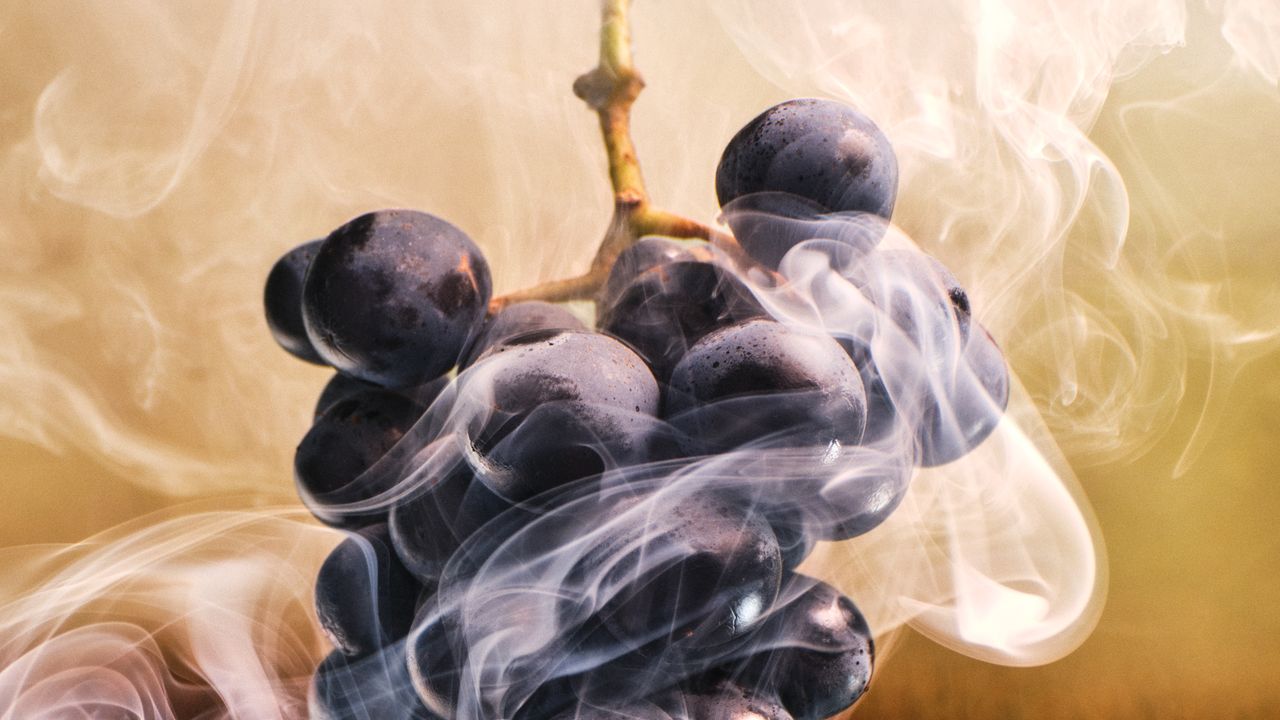
Although many wine drinkers have remained blissfully ignorant of this addition to wildfires’ already heavy toll, it has been disastrous for winemakers. One analyst concluded that the 2020 wildfires cost the California wine industry nearly four billion dollars, an amount that includes both direct fire damage and sales lost owing to smoke exposure. “We had brought in just twenty tons of Sauvignon Blanc, and we had to assume that everything else was ruined,” Egelhoff said. “It was a lost vintage.” The hundreds of thousands of tons of California grapes left unharvested that year were estimated to be worth more than six hundred million dollars alone. Oregon suffered similarly. “For a couple of days, it was a red sky, and then there was no sky,” Zolnikov said. “It was just solid smoke.” He painstakingly cleaned all the ash off his vines before harvest, but when winemakers shared the bottles they’d made with his grapes they still tasted acrid and smoky.
Clearly, the best way to prevent smoke taint would be to prevent wildfires in the first place. In the meantime, the wine industry is desperate to protect its grapes. As 2020 drew to a close, a trio of West Coast researchers—Tom Collins, at Washington State University; Elizabeth Tomasino, at Oregon State University; and Anita Oberholster, at the University of California, Davis—proposed an ambitious, “smoke to glass” effort aimed at finding an answer. “That year made it very clear we need to be better prepared,” Tomasino told me. The U.S.D.A., which normally has a puritanical reluctance to fund research that might be used by the beer, wine, and spirits industry, awarded the team $7.65 million in 2021. “As devastating as 2020 was, that’s the silver lining,” Egelhoff, who recalled sending the trio “a very angry e-mail” that year, complaining about a lack of help from researchers, said. “It really pushed them to get the solutions we need.”
In September, I joined Collins and a group of students on a trip to Washington State University’s experimental vineyards, in the Yakima Valley. It was early morning, and two sunrises lit the horizon. The false dawn, to the north, was a wildfire: overnight, a lightning strike had ignited the desiccated grasses of Rattlesnake Ridge, casting the hills around us into ominous relief. It was a stark reminder of the reason we’d woken up at this hour. Before the morning was over, we would simulate a rangeland fire of our own, to study the impact of smoke on wine grapes.
Collins runs the most impressive smoke-taint experiments in the country. Whereas Tomasino’s team, in Oregon, works with a handful of vines at a time, Collins smokes the equivalent of a quarter-acre vineyard in large hoop houses, allowing him to get closer to real-world conditions—and to make a decent amount of truly terrible wine. (Sadly, Oberholster died, from cancer, last year.) Each house encloses two hundred Merlot vines, and once we arrived we began pulling shade cloths over them, to the accompaniment of a portable speaker pumping out Fleetwood Mac. Three of the houses were to remain smoke-free, as an experimental control. In three others, we used zip ties to hang fat swags of vented plastic hosing along each row of vines, directly under the clusters of purple grapes.
Cartoon by Zachary Kanin
The students and I wrangled tarps and zip ties while Collins, who volunteers with the Boy Scouts, issued instructions leavened with gentle ribbing and reminders to hydrate. He fussed with the hoses, hooking them up to three battered grills. The light turned salmon, then golden, as we worked. Collins told the students to gather a few clusters and leaves for a pre-smoke sampling but to avoid vines with pink or orange tags, as these had been treated with an experimental barrier spray. Finally, with the samples stashed safely in an ice chest, Collins opened the grills, blowtorched some pellets inside, and watched as the smoke got going. I poked my nose through a slit in one of the houses as it filled with a pungent haze: the pellets were handcrafted from more than a dozen local rangeland species, including sagebrush, cheatgrass, and tumble mustard, all painstakingly collected by summer interns.
Although fire has been mankind’s constant companion and wine likely predates most agriculture, smoke-tainted wine seems to be a relatively recent phenomenon. “People weren’t really aware of it, but it probably had been happening,” Mango Parker, a senior research scientist at the Australian Wine Research Institute, told me. She pointed me to a reference in an Italian enological textbook from 1892, which lists “smoky taste” as a potential flaw in wine—fortunately “found more rarely in Italian wines than in German.”
Dining and Cooking