
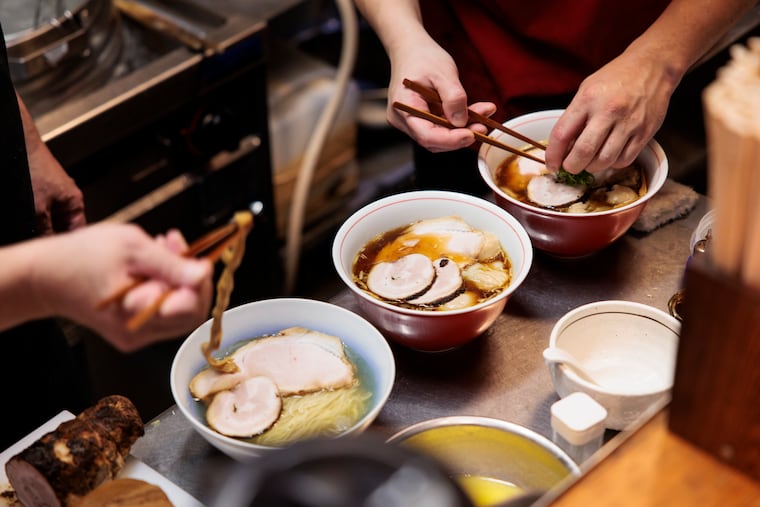
TOKYO — Lindsay Mariko Steigerwald and Jesse Pryor set the gold standard for ramen in Philadelphia during their five-year run at Neighborhood Ramen. But when the couple announced the closure of their beloved Queen Village restaurant at the end of 2024, they also teased an audacious bit of news: They were moving to Japan with plans to reopen their shop in the ramen capital of the world.
“This is the next chapter for Neighborhood Ramen!” said Steigerwald, 35, as we stood in a blustery November rain beside Shibuya Scramble Crossing, the famously chaotic, neon-lit intersection in Tokyo where we rendezvoused for a day of noodle slurping across the city.
The couple had arrived from Philadelphia just 10 days earlier — following a year of planning (and a pop-up venture called ESO Ramen Workshop in Society Hill). They’d already begun their classes at Japanese language school and launched the arduous visa process that must be settled before they can begin working on their own restaurant. It will likely still be many months before Neighborhood Ramen fires up its stockpots and noodle machine in Tokyo.
Their move was precipitated by a long-simmering goal to practice their craft alongside the best, but also a desire for “a better quality of life” they’ve come to love over the course of multiple visits to Tokyo, says Steigerwald.
Equally motivating is the couple’s passion for consuming ramen regularly; it’s every bit as intense as their drive to make it.
“I want to eat ramen every day,” says Pryor, 38. “I want to go to different shops all the time, be inspired and just soak it up. It’s hard to do that in Philadelphia.”
He’d already eaten 14 bowls of ramen in the first nine days since landing in Tokyo in November — on top of the 300 ramen shops the couple had visited during their 10 previous visits to Japan. By the end of December, Pryor was up to 80 bowls of ramen at 70 different places. (Steigerwald has been keeping pace with ramen, too, but she documents her own obsession — dumplings — on her GyozaKween Instagram account.)
That’s still just a fraction of the 10,000 ramen shops in Tokyo serving myriad variations: rich tonkotsus cloudy with the emulsified essence of slow-simmered pork bones; crystalline shio salt broths and shoyus tinted amber with soy; creamy miso ramens; and gyokai ramens punchy with seafood umami. Pryor’s quest for soupy inspiration here, he says, is “infinite.”
“Jesse is a true ramen hunter,” says Steigerwald. “At night he’s game planning what bowls he’s going to eat the next day.”
“The ramen comes first,” he says, “and then the rest of the day just fills in around it, you know?”
Ramen-hopping rules
We were about to learn firsthand, as the couple, who’ve begun a fledgling ramen tour business, had mapped out an afternoon of visits to some of their favorites. There were rules. Our group must be small (ideally two to three guests max) because the best ramen counters are often tiny. Also, come hungry.
“It’s expected each person that steps foot in the shop orders their own ramen and finishes the bowl. … Doggie bags are not a thing,” says Pryor.
The last edict was especially daunting considering the belly-filling richness of ramen. Consume three bowls and you’re in for a long nap. In addition, eating ramen like a pro is a full-contact sport — a messy, broth-splashing endeavor for which there is not only a recommended dress code (“Jesse’s entire wardrobe is black,” Steigerwald says), but also an almost athletic eating technique: the power slurp.
As the bowls landed before us at Ramen Ichifuku, our first stop in the Honmachi neighborhood of Shibuya, I marveled at the nutty aroma of the tan broth of an irorimen-style ramen, enriched with three kinds of miso, tender pork, tangy sake lees, and translucent threads of shark cartilage bundled over top.
I was just as mesmerized by Pryor and Steigerwald, though, as they locked onto their bowls with trancelike focus, then pounced, their faces hovering just inches above the steamy rims. As they began to slurp, columns of noodles steadily streamed upward into their open jaws. The jazz soundtrack of Hiromi’s Sonicwonder playing “Yes! Ramen!!” was punctuated by a gurgling roar reminiscent of shop vacs inhaling shallow pools.
“We call it ‘hitting the zu’s,’” says Steigerwald, noting the reference to zuru zuru, the onomatopoeia for slurping ramen in Japanese comics.
“It’s like turbo tasting, because you get the flavor of it up into all your sensory crevices,” says Pryor, who typically eats a bowl in five minutes or less, to consume each element at its peak.
I leaned over and gave it my best slurp — only to scorch my too-tightly pursed lips with hot broth while the noodles refused to rise. I resorted to my usual leisurely pace, savoring what was nonetheless the best bowl of ramen I’d ever eaten.
It was a comforting collage of firm but slippery noodles glazed in a nuanced broth with a parade of so many other textures — velvety pork, snappy bamboos shoots, tiny crunchy croutons. If only I could learn to properly slurp, it might be even better.
Steigerwald give me a sympathetic look: “We’ve had a lot of practice.”
Philly restaurant romance leads to Japan
Philly’s ramen power couple met at CoZara in 2016, where Steigerwald tended bar, and Pryor, a former news photographer from Delaware turned line cook at Raw, had become a regular for the restaurant’s $5 Japanese riff on a citywide (Orion beer and a shot of sake).
“I saw them falling in love at that bar,” says Mawn chef Phila Lorn, who was CoZara’s chef de cuisine at the time.
Steigerwald, who grew up in New Jersey near Fort Dix and McGuire Air Force Base with two half-Japanese parents who are both kung fu masters, found Pryor’s budding obsession with ramen endearing: “Cool, the guy I’m dating is into the food of my culture.”
She studied business management at college in Texas with an eye toward opening a Japanese restaurant, so it wasn’t long before they launched one of the city’s early pop-up sensations in 2016, dishing out bowls of intense tonkotsu and spicy tantan from his apartment between shifts at Cheu Noodle Bar, Morimoto, and Zahav.
When they finally opened their Queen Village shop in 2019, they instantly raised the city’s ramen bar. They acquired a used ramen machine in 2022 to begin making their own noodles (a rarity, considering the process is more involved than Italian pasta), raising the local standard once again.
But over the course of their research visits to Japan — where they were entranced by the abundance of quality ingredients as well as a public sense of order that keeps the streets tidy, safe, and tranquil — their pipe dream steadily bloomed into a determination to actually move.
“We did our thing for 10 years in Philly, but between the political climate and inflation there, the more we visited [Japan], we realized that this was where we want to be,” says Steigerwald. “We just want to make a modest living, be happy, and be proud of what we do.”
Steigerwald is eager to bring her family’s Japanese roots full circle, closing the loop that brought her two grandmothers to the United States after World War II: “My aunt in Texas finds it interesting that [my grandmothers] moved to America for a better life in the 1950s and that we are moving back to Japan to find a better life 70 years later.”
Steigerwald is pursuing a Nikkei visa for Japanese descendants. She hopes that the couple, who eloped in August — “moving to a new continent, we figured it was time,” she says — can open their shop in Koenji, a neighborhood known for its counterculture. It reminds them of South Street.
Tokyo transplants
In the meanwhile, they’ve been having rewarding ramen encounters everywhere. That included a spontaneous detour to Honmachi’s bustling and futuristic Denny’s, where ordering is automated and the food is delivered by a fleet of beeping musical robots.
“Honestly, I’d be hyped to eat that tantan anywhere,” says Pryor, gazing approvingly at a bowl of noodles whose broth is rich with sesame paste, ground pork, and orange puddles of chili oil. (Japanese Denny’s are owned by the same company as the country’s celebrated versions of the 7-Eleven, explaining the impressive confluence of quality and value.)
The duo’s exploration of the upper echelons of Tokyo’s artisan ramen world, however, has gone a long way toward building a community of friends and peers. When we arrived at Ichifuku, chef Kumiko Ichifuku was wearing a Neighborhood Ramen T-shirt. The 15-seat restaurant in a homey, living room-like space is one of the very few ramen shops in Tokyo owned and operated by a woman, and Steigerwald and Pryor had named one of their regular specials in Philadelphia “Mama Miso” in the chef’s honor.
The source of their inspiration did not disappoint, even if Ichifuku would not divulge how (or from what) she makes her signature croutons, which remain a subject of ramen-world speculation because they never turn soggy in broth.
Such minuscule details are the fodder for constant discussion among ramen hunters like Pryor and chef friends like Hiroshi “Nukaji” Nukui of Menya Nukaji in the Shibuya section of Tokyo, where Neighborhood staged a well-received pop-up in 2023. Nukui, who joined us for part of our journey, said he was thrilled the couple had decided to make the move to Tokyo.
“Their passion is so strong. Many Japanese have not been to the amount of ramen shops they’ve been to,” Nukui said. And their status as foreigners might also be an advantage, he suggested. “Japanese ramen chefs typically work under a famous chef and end up following in that tradition. But [Pryor and Steigerwald] are not boxed into a style or lineage.”
In fact, Pryor plans to focus on a ramen style similar to Nukui’s, a double-brothed ramen (also called “W soup”) that blends rich pork tonkotsu with an intense seafood broth called gyokai. While Nukui is known for his tsukemen style — in which noodles are served on the side for dipping into a broth as thick as gravy — Pryor intends to serve his noodles soup-style.
“This style is so impactful,” Pryor says, “you eat it and you’re like ‘Whoa!’” (I tried Pryor’s gyokai tonkotsu at both Neighborhood Ramen and Eso, and it is one of the most powerful, smoky, ocean-flavored broths I’ve ever tasted.)
“Their ramen is no joke,” agrees Kosuke Chujo, the griddle master of Nihonbashi Philly, Tokyo’s shrine to Philly culture. “They are very, very good. The broth, of course. But also the fact they make their own noodles. Your average Japanese ramen maker does not do what they do.”
Indeed, high-quality noodles are so widely available in Japan that few ramen shops bother; there are so many other details to refine in composing a great bowl. At our final stop of the day, Ramenya Toy Box in Minowa, we were given a master class in the art of ramen’s two most elemental styles: shio (clear broth seasoned with salt) and shoyu (clear broth seasoned with soy).
As we stood in line outside the small white building, Pryor warned us of a solemn dining experience to come. It sounded like the polar opposite of the relaxed atmosphere at Ichifuku. “Yamagami-san is strict. His vibe is very serious, and the cooks stand at attention,” he said, referring to owner Takanori Yamagami, who studied under famed “Ramenbilly” chef Junichi Shimazaki, the pompadour-coiffed social media sensation whose shop is known for its no-talking rule.
Yamagami has made his own name in this tiny space, where the counter wraps like an elbow around the open kitchen. Pristine renditions of three classic styles won him induction into the ramen hall of fame in 2024.
The small team worked silently alongside him, prepping the “tare” seasoning base while the chef drained baskets of noodles in both hands, shaking off cooking liquid with almost-musical syncopation. A flick of his chopsticks coaxed the noodles, placed in bowls, into a perfect comb-over wave, to be swiftly layered with two kinds of chashu pork belly, a perfect egg, a curl of bamboo shoot, and a final spoonful of rendered chicken fat that glinted like gold.
The intense broth of just chicken and water is the true source of Toy Box’s magic, drawn from a slow-cooking cauldron in back that appears to be more chopped-up bones than liquid. Three kinds of heritage chickens contribute different properties of richness, collagen, aroma, and flavor. In the bowl, the most straightforward shio ramen is seasoned only with salt, thinly shaved scallions, and a dusting of tart sudachi citrus zest; it’s one of the most vivid yet delicate distillations of chicken I’ve tasted.
Yamagami’s shoyu ramen — seasoned with six kinds of soy sauce, including several fermented in wood vats — begins with that same vivid chicken flavor, then blooms with earthy umami.
I lean in, inhale, and — at last — execute a proper slurp, the firm, slippery noodles swiftly rising up past my lips with a velocity and snap that fans the flavor volume even higher. I can understand why Pryor, who usually visits new shops daily, has returned to Toy Box a dozen times.
The respect is clearly reciprocal. Yamagami is eager to see the Neighborhood Ramen couple plant their flag in Tokyo. And, as if to punctuate that thought, he reached over the counter and gifted Pryor one of the white bowls lined with sky blue that he uses for his signature shio ramen. It’s like watching a great athlete hand his jersey to a rising star.
“It’s inspiring for us, too,” Yamagami says of their arrival. “I think it’s a great thing. If their ramen is good, people will go.”
The gesture isn’t lost on Pryor or Steigerwald, who clearly cannot wait to begin sharing their own ramen talents with Tokyo. They sold their coveted ramen machine before leaving Philadelphia (to the forthcoming Tako Taco) and have plans to buy a new one here soon, so Pryor can get his hands back in the dough.
The couple intend to level up to the standards of their new noodle landscape. “We want it to be fun, welcoming, and chill — not intimidating,” says Steigerwald, who imagines a space with fewer than a dozen seats.
But so many hurdles remain, from visa bureaucracy to finding the perfect location. So they have stayed focused on what’s next: their first holidays in Tokyo, a trip to the ramen museum in Yokohama, and a big test at their Japanese language school.
They already have a post-exam celebration plan in place. Not surprisingly, said Steigerwald, it will involve “one monstrous bowl of ramen.”
Dining and Cooking