
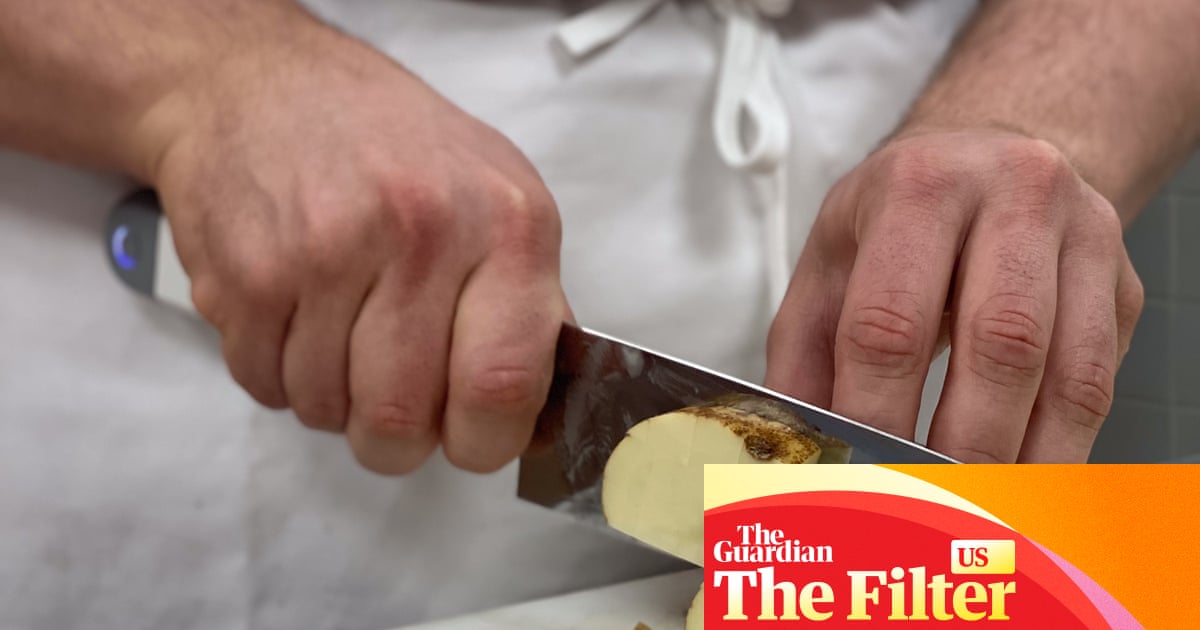
Knife technology evolves at glacial speed. If an 18th-century chef time-traveled to my present-day kitchen, they’d be terrified of the immersion blender, thrilled by the nonstick pans and perplexed by the can opener. But they could pick up any of the knives in my drawer and get to work on a ratatouille.
The Guardian’s journalism is independent. We will earn a commission if you buy something through an affiliate link. Learn more.
As long as they didn’t pick up my ultrasonic knife. The C-200 Ultrasonic Chef’s Knife by Seattle Ultrasonics, first launched this fall, marks a pivotal upgrade to the science of slicing: almost imperceptible vibrations move the blade 30,000 times per second, making it behave “sharper than it physically is”, according to the company.
It may sound “as seen on TV”, but it has a culinary pedigree. It’s the brain child of chef Scott Heimendinger, a self-described “food geek”, former chief innovation officer at Anova Culinary and former technical director at Modernist Cuisine. If anyone can innovate a chef’s knife, it’s Heimendinger.
As a classically trained chef and culinary educator, I spend a lot of time cutting things – and teaching students to do the same. So I asked to try the C-200 to see if it lived up to the hype.
At a glance$399 at Seattle Ultrasonics (preorder)$877 at Tormek $149.95 at Amazon
Read our review here: This versatile Japanese chef’s knife has lasted longer than some of my relationships
How the C-200 Ultrasonic Chef’s Knife works Photograph: Rachel Sherman/The Guardian
Think of how a knife cuts best on a tomato when you slide it through the flesh, rather than squashing it straight down like a guillotine. The C-200 emulates that action at a microscopic scale, not unlike how your electric toothbrush shrinks the motion of scrubbing. The company says this translates to 50% less effort in cutting, and some of the food that might normally stick to the blade vibrates off onto the cutting board.
There’s no motor. A rechargeable battery in the handle powers tiny piezoelectric ceramic crystals, which expand and contract thousands of times a second to create the vibrations. Of course, it can also be used as a regular knife without activating the ultrasonic feature.
How I tested Photograph: Rachel Sherman/The Guardian
Before testing, I followed Heimendinger’s instructions to get a literal feel for the ultrasonic vibration: pinch the face of the blade and rub it, with the power on. “This is an unusual sensation – most people describe it as being similar to an air hockey table,” he told me; it really does. “You are feeling the microscopic movement of the blade metal as it resonates.”
Then I moved on to the kitchen. I entertain a lot at home during the December holidays, and this season did so with two knives on my cutting board: the C-200 and my usual boring analog chef’s knife. The latter is a custom model that a former student made me from salvaged Japanese steel, which I sharpen regularly with a Tormek T-2 knife sharpener.
I made everything from seven fishes (the saltfish accras always win) to zero-waste fried rice of wagyu trim and veggies. Wherever possible, I started with the C-200. If it wasn’t up to the task, I tried other approaches, alternating among three modes: C-200 powered on, C-200 powered off and my usual knife.
What we loveA cut made by the C-200 Ultrasonic Chef’s Knife, left, and one made by an analog knife, right. Photograph: Rachel Sherman/The Guardian
It really works. That may seem obvious, but I wasn’t sure I would notice the difference. You notice the benefits of the ultrasonic capabilities most when cutting things without much resistance: slicing mushrooms, julienning carrots, chopping garlic, chiffonading leafy greens and so on. It’s also great at shaking free of sticky ingredients that tend to latch on to the knife, such as poultry skin and thinly sliced beef.
Heimendinger advised that the “action on the blade is strongest toward the tip and at the choil (heel)”, and I found that to be true for delicate work with the tip, like coring tomatoes, as well as chopping herbs with the heel.
You activate the ultrasonic function with a trigger on the bottom of the handle, which also turns on a light and a space-age humming sound similar to an EV. Cool!
Through all my hours of holiday cooking, I didn’t need to recharge the battery a single time. When it needs it, you can use either a standard USB-C connection, or a wireless charging tile ($149, sold separately) that also acts as a magnetic wall mount.
What we don’t love Photograph: Rachel Sherman/The Guardian
I have large hands, so I found keeping the trigger on the underside of the handle depressed was uncomfortable over long periods of knife work. The battery is also challenging to remove for charging, especially without perfectly dry hands (a rarity while cooking and cleaning).
While the knife slices and dices smoothly, I had to switch to something heavier-duty for work such as halving a butternut squash or large carrots. Heimendinger anticipated this limitation: “It’s important to note that it’s not a lightsaber; it won’t do all the work for you. However, it provides an assist you may start to miss when you switch back to a regular knife.”
Is it worth it?The C-200 Ultrasonic Chef’s Knife charger/holder. Photograph: Rachel Sherman/The Guardian
While the C-200 isn’t cheap, $400 is not unheard of for a premium “analog” knife. If you are the type of cook who is comfortable spending at that level, the C-200 gets you a lot more than fancy wave patterns in the blade for your money. It’s a fun gift for the home cook who has everything. And I will admit that while I don’t need it, I will miss its good vibes.
Specifications Photograph: Matthew Schaffner/The Guardian
Blade length: 200mm (8in)
Steel: Japanese AUS-10 in three layer (san mai) construction
Hardness: 60HRC
Edge angle: 13° per side (26° inclusive)
Battery: 1100mAh removable lithium-ion battery pack
Charging: USB-C, or with the Wireless Charging Tile
Water resistance: IP65
Operating frequency: 33kHz
Operating power: 10W
Upgrade your cutlery$399 at Seattle Ultrasonics (preorder)$877 at Tormek $149.95 at Amazon
Read our review here: This versatile Japanese chef’s knife has lasted longer than some of my relationships
Jonathan Deutsch, PhD, is a certified research chef, professor of culinary arts and science, and the director of the Drexel Food Lab at Drexel University in Philadelphia
Dining and Cooking