
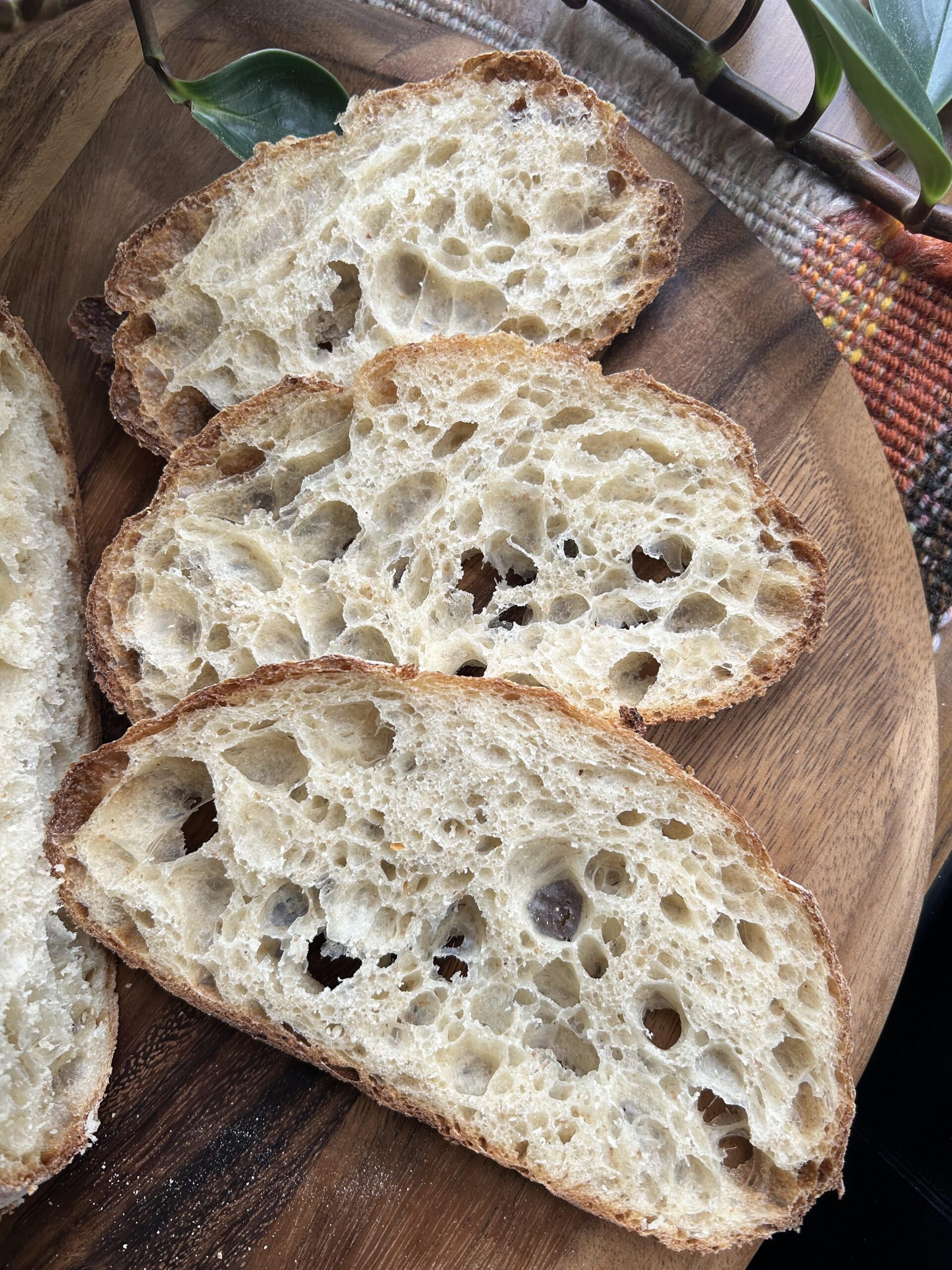
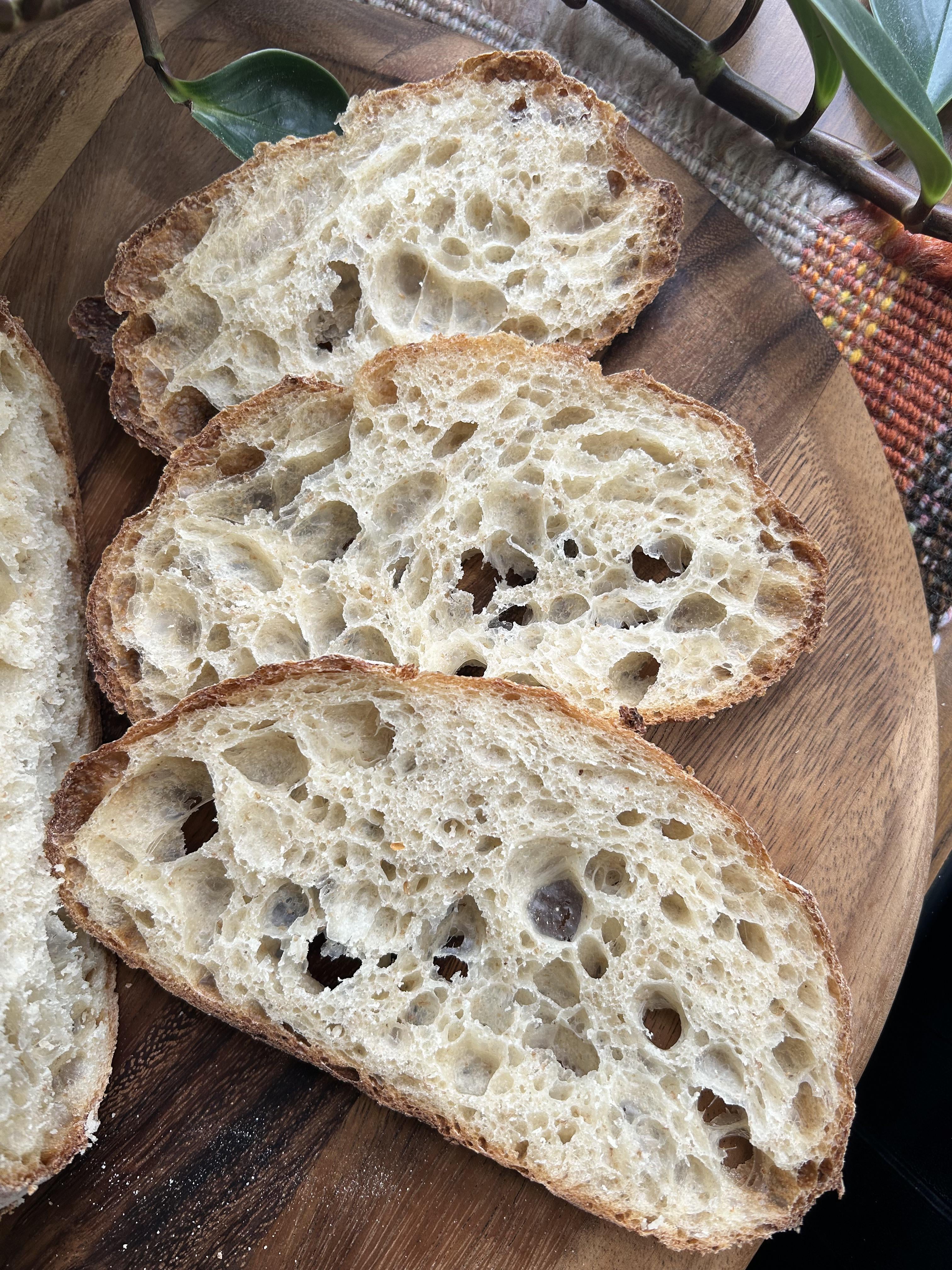
I was really happy with this bake.
My method:
500g all purpose flour
375g water
100g active starter
10g salt
Method:
10 to 12 hours before you plan to start mixing, take your starter out of the fridge, save 10 grams and discard the rest. Feed the 10 grams of starter with 50g water and 50g flour mixture .
Keep it in a warm place overnight. I keep mine in my oven (not turned on), with the oven light on, and the oven door cracked open slightly so it doesn't get too hot. I use a wooden spoon wedged in between the oven and the door so the oven door doesn't completely close.
Weigh 300 grams of warm water (85-90F) into a mixing bowl and add 100 grams of starter. Use a whisk to disperse all the starter into the water. Add the flour and salt. Mix together with a wooden spoon until all the flour is incorporated and there are no more dry ingredients. Use a plastic bench/dough scraper to get all the dough off the sides of the bowl and off your spoon. This will be the first rise, also called bulk fermentation. Total time of the bulk fermentation will be 3 hours.
During the 3 hour bulk fermentation, coil fold the dough every 30 minutes for the first 2 hours. To do a fold, wet your hands, and grab the dough with both hands on the sides. Lift the dough, and place back down, folding half the dough underneath. Turn the mixing bowl until you have done 3 or 4 of these lifts and folds, so the entire round piece of dough gets smoother and more elastic.
After the 3 hour bulk fermentation, lightly dust your work surface with flour. Dust some flour on the top and sides of the dough in the mixing bowl. Use your dough scraper to scrape the dough away from the sides and loosen up the dough in the bowl. Gently lift the dough out of the mixing bowl and onto your floured work surface. Lightly dust the surface with flour, cover with plastic and let this rest for 20 minutes.
Gently flip the dough over so the smooth side is now facing down, and shape the dough into a boule. View online tutorial here
Flour the inside of your banneton generously. Cover your entire shaped loaf generously with flour, and place the loaf seam side up in the banneton. Let this rise in a warm place (80F) for 1.5 hours. When there is 30 minutes left on the rise, place your dutch oven with lid on in your oven in the middle rack position. Turn your oven on to 450F.
Lightly flour a dish plate. After your oven has preheated for 30 minutes, flip your loaf very gently out of the banneton onto your floured dish plate. The seam should now be facing down. Using oven mitts, carefully remove the Dutch oven and take off the lid. (Make sure you close your oven door so the heat does not escape). Be extremely cautious as the Dutch oven is very very hot. Now, without oven mitts, very gently lift your loaf off of the plate and place it gently into the Dutch oven, seam side down. Be careful not to touch the sides of the pot. Score the top of the bread with a lame. Using oven mitts, put the lid back on and place it back in the oven. Bake for 20 minutes.
*Note: The step above can be done by flipping the dough out onto a silicone baking sling that is designed for use with a dutch oven. Use the handles on the sling to lift and lower the dough into the dutch oven. The loaf can be scored before lifting it into the dutch oven.
After 20 minutes, remove the lid and bake for another 15-30 minutes. Bake until the crust is a deep golden brown and the bottom feels and sounds hollow when you tap on it. The internal temperature of the fully baked loaf should be around 200-205F. Remove the bread from the Dutch oven and put on a wire rack to cool. Wait at least an hour before cutting.
by PrairieBreadLab
5 Comments
Looks divine!
Very good explanation! And such a beautiful crumb! Thank you 🤩
So good! Same day bake?
The wooden spoon in the oven door is genius
Edit: how do you feel about declaring 3 hours the correct amount of time to bulk though? This would vary by folks starter, kitchen temp, etc, no?
!CORRECTION!
Weigh 375 grams of warm water (85-90F) into a mixing bowl and add 100 grams of starter. Use a whisk to disperse all the starter into the water.