
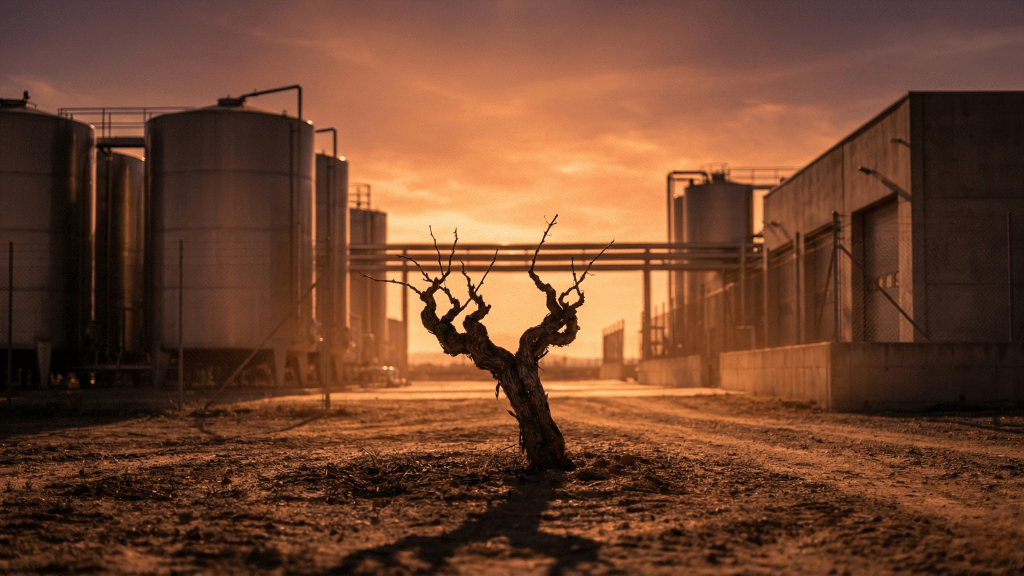
Image courtesy Bottle Shock
A new documentary from Australian wine YouTube channel Bottle Shock, sheds light on the economic reality facing Australia’s Riverland wine region, where growers are paid as little as $100-$200 per tonne for grapes that cost $400 to produce.
The documentary follows Bottle Shock founder Brendan Carter’s investigation into why the Riverland—once known as the “engine room” of Australian wine—is now facing an existential crisis, with growers selling equipment to survive and ripping out 80-year-old vines because they don’t produce enough volume.
The documentary aims to not just diagnose the problem, but to explore how similar challenges have been overcome elsewhere. Carter travelled to South Africa’s Swartland region to document how a comparable wine region transformed itself from bulk wine obscurity to global cult status in just 15 years.
The crisis by numbers:
Riverland growers are losing $60,000 per year, or more.
Break-even cost: $400/tonne; current prices: $100-$200/tonne
Water costs have tripled in 25 years
Ancient bush vines planted in the 1920s are being destroyed
Growers are trapped selling to a single corporate buyer with no incentive to raise prices
The Swartland solution: In the 1990s, South Africa’s Swartland faced identical challenges—hot, dry, dominated by a bulk wine cooperative paying rock-bottom prices. Then a small group of winemakers, including Eben Sadie, Adi Badenhorst, Callie Louw, and Chris & Andrea Mullineux, took a different path:
Built premium brands around old vines and dryland farming
Created collective certification (Swartland Independent Producers)
Transformed bulk wine into $165 cult classics
Attracted global critical acclaim and investment
Completed the transformation in 15 years
“The Swartland proved that a bulk wine region can reinvent itself,” said Carter. “But it required pioneers willing to risk everything, institutions that created collective power, and a market hungry for their story. The Riverland has the raw materials—those incredible old vines. The question is whether there’s the will to use them differently.”
The documentary features interviews with Riverland growers, industry leaders, Swartland winemakers, and academics who studied the transformation, including PhD researcher Jonathan Steyn who documented how the Swartland producers created a market from scratch.
As Carter puts it, the Riverland faces a fundamental choice: continue managing decline by diversifying away from wine, or build demand by telling a better story and protecting genetic heritage.
“Every grower who plants olives instead of vines, every old vineyard ripped out—that’s genetic heritage gone forever,” Carter said. “In the Swartland, 80-year-old bush vines command premium prices and certification marks. In the Riverland, they’re being destroyed. It’s the same vines, different stories, different futures.”
Are you a Daily Wine News subscriber? If not, click here to join our mailing list. It’s free!
Dining and Cooking