
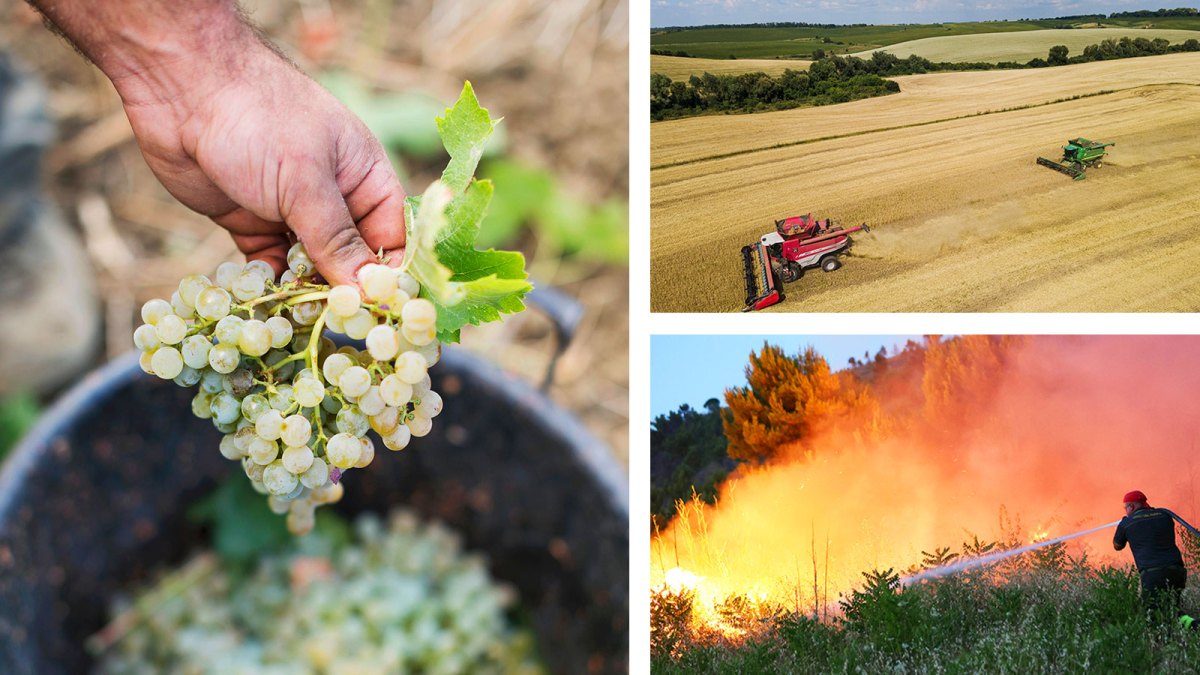
Italy’s heatwave has contributed to a dramatic slide in the production of grain this year, as well as the wine and olive oil that make up the traditional Mediterranean diet.
Coldiretti, Italy’s largest farmers’ lobby group, reported that grain production was down 10 per cent because of adverse weather conditions, driving up the price of staples such as flour and pasta that had already climbed thanks to the war in Ukraine.
Ignazio Gibiino, the vice-president of Coldiretti in Sicily, a key farming base, said the average Italian family had spent €30 to €40 more on pasta so far this year as wheat producers were “discouraged” by bad weather. “Italians are already consuming less grain-based products. The cost could become a real problem if producers start shutting down,” he added.
The island of Sicily, whose fertile soils and advantageous climate made it the breadbasket of the Roman republic, is now too hot for the optimal production of wheat, oil and vines, analysts say. Those products remain pillars of the local economy, but with temperatures rising above 40C across much of the island in recent days, after abnormal bouts of torrential rain in May and June, crops on the island and in the rest of Italy have been battered.
Coldiretti said that harvests of durum wheat, used in pasta, could fall by more than 3.7 million tonnes this year. Production of soft wheat, used for bread and biscuits, could fall by 2.7 million tonnes, with floods in Emilia-Romagna in May leading to a 12 to 15 per cent drop there.
The climate impact on the cultivation of wine and olive oil has also put Italy’s traditional Mediterranean diet — celebrated for its health benefits as well as its emphasis on fresh produce — at risk.
Milk production is down 10 per cent, because dehydrated cattle are stressed by the heat. Cherry harvests and honey production are down by 60 and 70 per cent respectively.
• Heatwave fans flames across Sicily, as temperature hits 40C for fourth day in Palermo
“Data shows children are increasingly ditching good quality home-grown foods, especially in Italy’s south,” Alberto Grandi, a food historian, said. “They are eating more sweets, cheap snacks and industrial foods.”
According to a study in May, only 13 per cent of Italians still follow the typical Mediterranean diet with plenty of fresh fruit, vegetables and fish, in part because of the costs. “The Mediterranean diet is more expensive than going to McDonald’s,” Grandi said.
Sicily’s wine producers, famed for their full-bodied native reds such as Nero d’Avola, have reported falls in production. Antonio Rallo, head of the consortium for the protection of Sicilian DOC wines, said that native grapes were coping with the heat and rain, but international varieties had withered.
Luca Mercalli, a climatologist who has studied the impact of climate change on wine production, said that rising temperatures meant southern wine producers would soon have to shift to more temperate environments such as the Langhe, in the cooler region of Piedmont.

Vineyards such as this one at Tasca d’Almerita, on the lower slopes of Etna, may become scarce as extreme heat pushes grape cultivation further north
MICHELE BELLA/UNIVERSAL IMAGES/GETTY IMAGES
“The fact that it’s hotter means cultivation will be pushed further north,” said Mercalli. “We may be producing Sicilian wines in the Langhe, and in Sicily we’ll grow dates, because [we] will no longer be able to produce wine there.”
Mercalli said producers might shift to higher altitudes. “You’ll be seeing vineyards on Etna or other mountainous areas,” he said. “You will no longer be picking up bottles of chianti or your Spumante d’Asti. New types of grape will be selected especially to resist new climatic conditions.”
Olive oil producers have been hit hard, with output in Sicily expected to fall by as much as 50 per cent this year, according to Mario Terrasi, president of the Oleum Sicilia consortium. “The crazy weather has damaged olive groves,” he added. “They are not great at resisting the heat.”
The scarcity is already pushing up prices, with bottlers buying Sicilian olive oil for €9 a kilogram compared with €6 a couple of months ago, he said.
Prices are also higher for oil imported from Spain and produced in Italy’s southern Puglia region, where groves have been ravaged by Xylella disease. As a result, Italy’s oil consumption has recently fallen by 10 per cent, Terrasi said.

Olive oil production in Sicily is expected to fall by half this year, as olive groves are not good at resisting heat
ALAMY
However, as traditional crops wither, plants that are usually cultivated south of the equator, including coffee and tropical fruits, are now prospering on the island. In September 2021, a month after a European record-breaking temperature of 48.8C was recorded in Sicily, the Morettino roastery in Palermo cultivated 30kg (66lb) of coffee from 66 seedlings.
Coffee is usually imported from Africa, Asia and the Americas. Morettino’s breakthrough raised prospects that the Sicilian capital could become home to the world’s most northerly coffee plantation.
Consistently higher temperatures on the island allowed for an “acceleration” in coffee production, with plants flowering in May rather than the summer, said Andrea Morettino, who runs the roastery with his father. The company expects to double its harvest this year, from 50kg (110lb) in 2022 to 100kg. He said that it was definitely because of climate change. “We have had highs of over 40C, and we are trying to respond to the way in which mother nature is helping us.”
Some plantations are now specialising in tropical fruits. Andrea Passanisi, the founder of Sicilia Avocado in the town of Catania, said he had already harvested this year’s avocados, and that mangoes and papaya were bearing up in the blistering heat. Even so, he said that the heatwave was causing alarm, given that tropical fruit plants thrive best in temperatures in the low 30s.
• Heatwave turns Britain into a fruit hothouse
The extreme shifts in recent weather are also a big concern, Passanisi said. “One day you have thermal stress that causes all of your fruit to fall, the next you have a spring that feels like autumn,” he said. “What’s the biggest threat to Sicilian farmers at the moment? Unpredictable weather.”
Dining and Cooking