
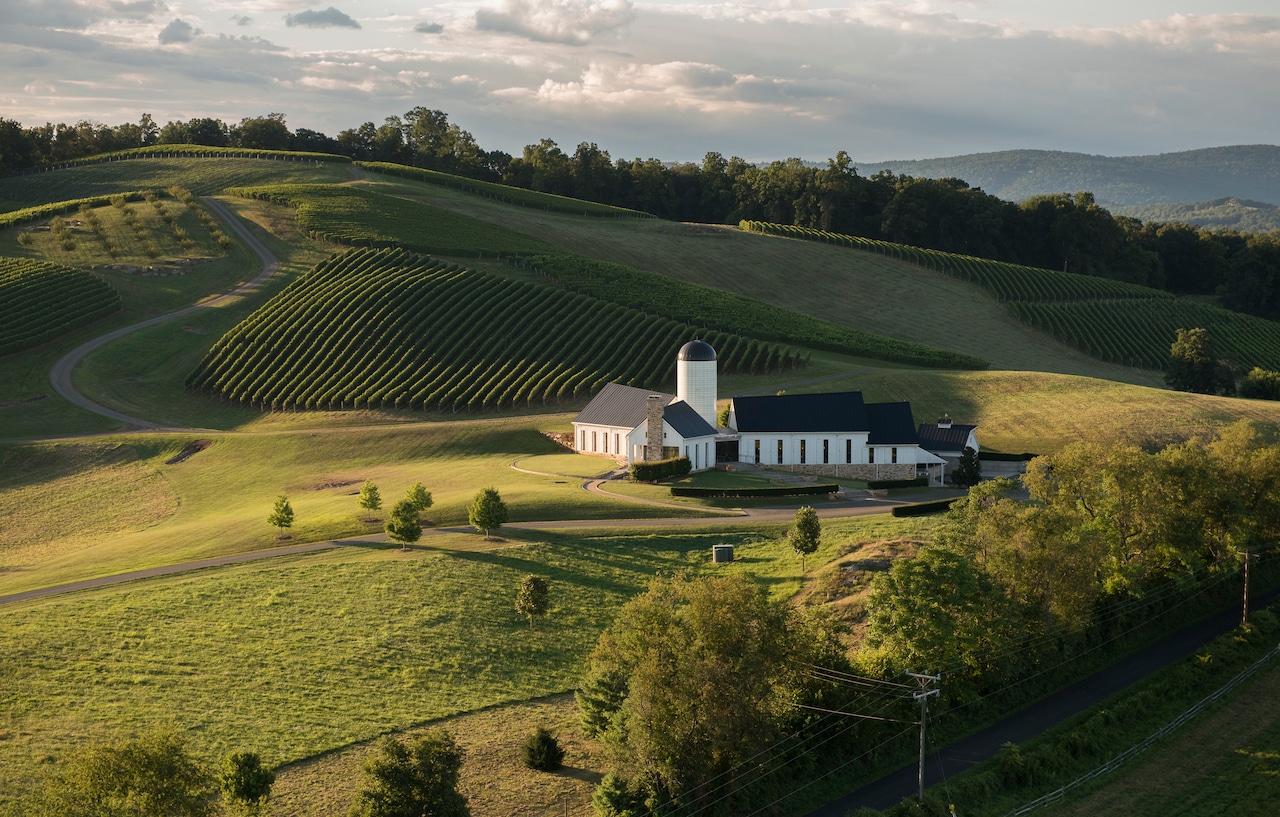
Around a year and a half has passed since the news broke that the owners of Château Montrose in Bordeaux were buying RdV Vineyards in Delaplane, Virginia.
It was the Bouygues family’s first winery purchase outside France, but what made it more newsworthy was the location of this addition to its esteemed portfolio — in Virginia and not California, where several Bordeaux estate owners had previously bought properties. It also became the first major foreign wine investment in Virginia since Italy’s Zonin family established Barboursville Vineyards in 1976.
Among the changes at RdV Vineyards, named after its founder, Rutger de Vink, when it was established in 2006, was a new name: Lost Mountain Vineyards.
While de Vink remained through the 2024 harvest as a consultant, the rest of the RdV team stayed, including esteemed winemaker Joshua Grainer.
Per the release at the time of the announcement in mid-June 2024, Lost Mountain would be under the direction of Grainer and Pierre Graffeuille, CEO of Château Montrose.
So how much is different at the site of the unique producer, which welcomes guests on Thursday through Sunday, by reservation only, and offers a tour and tasting experience that begins with either a private or small group tour of the winery and followed by a seated flight tasting of the two wines it makes — Lost Mountain and Rendezvous — paired with a seasonal food board?
At least on the surface, little has changed, Grainer said.
“That is a tribute to Eutopia Estates, the parent company, of where we fall into the portfolio,” he continued. “They have four other wineries in France. And if you were to visit them, you wouldn’t see a common thread beyond quality amongst any of them, in the sense that, four different expressions, four different wine styles, four very different personalities. And that’s what excites the Bouygues family, the folks who ultimately purchased the vineyard, about wine, is that it can be so unique and singularly expressive. That’s what they liked about Lost Mountain, and that’s what they wanted to preserve. So they’ve been very conscientious about making sure that each of their properties maintains its own unique identity that makes it special.
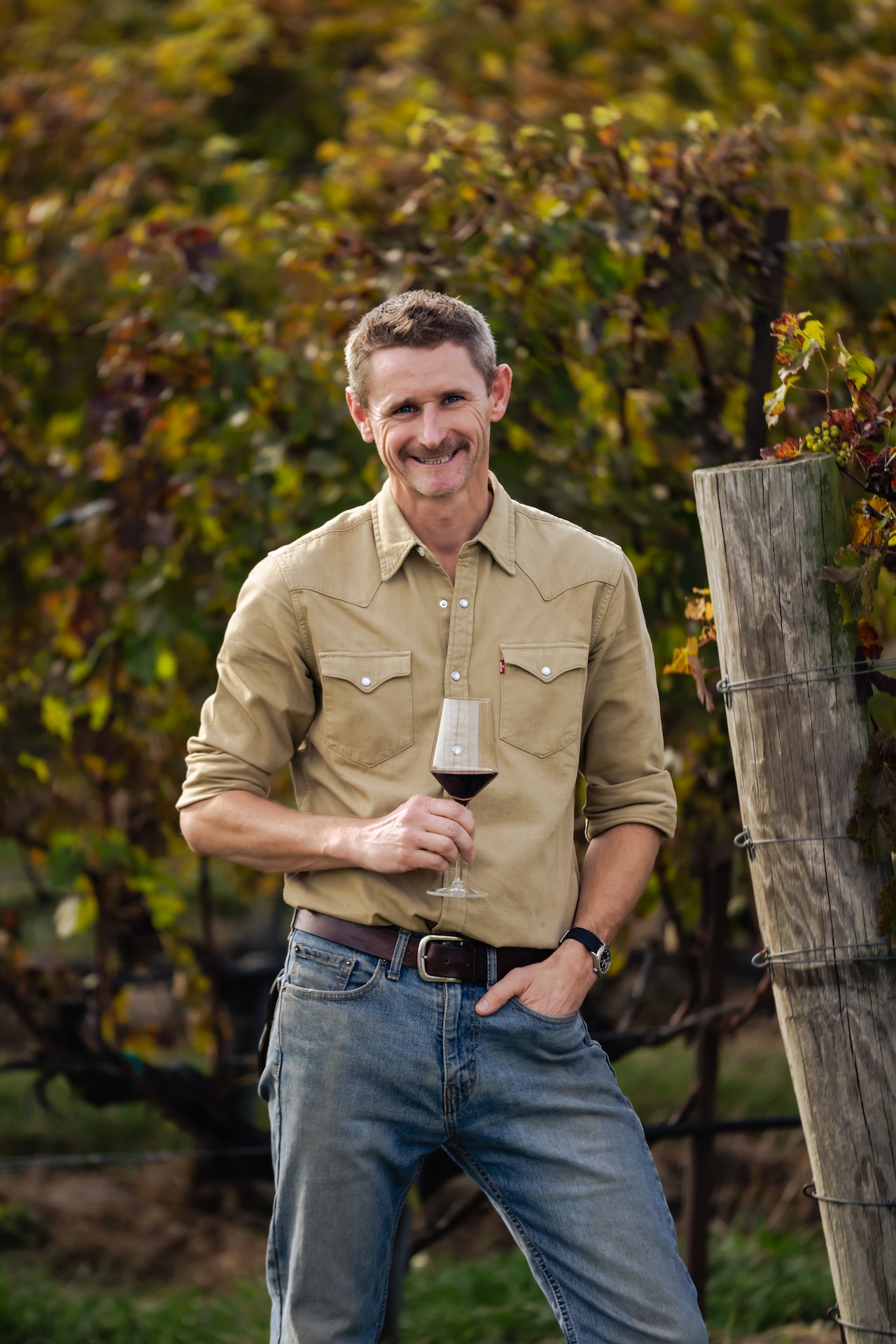 Joshua Grainer says that he’s very pleased to be part of the Eutopia Estates wine family. ‘[They] are all very good at what they do.’Lost Mountain Vineyards
“On the other hand, though, I will say, you’ll hear no complaints from me about being a part of this family of wineries … [they] are all very good at what they do. And so we get together, we exchange ideas a lot. Montrose has multiple acres just dedicated to research and development with technologies, and rootstocks, and clones, and so we have access to all that information now that we can start to institute here on the vineyard. In terms of the business aspect, we wanted to maintain the continuity for our membership, just because they’ve been so loyal to us, they like what we do, and so we wanted to maintain that.“
But, as quickly as he described what’s the same, he acknowledged there are changes ahead.
“The wine in the future will start to travel a bit more,” he continued. “Most of our wines have been sitting in the mid-Atlantic since its inception because that’s where the strongest potential for our customer base is. But the goal for Lost Mountain now is to be nationally and internationally known. So we’re going to go more into distribution, and we’re starting to execute on that now and build out a little bit more of a broader knowledge base.”
What also hasn’t changed for Grainer is the schedule. They are back in the cellar starting their blending trials, which usually take a couple of months to land on the most appealing percentages. Meanwhile, they’ve already begun to prune the vines, a process that removes old, unproductive wood to encourage vigorous new growth.
He said that while he oversees the winemaking, 90% of the production work is done in the vineyard, which is also under his management. It’s a cliché, he said, “but it’s one I fully believe in. So most of my time is actually spent outside, in terms of how we make the wines and craft the wines. It’s all coming back to the farming aspect of it. And then once we get to the cellar, it’s me just trying not to mess it up. You know, it’s kind of like when we get that perfectly-vined tomato or orchard-ripened peach, right? You just try to capture it as it is, versus do too much stuff to it. And so that’s my goal with how we farm and produce wines.
“So yes, to answer your question, I definitely believe winemaking is enhanced by the vineyard connection, and so knowing very intimately each corner of the parcels and what’s performing best and all that, it all cascades into how we make wine.”
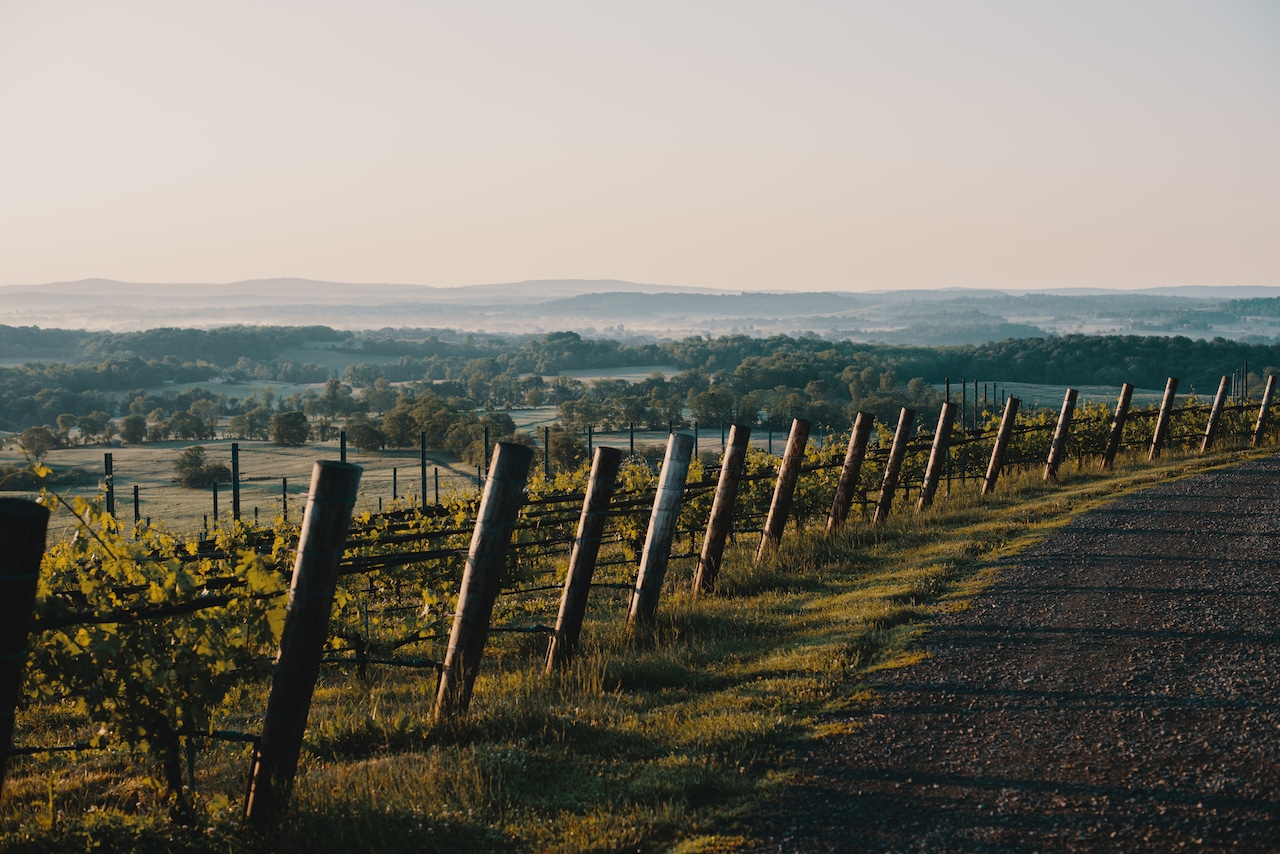 Lost Mountain Vineyards is about equidistant from Washington D.C. gto the east and Strasburg, Virginia, and Route 81 to the west.Ultra Studio
The vineyard started with around 16 acres, and by spring will be up to around 20, Grainer said, featuring the four Bordeaux grapes — Cabernet Sauvignon, Cabernet Franc, Merlot and Petit Verdot — that de Vink and vineyard manager Gabriel Flores planted more than two decades ago. The couple of extension parcels that are planned will include more Cabernet Franc and Merlot, “which is about all we can be at this point.”
With one exception, he noted.
There is this 1-acre experimental parcel of white grapes he has planted, featuring Semillon, Petit Manseng and Albariño, with perhaps some others to be planted in the near future.
“We’ll still always be a red wine house,” he said, “but I do love white wine as well, and having a very small production parcel of it would be a fun little side project. At this point, it’s all still experimental and to be determined, but, yeah, it’s something that’s exciting. But in terms of reds, I think we’re going to stay exactly where we are. Our hillside is really a hillside for Cabernet Franc and Cabernet Sauvignon, frankly.”
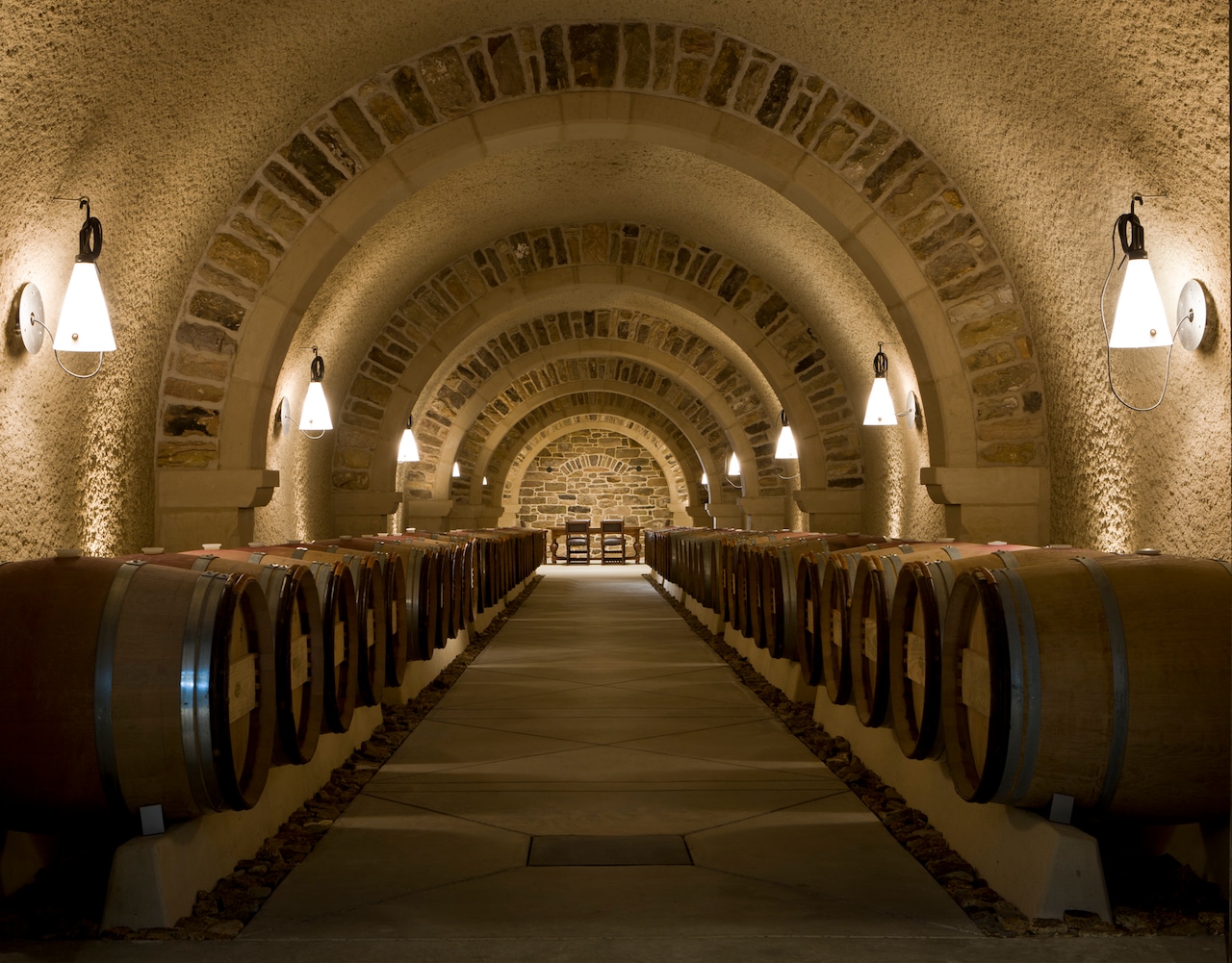 Barrels of wine line the cellar at Lost Mountain Vineyards, formerly RdV Vineyards, which released its inaugural vintage in 2008.©2011 Gordon Beall
Lost Mountain Vineyards is located in the foothills of the Blue Ridge Mountains, on a steep, granite-rich hillside, about 45 minutes west of Washington D.C. The area was historically considered “lost” on early maps until George Washington, working as a surveyor according to legend, identified these specific hills and optimistically named them the “lost mountains.”
The winery offers two wine clubs: Envoy (four-bottle membership) and Ambassador (12-bottle membership). Members are able to visit, by reservation, and order from an a la carte menu as opposed to the more formal tour and tasting experience mentioned earlier.
Here’s a link to the tasting notes for every vintage, going back to the debut in 2008.
Asked about the challenge of keeping the bar raised, Grainer responded that “we’re always trying to do a little bit better every year, get that few percentage points better. And, you know, that was the initial focus, and it’s still the focus here. … We wanted to focus on doing one thing well. We didn’t want distractions of trying to be a jack-of-all-trades kind of aspect … and that has a lot to do with this simple marketing and proximity to the market. We said that we’re going to dedicate ourselves to Bordeaux reds. Rutger, the founder of the place, sought out this hillside, discovered it, and it met all the criteria for it being able to achieve full ripeness on those reds. We are a red wine hillside. It’s a warm, rocky hillside. It’s suited well to reds, and so it was all about pursuing quality at the end of the day.”
Per Grainer’s bio, he discovered his love of wine in his early 20s while traveling through Italy, and developed his craft in the U.S., France, and Australia before joining RdV. He earned his Master of Wine (MW) designation in February 2023, making him the 58th American and first Virginian to join this group.
As Grainer spent the past couple of decades working to continually improve quality at RdV, he said that he has seen a similar trend not just in Virginia but throughout the mid-Atlantic.
“When I first started in the industry, you would go to winery tastings and different tasting rooms throughout the state, and some were better than others,” he said. “You had your name players, like Linden — I’m giving Virginia examples — Barboursville, up in Maryland you had Black Ankle, and they were making good wines. Even great wines, at times. But a lot of the other wineries, and, you know, I’m not calling everyone else out, but a lot of other wineries, you go in and kind of get some Mom and Pop wines and some, frankly, just flawed wines. That doesn’t happen with any regularity, in my opinion, anymore, in Virginia. Everyone’s making good, serviceable wines. You’re seeing a lot more really great wines from some producers. You’re seeing consistency across vintages now. And so people have fine-tuned where good vineyard sites are. They have fine-tuned their skill sets in the winemaking and so forth and so on.
“I still think we have a great amount to do in discovering the terroir of the mid-Atlantic, the East Coast even. And so there’s a lot of untapped potential out there. It’s still very much in a pioneering state, but we’ve moved from hobbyist to professional. I would say that the industry has matured.”
 Joshua Grainer earned the Master of Wine designation in February 2023, becoming the 58th American and first Virginian to earn the coveted designation.Marco Javier
With the maturation has come higher prices, and a market willing to pay them.
In addressing those changes, Grainer made the comparison between the Virginia wine industry and that of Oregon’s Willamette Valley, which both got rolling in the late 1970s and early ‘80s.
“The main difference was that Oregon didn’t really have a market that could consume their wines just in the backyard,” he said. “Like Portland wasn’t going to drink all of Willamette Valley, right? And so they quickly had to identify who they were, i.e. Pinot Noir. They had to bring the quality level up to compare with California or French wines, and then they had to get their wines to travel, because they had to sell them all. Virginia, on the other hand, has always benefited, and it’s been a little bit of a curse in a way, but largely a benefit, from the D.C. metro area that was willing to drive the hour, hour and a half, to support the local winery. And that kind of goes back to your first question, in that people were making all kinds of styles of wines, sweet to dry, sparkling to still, red, white, everything in between, to try to capture whoever walked in the door, and that kind of retarded our growth in a way.
“We didn’t have to get the wine to travel, we didn’t have to identify ourselves under one certain or several different styles,” he added. “We were kind of doing the Baskin-Robbins 32-flavors thing. That’s beautiful from a business aspect, because all that direct-to-consumer revenue has supported the industry. It’s also driven prices up. But the downside of it is we just haven’t gotten to that next evolution that the Willamette Valley has gotten to because of how easy it is to sell wine.”
Dining and Cooking