
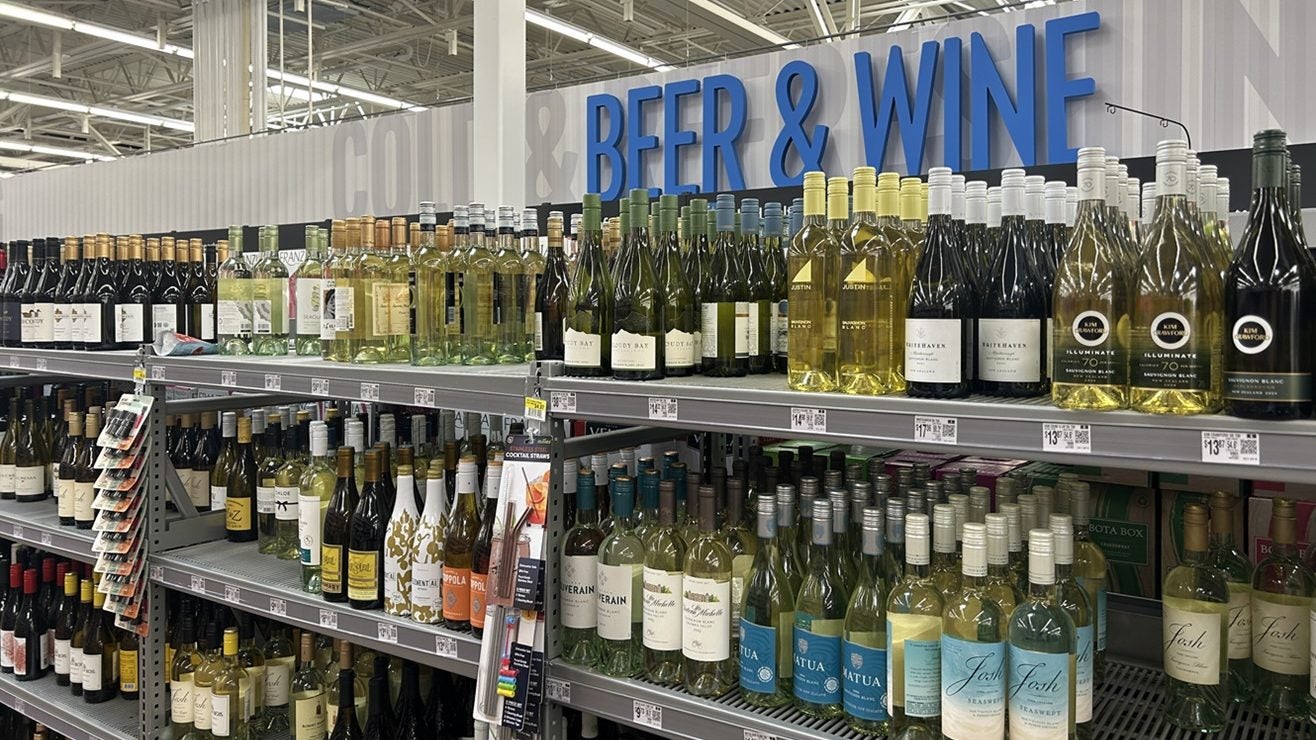

White wines on display at Wal-Mart, Denver, North Carolina. Credit: Lindsey Nicholson/UCG/Universal Images Group via Getty Images
Wine sales declined again in the US last year and are expected to do so once more in 2026 – but at a slower rate, an annual study of the sector has forecast.
Volumes are estimated to have stood at around 329 million cases in 2025, down 2.1% on 2024, according to a yearly report from Silicon Valley Bank.
 Discover B2B Marketing That Performs
Combine business intelligence and editorial excellence to reach engaged professionals across 36 leading media platforms.
Find out more
Around $74.3bn of wine was sold in the US last year, a decline of 1.6% on the previous 12 months.
In the report, Silicon Valley Bank said the value of sales “flattened in a discounting environment, held up by the premium segment but even that has begun to soften”.
Sales of wines sold under $12 “deteriorated more rapidly, pushing production level volumes to their lowest in more than a decade”, the report added.
The bank forecasts the US wine market will see declining volumes this year alongside what it called “value compression and persistent oversupply”.
However, it added: “The rate of deterioration will begin slowing in 2026. What emerges from the data is a picture of a market still challenged but one with stabilisation on the horizon.
“With no immediate increase in demand in sight, right-sizing industry production capacity becomes a reality.
“2026 will mark the point in this correction where some growers and wine companies that have struggled for the past five years will publicly capitulate and exit.”
The bank’s researchers predict “demand softness” will continue in 2026 across price brackets but “particularly below $12”.
However, the report forecasts there will be “value pressure” at higher price-points.
“While the premium tier will continue to outperform the lower-priced segment, it is not insulated from broader consumer change,” the report read.
“Inflationary fatigue, shifting discretionary priorities and a slowdown in affluent consumer spending have tempered pricing power.
“Premium demand remains viable, but it now requires more persuasive value communication and/or hospitality-led differentiation rather than relying solely on price increases.”
The State of the US Wine Industry report described the oversupply of grapes in the sector as a “structural headwind”. It added: “Improvement has to start in retail sales before we can expect to see bloated wholesale inventories improve. While we expect progress on both , the supply chain won’t be fully in balance at the end of 2026.”
The report does provide some optimism beyond 2026. It forecasts consumer spending on wine in the US will “flatten through 2027 to 2028 after which we expect a shift back to modest growth”.
It added: “Think of it as a return to normal – not the boom years of the mid-1990s, but a healthier trajectory grounded in slow population growth, light inflation and lower per-capita consumption.
“We think that the steepest part of the downturn is behind us, but we aren’t out of the woods. 2026 and 2027 will still be challenging, however, the demographic drag will lessen as the large 30- to 45-year-old cohort moves into more wine-friendly life stages and the impact of the older consumer sunsets.”

Sign up for our daily news round-up!
Give your business an edge with our leading industry insights.
Dining and Cooking