
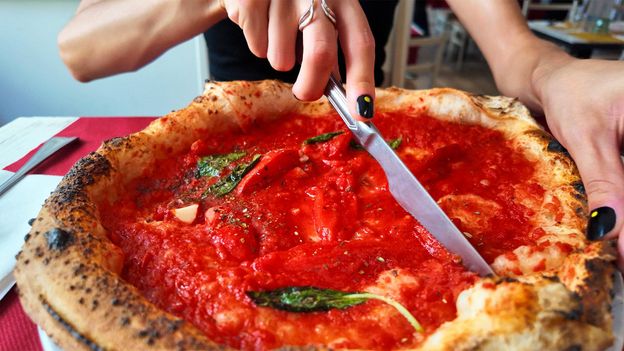
Grandi’s book explains that when industry-driven growth started to lose steam in the 1970s, Italy’s economy pivoted to small companies, niche products and local excellence. Thousands of protected labels and regional products emerged and Italians doubled down on gastro-nationalism.
“Cuisine is no longer part of our identity,” says Grandi, “it is our identity.” He argues that after decades of industry decline and economic stagnation, Italians have no faith in the future – that’s why they “invent the past”.
In less than a century, Grandi says, Italians went from being malnourished migrants to self-appointed custodians of ancestral traditions. The obsession for tradition has sparked searches for “true” recipes and “correct” ways of consuming food. Italians are ever more adamant to say that bolognese should be called ragù alla bolognese and never served with spaghetti. You should also never put chicken (let alone pineapple) on pizza, cook pasta alla carbonara with cream or break spaghetti in two.
“I always say that every time anyone in the world adds cream to carbonara, somebody in Rome dies,” says Grandi. “Italians used to get upset when they were defined as ‘pizza, pasta, mandolin, mafia’,” he adds. “Now it looks like it’s us Italians feeding those stereotypes.”
An Italian reaction to food ‘blasphemy’
Social media seems to have contributed to popularising these attitudes. The X account Italians mad at food, launched in 2015, showcases comments of furious Italians who are outraged and offended by how people in other nations choose to eat “their” cuisine. The account even sells t-shirts with quotes like “carbonara is not an opinion” and “you break spaghetti, you break my heart”.
Dining and Cooking