
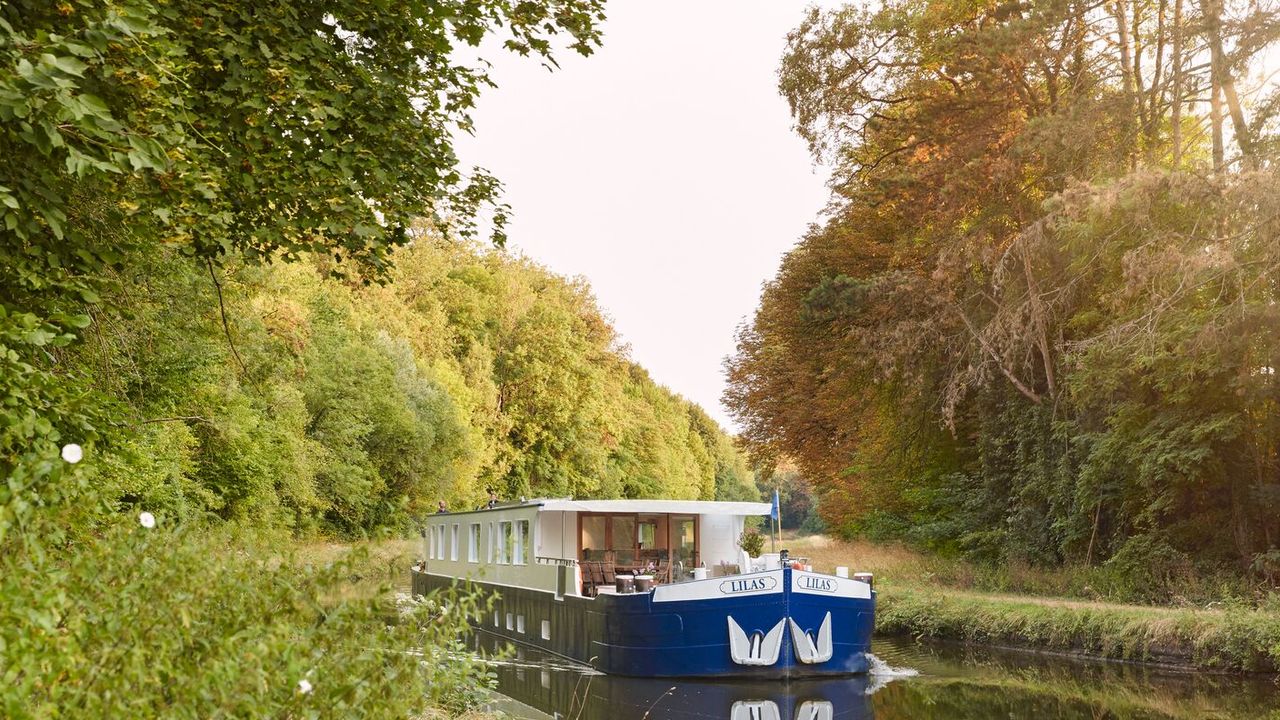
Chef Dominique Crenn—the legendary first female chef to attain three Michelin stars in the U.S. and chef to Monsieur Dior—is waving with gusto from the deck of Lilas, each flourish seeming to propel the barge across the sun-dappled River Saône. On shore, admirers have gathered: a quintet of creamy-colored Charolais cows, lowing as we pass.
“Bonjour, bonjour!” Chef Crenn cries. “Désolé, I have lunch to serve!” She turns her attention back to us and the menu du jour—one she has specially created as the first culinary curator for Belmond’s Les Bateaux, a fleet of seven French river barges, which includes our good ship Lilas, traversing the river and canal networks of Burgundy, Champagne, and the South of France.
As we cruise along on our sleek péniche-hôtel, a journey through Chef Crenn’s childhood summers spent in Brittany and the seasonal delights of the surrounding region unfurls: a sprightly spring pea tart topped with trout roe, asparagus picked from the river banks that morning and dressed with caviar and saffron, a tumble of the French-style pasta Raviole du Dauphiné with Bouillabaise and thick braids of mussels and crab meat, and an elegant lemon and olive oil cake dusted with tarragon and pistachio. A zippy Chablis of the local family-run Domaine des Malandes keeps us buoyant. Lilas glides languorously toward Mâcon, and Chef Crenn suns herself on the polished teak steps of the on-deck pool.
“I hope you fall in love with Burgundy like I have. You have much to discover—if you can force yourself off of the boat!” she says, sprinkling the remainder of the gold leaf from dessert through the air; a second, culinary christening for Lilas and our next five nights calling the barge our home.

Raviole du Dauphiné by Chef Dominique Crenn.
Photo: Courtesy of Les Bateaux Belmond
A tomato salad and fresh baguette from an on-shore boulangerie.
Photo: Courtesy of Les Bateaux Belmond
Before Lilas became part of the LVMH-owned Belmond family, she was Josiane, a 40-meter-long river freighter that carried grain across France from 1952 to 2017. Designer Inge Moore took to restoring her, inspired by biophilic design sensibilities: rooms are accented with the lilac florals the boat takes its name from, with opulent Carrara marble bathrooms. The four bedrooms—one above deck and three below—are surprisingly spacious, and one even has room for a free-standing tin bathtub. The main cabin basks in the pale morning sun and mauve sunsets, all pale rattan furnishings and lime-washed, oak walls. Stacks of periwinkle knit blankets sit out for cooler evenings, with hurricane lamps providing ambience for aperitivo hours. The bookshelf houses well-thumbed copies of The World Atlas of Wine and Richard Olney’s Simple French Food, with maps of the region’s wine and cheese that we’ll sample along the way by the dozens. Outside, Lilas is striped white and blue, like our captain and crew of five’s Breton shirts. An elongated porthole window provides a tableau to gaze out at the passing chateaus and medieval churches over slow breakfasts: warm viennoiserie from local boulangeries we had moored close to, jewel-like apricots and citrus, a soft pepper-dusted goat’s cheese for spreading on warm baguette.

Slow afternoons cruising offers guests ample time to taste the local wines.
Photo: Kate Devine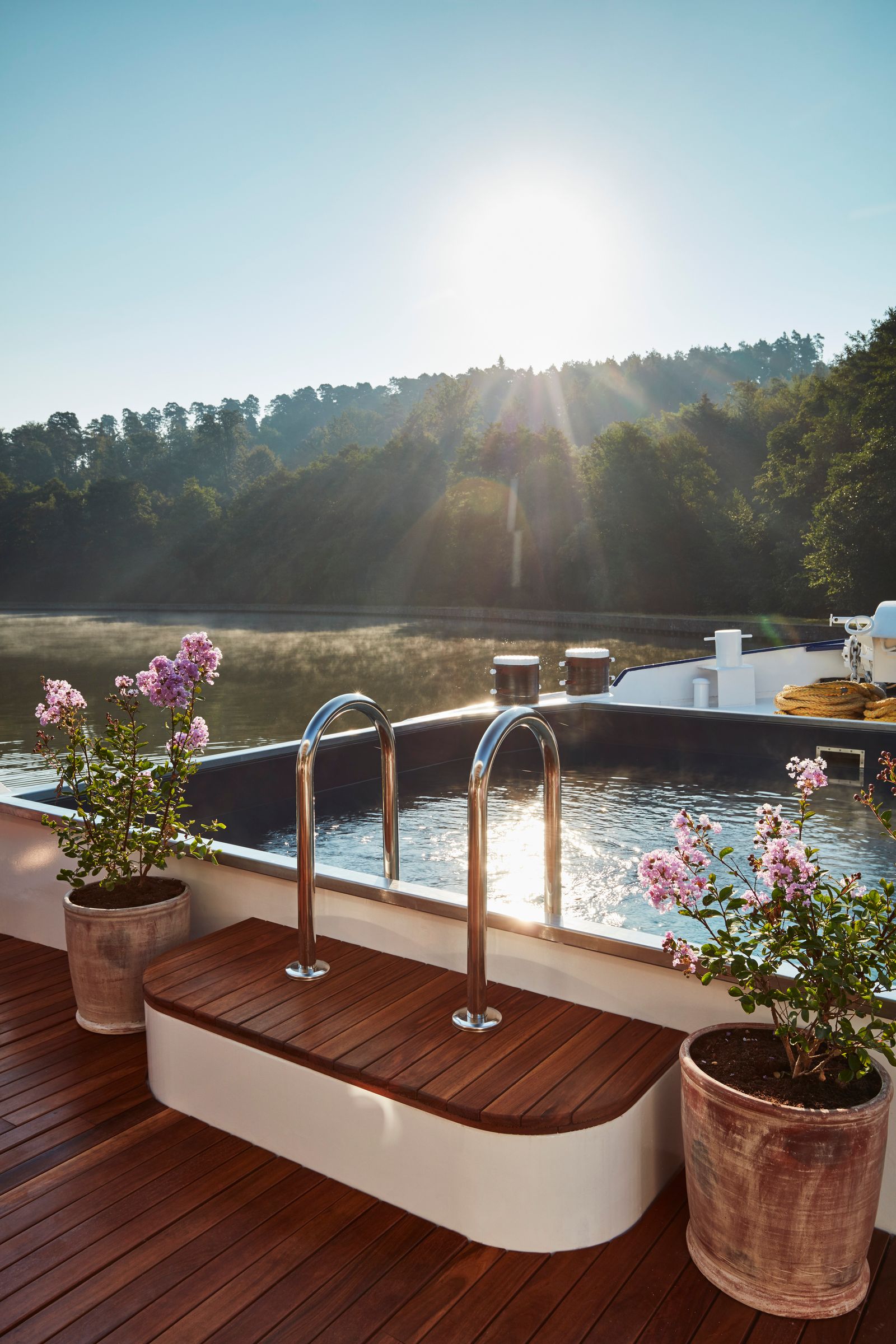
The deck of the Lilas, which features its own plunge pool.
Photo: Richard James Taylor
Our itinerary is just as malleable, from Lyon to Montmerles, Tournus, Chalon-sur-Saône and Beaune, Seurre, Dijon, and St Jean De Losne: regional wines, local cheeses, and our trips to the markets shape the day more than anything. Before we had even set foot on Lilas, our group met in Lyon and toured the famous indoor market Les Halles de Lyon Paul Bocuse (named after the “Pope of French cuisine”)—tasting the nutty, creamy Saint-Marcellin cheese, truffle-studded hams, and brioche sparkling with pink praline. My vocal admiration for the bowls of sumptuous oeufs en meurette and plump quenelles was quietly noted, and appeared later in on-board menus that were presented to us each morning on pretty scalloped-edged cards. But ultimately, this trip is a sensuous, unhurried immersion for wine-lovers in terroir, designed for oenophiles who prefer their grands crus paired with time, elegance, and the soft rhythms of the river.
Dining and Cooking