
Throughout the 1990s and into the early 2000s, under the banner of story, art and folklore, the Roman publishing house Newton Compton published a series of 27 books about regional Italian cooking. Some, such as Jeanne Carola Francesconi’s epic 1965 La Cucina Napoletana, were reprints of established books, while others were specially commissioned for the series. There is considerable variation; some of the 20 regions occupy 650 densely filled pages, sometimes spread over two volumes, while other regions have 236 pages with larger fonts, with everything in between. All of which is great, although I can’t help feeling affectionate towards the regions with 14-point font.
In the face of the vast variation of regional culinary habits, knowledge and rituals, I also feel affectionate towards the common traditions; those that are specific to a place, but at the same time that cross local and national borders, as well as for the stories of the ingredients. Take pasta e fagioli, for which beans are boiled in water with fat, maybe fragrant herbs and vegetables, then pasta is added for a dense dish that probably needs a spoon. Almost all regions (and towns and individuals) have a version that is both extremely general, and specific – white beans, potato, no rosemary in Lazio, say; lardo, sage and plenty of rosemary in Piedmont; nutmeg, bread and pasta in Liguria; lardo, marjoram, tomato and chilli in Abruzzo – inviting a sort of pick and mix. And the embracing of new ideas, too, because cooking is a living, evolving thing.
Cesare Battisti, head chef and owner of Ratanà in Milan, is great on all this, noting that: “It’s true that we need to be custodians of tradition, but we also need to have a little courage to desecrate it a little, and in an intelligent way, but we have to do it.” It is with these words that he suggests a pasta e fagioli that follows a familiar pattern – soaked beans added to a soffritto, followed by water, then pasta – but then also takes inspiration from Thailand and includes coconut cream, spring onion, chilli and optional lemon.
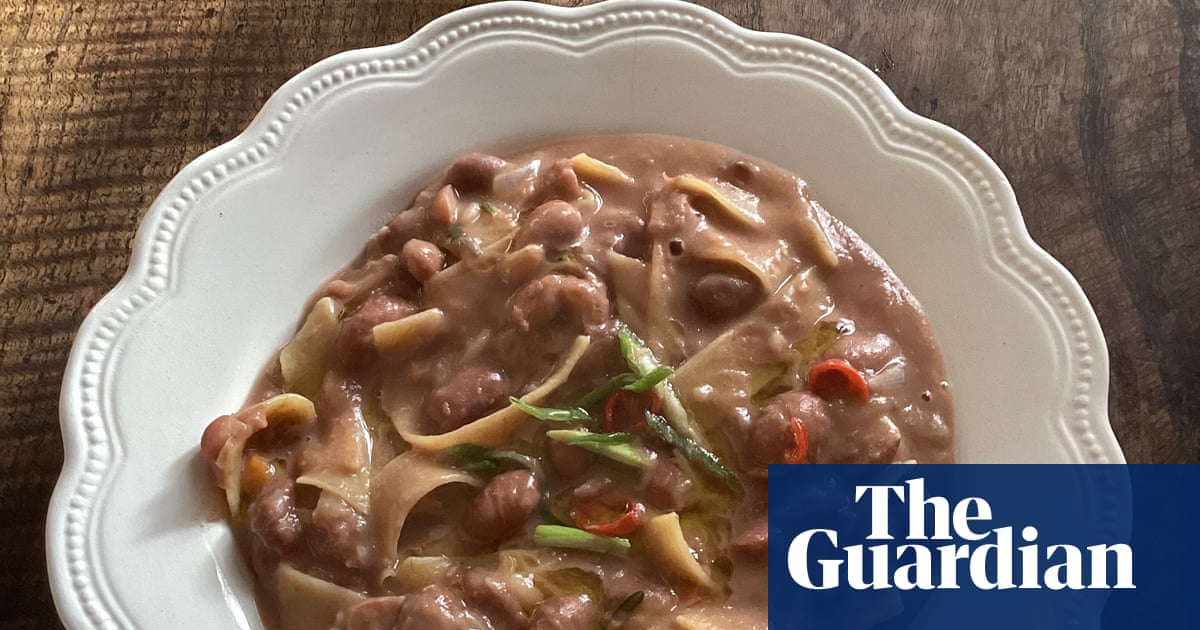
We were delighted by the contents of our steaming bowls, and especially the addition of that coconut cream, which softens the colour to taupe and makes the dish feel luxurious while remaining fresh. I agree with Battisti when he suggests it must be hot with chilli, but, of course, you decide. The same applies to the lemon (“ingrediente inaspettato”, or unexpected ingredient), which turns the dish around like a bright spark.
I will leave the last word to Battisti: “Questi piatti non sono da discutere, sono da provare, dovete provare a rifarli, provate.” Which is to say: these aren’t dishes to discuss, these are dishes to be tried. Although you could also try, then discuss.
Pasta e fagioli with coconut, spring onion, chilli and lemon
Serves 4
200g dried borlotti beans, soaked overnight in plenty of cold water
5 tbsp olive oil
3 spring onions, white bulbs diced, green parts thinly sliced
1 stick celery, diced
1 small carrot, peeled and diced
1 fresh red chilli, sliced
2 sprigs fresh rosemary, 1 picked and minced, the other left whole
2-3 tbsp coconut cream
200g tagliatelle, roughly broken up
Juice of 1 lemon (optional)
Drain and rinse the soaked beans. Put the olive oil, spring onion whites, celery, carrot, half the red chilli, and all the rosemary in a heavy-based pan and cook on a medium-low heat, stirring, until the vegetables start to soften and turn translucent. Add the soaked beans, one and a half litres of fresh water and a pinch of salt, bring to a boil, then turn down the heat and simmer for an hour, or until the beans are soft.
Remove half the soup, blend it smooth, then return to the pan with the coconut cream and salt to taste. Put the pan back on the heat and bring to a lively simmer. Add the broken tagliatelle and simmer, stirring regularly, until the pasta is cooked – you might need to add a bit more water.
Serve, topping each bowl with the sliced spring onion greens and a little extra chopped red chilli, and encouraging those who want to add a squeeze of lemon.
Dining and Cooking