
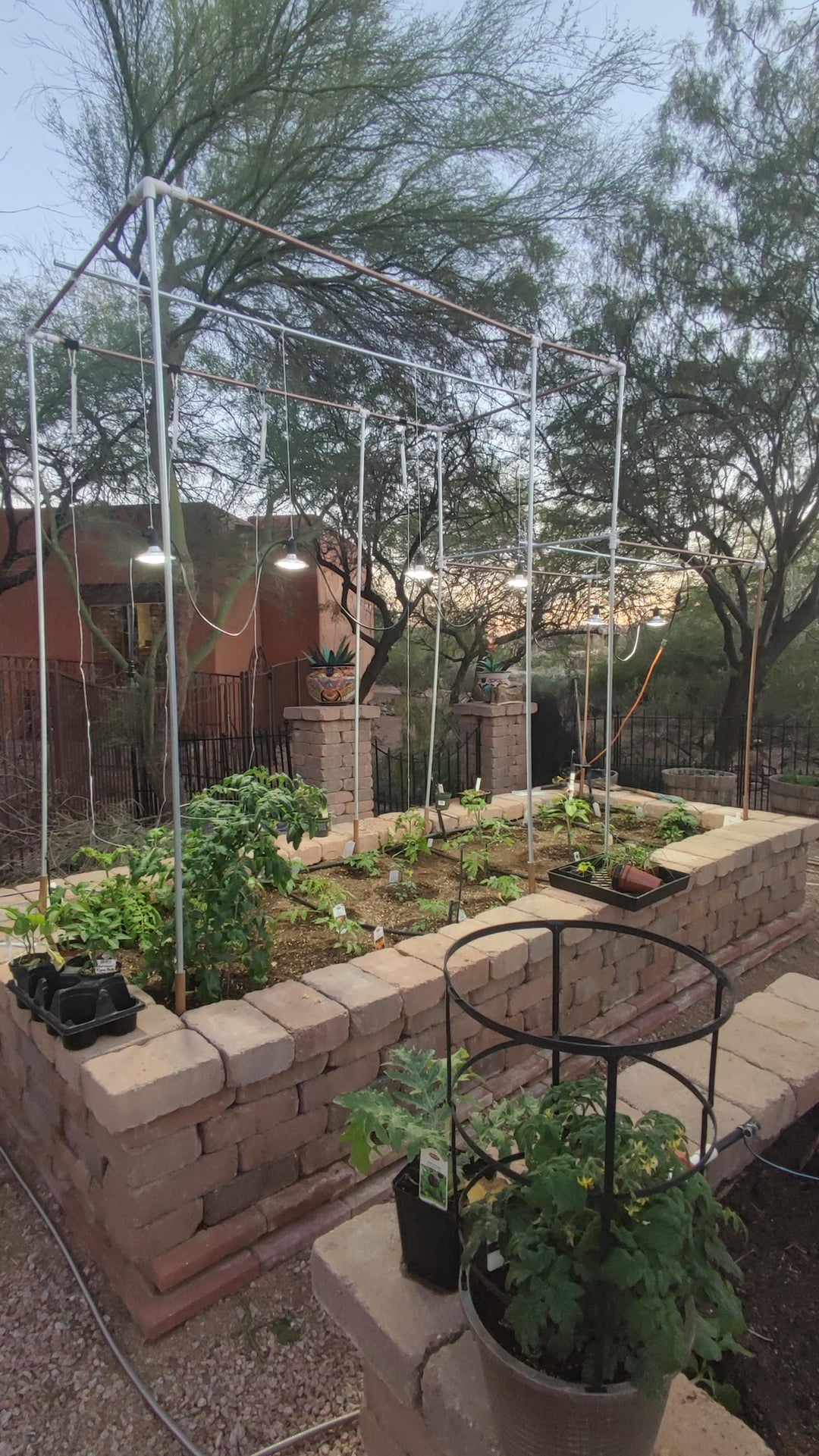
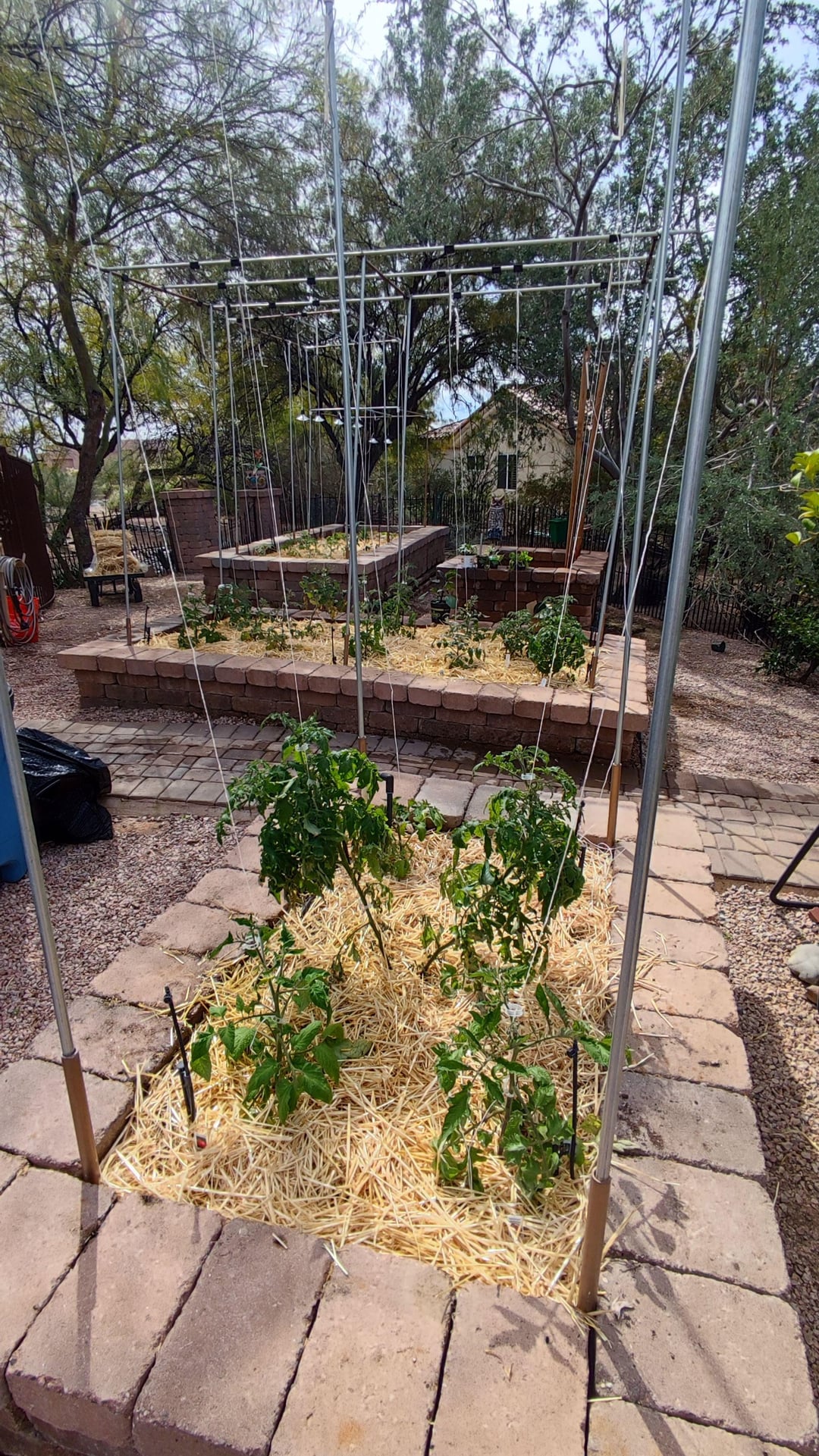
Any Arizona growers have any advice for keeping tomatoes alive and fruiting in the summer? Or at least into July. I get my tomatoes in the ground in early January to maximize the nice weather but usually by June I no longer get fruit and I sort of give up for the year. I've had people telling me that with shade cloth you can keep them fruiting but I'm finding that hard to believe when the ambient air and temperature is 110 my setup allows for good shade cloth coverage but I was thinking about adding misters as well. I have managed to keep some of the plants alive to refruit in the fall with 50% shade cloth but I really to to try and see if I can get fruit all summer, hence the mister idea.
I was surprised not finding much in the way of searches (reddit and Google) about this.
We have misters with a pump around our patio (well away from the tomato garden and it drastically lowers the temperature to a comfortable 80-90 even in the hottest part of the day. I'm weary about using them with my tomatoes because everyone says not to keep the plants wet and it introduces disease and rot.
The alternative is they die from the heat so would it be any worse? With pump powered misters it creates a very fine mist that doesn't water log everything around it. I was going to add a fan to help circulate air and keep water evaporating/cooling as well.
I would drape shade cloth (or possibly aluminum cloth which reflects the heat and light) to completely enclosed the raised beds with my metal trellis system. At the ends I would run an oscillating fan to help with evaporation and cooling and to hopefully help keep the plants from being constantly wet. The pump powered misters create a super duper fine mist (more of a fog) and don't soak everything they touch as there's a bit of equilibrium where the water evaporated almost as fast as the system puts out. I would prefer to not use a pump system as its way more expensive letting the psi from the hose (60-85ish) do all the work (price difference is $50 vs $800).
Anyone tried this? Would it work using the cheaper option or do I need to fork out for an expensive powered system?
Thanks!
by Crazyhairmonster
16 Comments
We have a heatwave starting today. I have a misting setting on my hose, also wondering if it will help. At least overnight temps will be relatively cool. Forecast below (°C). I think the max forecast for Wednesday is ~ 110°F?
https://preview.redd.it/m66iq3uwx6fg1.png?width=1440&format=png&auto=webp&s=b9ee0e8e13cbc6b9a9061c0a11e608728cf79ff8
Ill await another opinion, but I don’t think that’s such a good idea. Encourages disease on the leaves.
It is possible but you gotta know what you’re doing. The fungal risks sky rocket. Sun will destroy them if they’re getting wet. Better have a real nice shady backyard or the sun in summer will scorch them fast. I’m in the valley it gets way too hot for tomatoes to survive here without a greenhouse or a variety that can handle the heat. Heat tolerant varieties are still something I’m investigation. Be careful!
Once average temps get above 90° F tomatoes stop setting fruit. Misters might delay that for a while but you might have to run them straight time, which is not a good idea for water conservation reasons or your for your misters pump. Also the winds that come up in late May and June will blow the mist away from the plants. BTW Sweet 100 is good about producing long into the hot weather, if you like cherry tomatoes.
You’re planting in January? That’s too early because temps below 50°F will also cause tomatoes to quit growing and setting fruit. March 1 is the transplanting time recommended by UA extension . I may go a couple weeks earlier this year if the warm weather is forecast to hang on.
I live in Maryland where we have 60-80% humidity on any given summer day with 90 degree daytime temps. When temperatures break 95, I mist my plants, including tomatoes. It drops the temperature temporarily. Since it’s so hot, the plants dry rather quickly, even in 80% humidity.
I’m not sure how much of a negative effect it would have in AZ since the water evaporates almost immediately. But it would provide cooler air when coupled with a sunshade.
This works for me because night time temps usually go down into the 70s. I know the Phoenix area doesn’t see a drop that low. So I can’t say that it would help you. But it won’t hurt.
I have tried this in Arizona and wound up with mineral deposits on all the leaves from the hard water and evaporation.
Also wound up with burned leaves from water magnifying the light. Same reason you get a worse sunburn at the pool, lake or beach.
Proper watering, from below if possible is key, but not in the heat of the day when leaves are wilted with shade cloth to protect them from mid-day sun is where I have had the best luck.
Hi! I’m in Australia, but am sure similar rules apply even though they may be “upside down”.
When you said that your tomatoes stop fruiting in June, are these the same tomatoes you’ve started in Jan?
Do you usually grow determinant varieties? This type usually has most of the fruit ripen at once. so if the days to maturity is 70-90 it might not be weird you’re not getting fruit in June?
These look like indeterminate varieties to me. at the same time, I imagine that up until June you have perfect growing conditions for tomatoes. Heaps of sun and consistent weather… are yours maturing quicker than the packet states?
The shade cloth would be not to block out the sun entirely as you need this!
I have similar daylight hours to you (14hrs daylight in summer, 9hrs daylight in winter) – but you have double the amount of sunshine hours (~3900 per year compared to ~2000 sunshine hours for me).
You want the shade cloth to block the hottest part of the day. For me, if it’s 40 degrees, the temperature is usually hottest between 2-6pm. This will stop your bricks heating up so much and drying out the soil…
I’m not sure about the water situation in Arizona, but we’ve had pretty significant drought and water restrictions here at times… so I personally would try to find other ways of cooling rather than constantly misting my plants (if it were me) .
Btw, put one plastic saucer of water in direct sun outside and one in a filtered light position and measure temps of both + evaporation times to get an idea of whether the shade cloth thing would work for you… I know you said the ambient temp is 110•F but I’m sure once those bricks heat up it’s getting pretty warm
I barely know enough about this to comment, but it’s something I have been studying. So please just take this with a grain of salt, but the reason tomato fruiting is limited or halted during the peak summer months in climates like yours (and to some extent mine as well, NE Texas) is not just ambient (air) temp or even air temp plus soil (root zone) temp. Production is also dependant on an appropriate DLI (daily light integral.)
Shade cloth can help your production by reducing daily light exposure below a toxic amount when days are long and UV radiation is extremely high. Tomatoes, generally speaking, thrive with a DLI (daily light integral) of 25 to 30 (mol·m⁻²·day⁻¹). But in July in Arizona (or Texas,) it can climb into the 40’s and 50’s. At those levels it is not beneficial. The plant cannot use that surplus radiant energy, it just produces stress. And plant stress starts a cascade of deterioration.
Cooling with fine mist lowers temperature but does nothing to reduce the excess light and UV radiation the plant is receiving. That, coupled with the way moisture increases risk of fungal and some bacterial diseases, makes me think it probably will not provide a solution, and might actually lead to a setback in plant health and productivity.
Maybe it would be more fruitful to explore different shading approaches. Different materials, for example. I can’t speak to that. My own “solution” has been to just have an early crop, then pull the tomatoes out and call it a day.
Keep the leaves dry. Use drip irrigation. The mould will get ya, especially if covered in shade cloth. I use insect netting, which reflects quite a bit of the sun, but more breathable, then shade cloth on top the really hot days to stop fruit burn. It’s been, on average, around 30-33⁰c here in NSW Australia (86-91) but we’ve had a lot of days over 100⁰ (40⁰+ C). It will be tomorrow. The Krims I’m growing haven’t skipped a beat though, still setting.
Almost there, shade cloth will bring down the stress and temps. Survive v thrive; don’t force plants to work when they just want to survive.
I’m in ABQ at 5000′ so we don’t get as hot as you. I find 40% shade cloth essential for growing tomatoes here now with climate change, but my toms basically stop setting fruit when we get into the mid-90s unless our evening temps are below 70. June and July have become much, much hotter in the last decade or so. I keep them alive and get a big push of fruit again late summer and fall. I’d worry that misters could cause disease if they get on the leaves, but if you had both shade and misters that lowered the surrounding temp but didn’t deposit on the plants then maybe it would help. If you can keep your plants alive with shade during the worst heat, you may have another nice flush of fruit once it lets up.
I’d love to ask you about your trellis system, if you don’t mind. Is that EMT pipe? Can I ask you here or DM you about pipe size and span? I’d love some real advice from a fellow gardener! I’m thinking of doing something very similar before Spring.
I’m in Alabama, Zone 8b so effing hot and humid. I put up 40% shade cloth up and they started producing fruit
In florida tomatoes are done by Memorial day regardless of misting. They need nights in the 50s and 60s to fruit. Arizona is much hotter than florida. Good lucj.
What’s the worst case scenario if it doesn’t work? Can you repurpose the system for something else? I grow in the tropics and my plants are constantly wet, it’s still possible to grow tomatoes. If the sun can evaporate the water in a few hours, then I don’t think you will have an issue with disease. The misters would help with preventing flower abortions. My vote is to try it out. Gardening is fun because we experiment ways to tackle our issues.
Also, I don’t use shade cloth because I noticed my plants were getting leggy and not producing as much as the ones in full sun despite having the highest UV rating and leaf temps being in the high 90s to low 100s. Then again, we have clouds so our 12 hours of sun translates to maybe 4-7.5 hours of actual sun.
Pollen is sterile at 90 degrees. You would only be keeping them alive for them to get a jump start to fruit in the fall. Now is the time of year to have tomatoes. Hasn’t even gotten cold enough to need to cover.
https://preview.redd.it/6hwh3bbcv7fg1.jpeg?width=3024&format=pjpg&auto=webp&s=2736d3b7aff324959194a6ea8175bce5f2ecbead
I’m in AZ and a couple things I see that I would change. I suggest DIY sub irrigated planters made from Rubbermaid stock tanks. They work great for growing tomatoes here in the summer.
The other thing would be to grow drought tolerant varieties. Check out seeds from Native Seed Search, which IMO perform the best here.
The issue with your garden is that it’s a raised bed. In the drylands you want to grow in the ground or in sub irrigated planters. Otherwise, your plants will struggle. Raised beds are good for places that are wet and cold. We need beds that retain water and stay cool. That’s the opposite of raised beds. Especially cinder blocks that retain and emit heat.