
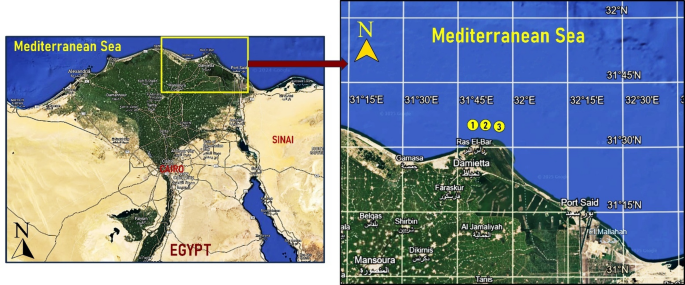
Toxic metal concentrations (mg/kg wet weight) in muscles of different fish species
Toxic metals are among the most dangerous substances, as they cannot be degraded by various biological systems and are bioaccumulated in the tissues of living organisms. Metals released into the aquatic environment may accumulate in the food chain, leading to environmental damage and posing a threat to human health, including cancer and damage to the cardiovascular, digestive, and nervous systems, as well as brain function. Arsenic is the most harmful metal, as even small amounts ingested over a long period can cause skin cancer and other serious health issues, including tiredness, sleeplessness, hair and weight loss34. Additionally, it is associated with various organ damage, carcinogenesis, and skin irritation35.
In this study, As levels in the fish samples tested ranged from 0.63 to 7.05 mg/kg, with a mean ± SE concentration of 2.29 ± 0.22 mg/kg for thinlip grey mullet; from 0.44 to 5.3 mg/kg, with a mean concentration of 1.68 ± 0.18 mg/kg for European sardine; and from 0.55 to 6.18 mg/kg, with a mean value of 1.87 ± 0.16 mg/kg for sand smelt (Table 3; Fig. 3). Fish species can be ordered from the highest to lowest levels of arsenic as: thinlip grey mullet > European sardine > sand smelt, with a significant difference (P < 0.05) in the As content between thinlip grey mullet and each of sardine and sand smelt (Fig. 3).
Table 3 Comparison of toxic metal concentrations in fish muscles (mg/kg wet weight) with the national and international maximum permissible limit (MPL).Fig. 3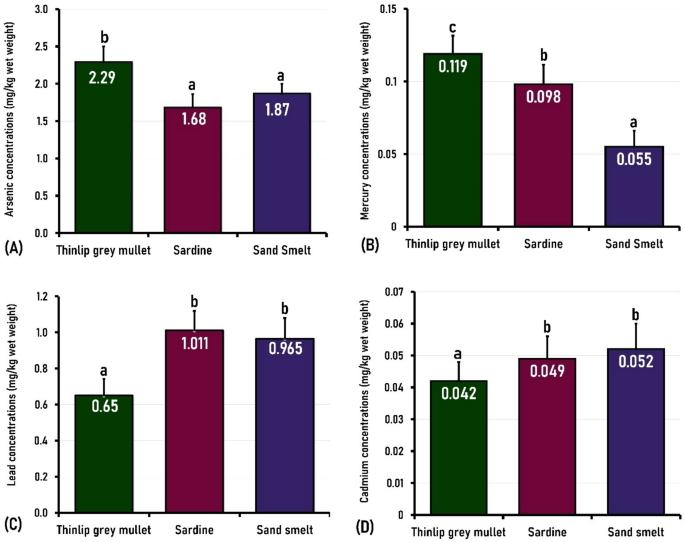
The mean concentrations of toxic metals (mg/kg wet weight) in thinlip grey mullet, European sardines, and sand smelt. Columns with different letters for each metal indicate significant differences (P < 0.01; or P < 0.05).
Comparable As concentrations ranging from 3.53 to 3.94 mg/kg were reported in European sardines from the Western Mediterranean Sea, Spain41, as well as at a mean of 2.82 mg/kg in European sardines from the Adriatic Sea, Croatia42. On the other hand, arsenic was undetected in European sardines in many studies reported worldwide, including the Eastern Mediterranean Sea, Türkiye43, the Adriatic Sea, Italy44, and the Tyrrhenian Sea, Italy45,46. Moreover, the current results of As values in sand smelt was almost comparable to the levels of 2.19 ± 0.19 mg/kg in sand smelt caught from the Gulf of Patti, Italy47, even though it was 3 times higher than those demonstrated by Köker (2022)48, who reported As concentration ranging from 0.40 to 0.84 mg/kg with a mean of 0.63 ± 0.18 mg/kg in sand smelt caught from the Inzink lake basin, Türkiye.
Mercury is one of the most toxic metals that can enter aquatic environments through various means, such as coal-fired plants or industrial processes. Mercury toxicity can have significant effects on young children, resulting in learning disabilities, behavioural problems, and intellectual impairment23. In this study, Hg levels ranged from 0.01 to 0.31 mg/kg with a mean ± SE of 0.12 ± 0.02 mg/kg in thinlip grey mullet; 0.01 to 0.26 mg/kg with a mean ± SE level of 0.098 ± 0.02 mg/kg in European sardine; and 0.01 to 0.17 mg/kg with a mean ± SE level of 0.06 ± 0.06 mg/kg in sand smelt (Table 3; Fig. 3). Mercury concentrations in different fish species were ordered as thinlip grey mullet > European sardine > sand smelt, with a significant difference between the Hg level of thinlip grey mullet and each of sardine (P < 0.05) and sand smelt (P < 0.01); besides, there was a significant difference (P < 0.01) in Hg contents between sardine and sand smelt.
Our findings of Hg concentration are consistent with the level of 0.1 mg/kg reported in thinlip grey mullet from the Gironde estuary, France49, and with that reported in European sardines from the Western Mediterranean Sea, Spain, which ranged from 0.07 to 0.09 mg/kg41. In contrast, a lower Hg value of 0.05 mg/kg was detected in thinlip grey mullet samples caught from the Adriatic Sea, Italy50. On the other hand, Canli et al. (2001) found undetectable levels of Hg in European sardines from the Eastern Mediterranean Sea, Türkiye43, while higher Hg concentrations of 0.28 and 0.15 mg/kg were detected in sand smelt caught from the Inzink lake basin, Türkiye48, and that from the Axios Delta, Greece51.
Lead is recognized as a neurotoxic metal that leads to hepatic and renal damage, mental retardation, visual abnormalities, gingivitis, and nervous system damage, as well as irregularities in pregnancy and fertility, including spontaneous abortion52. Oil combustion, cigarette smoking, industrial waste, and vehicle exhaust are the primary sources of lead pollution53. In the current study, Pb was detected in all tested fish samples at concentrations ranging from 0.01 to 2.22 mg/kg, 0.01 to 2.38 mg/kg, and 0.03 to 2.19 mg/kg, with mean ± SE values of 10.65 ± 0.13 mg/kg, 1.011 ± 0.17 mg/kg, and 0.97 ± 0.19 mg/kg in thinlip grey mullet, European sardine, and sand smelt, respectively (Table 3; Fig. 3). The highest Pb level was observed in European sardine, while the lowest was found in thinlip grey mullet, allowing for their ranking as: sardine > sand smelt > thinlip grey mullet, with a significant (P < 0.01) difference between thinlip grey mullet and each of sardine and sand smelt (Fig. 2). The concentration of Pb may vary among different fish species even when caught from the same area due to several factors such as feeding level, fish size and age, foraging method, and the metal’s bioaccumulation capability in seafood54.
A higher mean Pb concentration of 1.88 mg/kg was detected in European sardines caught from the Latium coast, Italy45. Also, a high range of 1.160–1.680 mg/kg was determined in European sardines from the eastern Mediterranean Sea, Türkiye43. Lower Pb concentrations have been reported in other studies, including < 0.1 mg/kg in thinlip grey mullet from the Adriatic Sea, Montenegro55, 0.15 mg/kg in sardines from the Mediterranean Baltim coast, Egypt56, and 0.22 mg/kg in sand smelt from the Inzink Lake Basin, Türkiye48. Much lower Pb levels were reported for Sardina pilchardus, with 0.007 mg/kg in samples from the Mediterranean Sea, Italy44, and 0.002–0.05 mg/kg in those from the Mediterranean Sea, Morocco57. On the contrary, higher Pb levels of 6.12 and 5.57 were detected in sand smelt and Sardines Pilchardus, respectively, caught from the northeast Mediterranean Sea, Türkiye58. Additionally, an extremely high Pb level of 11.1 mg/kg (10 times higher than our findings) was detected in sardines marketed in Egypt59.
Cadmium is a toxic metal with no known biological function that can accumulate in the body, adversely affecting the kidneys, skeletal muscles, reproductive systems, and digestive systems60. In the present study, Cd levels ranged from 0.01 to 0.11, 0.01 to 0.12, and 0.01 to 0.13 mg/kg with mean ± SE values of 0.04 ± 0.01, 0.049 ± 0.01, and 0.06 ± 0.01 mg/kg, in thinlip grey mullet, sardine, and sand smelt, respectively (Table 3; Fig. 3). The highest Cd content was observed in sand smelt, while the lowest was in thinlip grey mullet. The order of mean Cd values, from highest to lowest, was as follows: sand smelt > European sardines > thinlip grey mullet, with significantly (P < 0.05) lower difference in Cd content between thilip grey mullet and each of sardine and sand smelt (Fig. 3).
Comparable mean Cd concentrations of 0.05 mg/kg44 and 0.03 mg/kg48 were detected in European sardines caught from the Mediterranean Sea, Italy, and in Sand smelt from the Inznik Lake Basin, Türkiye, respectively. Likewise, comparable Cd levels of 0.037, 0.04, and 0.05 mg/kg were reported in common sole, red porgy, and striped red mullet caught from the Mediterranean Sea coast in Egypt, respectively61. In contrast, lower Cd concentrations were reported, including 0.0019 mg/kg in thinlip grey mullet from the Adriatic Sea, Montenegro55, and 0.002–0.01 mg/kg in sardines marketed in Catalonia, Spain41. Higher Cd levels of 0.37 and 0.55 were found in sand smelt and Sardines Pilchardus caught from the northeast Mediterranean Sea, Türkiye58. The rate of toxic metal accumulation in different fish species varies based on the metal extracted, accumulation time, and the rate of scale formation62. Cadmium is primarily used in various industrial processes, such as zinc refining and lead smelting63.
These variations in heavy-metal levels among regions and species most likely reflect differences in local contamination sources, environmental conditions, and species ecology. Factors such as soil composition, water chemistry, industrial and urban discharges, and the degree of metal bioavailability in each aquatic system all have a significant impact on the accumulation of heavy metals in fish. The rate at which metals are bioaccumulated and biomagnified is also influenced by species-specific traits, including feeding patterns, trophic position, and habitat utilization.
Fish acceptability based on the recommended maximal permissible limits (MPLs)
The present results indicated that 32.5% (26/80), 25% (20/80), and 27.5% (22/80) of the tested thinlip grey mullet, sardines, and sand smelt, respectively, contained As levels higher than the proposed legal limit36 (Table 3; Fig. 4). The elevated levels of As in more than 28.3% of fish samples may reflect industrial discharge and untreated domestic effluents near Damietta.
Fig. 4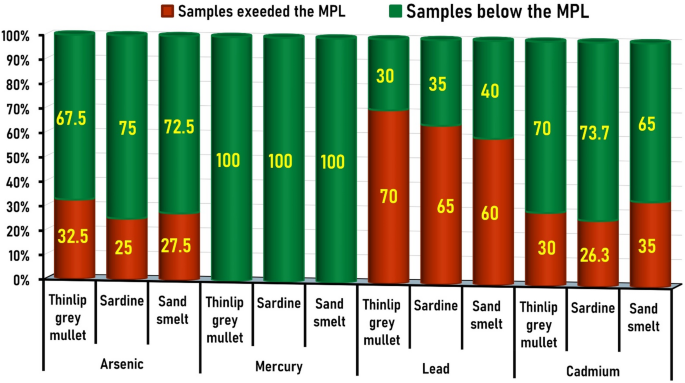
Fish acceptability based on the recommended maximum permissible limits (MPLs) showed the percentage of fish samples exceeded the MPLs versus those within the MPLs for toxic metals analyzed in thinlip grey mullet, European sardines, and sand smelt.
On the other hand, Sabala et al. (2024) found that 100% of sardines marketed in Egypt exceeded the recommended limits for As64. Likewise, Mahmoud et al. (2025) revealed that all (100%) of the marine fish samples from another species collected from the Mediterranean coast at Damietta City, Egypt, exceeded the MPL set for As61.
Interestingly, Hg contents in the current study were detected in all fish samples at low concentrations, remaining below the MPL of 0.5 mg/kg set by EOS (2010)37 as well as by the Commission Regulation (EU) (2022)38. Similarly, the Hg levels in all (100%) sardine samples marketed in Egypt were within the safe limits64. On the other hand, only 12% (12/100) of sardine samples caught from the Mediterranean Sea in Egypt exceeded the MPL for Hg56.
The percentages of fish samples that exceeded the Pb permissible limit (0.3 mg/kg)37,39. in this study were 70% (56/80), 65% (52/80), and 60% (48/80) of thinlip grey mullet, sardines, and sand smelt, respectively. Previous studies in Egypt reported that the Pb contents exceeded the recommended limits in 45% (36/80)64 and 10% (10/100)56 of examined sardine samples. Concerning Cd tested in this study, 30% (24/80) of thinlip grey mullet, 26.3% (21/80) of sardines, and 35% (28/80) of sand smelt exceeded the permissible Cd limit of 0.05 mg/kg37,40. A previous study in Egypt reported that 90% (72/80) of sardine samples exceeded the recommended Cd limits64, while another study found that only 6% (6/100) of sardine samples surpassed these limits56.
Effect of cooking on metal contents in fish samples tested
In this study, frying of thinlip grey mullet samples exhibited reduction percentages of 45.6%, 66.7%, 36.3%, and 75% in As, Hg, Pb, and Cd levels, respectively, with significant differences observed in all metal levels before and after frying (Table 4). In sardine samples, frying resulted in a reduction of 10.71% for As, 83.33% for Hg, 30.16% for Pb, and 60% for Cd, while in sand smelt, frying exhibited a reduction of 16.33%, 37.5%, 63.87%, and 75% in As, Hg, Pb, and Cd levels, respectively, with significant differences (P < 0.05) in Hg, Pb, and Cd levels before and after frying (Table 4). Significant pre- and post-frying differences were observed for Hg, Pb, and Cd in the three fish species tested, whereas As did not show a significant (P > 0.05) change in sardine and sand smelt, although it demonstrated a pre- and post-frying significant change in thinlip grey mullet (Table 4). The reduction in metal values resulting from cooking methods may be attributed to their release through drips as free salts, possibly in connection with soluble amino acids and uncoagulated proteins65, as well as cooking decreasing the fish protein content66.
Table 4 Effect of cooking on toxic metal levels in thinlip grey mullet, sardine, and sand smelt.
Similar to our results, roasting has been reported to decline Hg levels by 63% in sardine samples67. In contrast, pan-frying elevated the concentrations of Hg, Pb, and Cd by 377%, > 200%, and 223%, in shrimp samples, respectively68. Additionally, the Cd level increased by 250% in cooked female crabs and 100% in cooked male crab flesh69. Moreover, frying raised the Cd content in shrimps by 55% and the Pb level in lobster by 29%70. This increase in metal content during frying might be linked to the evaporation processes involved during frying.
Grilling of thinlip grey mullet resulted in a reduction of As, Hg, Pb, and Cd residues by 35.53%, 33.33%, 15.87%, and 40% with a significant (P < 0.05) difference detected before and after grilling for As, Hg, and Cd but not for Pb (Table 4). Grilling of sardine, however, resulted in 10.23%, 33.33%, 64.17%, and 33.33% reductions in As, Hg, Pb, and Cd contents, respectively in sardine with a significant (P < 0.05) difference in the metals analyzed, except for As, along with reduction by 29.23%, 66.67%, 22.92%, and 60%, respectively in sand smelt, with a significant difference detected before and after grilling in Hg and Cd, but without a substantial difference in As and Pb in sand smelt (Table 4).
Grilling has been reported to produce controversial effects in different fish species tested worldwide. In Egypt, grilling produced a significant reduction in Hg, As, Pb, and Cd contents in common sole and red porgy61, although it didn’t exhibit a significant reduction in the mean levels of metals (As, Hg, Pb, Cd) tested, except for Pb in crabs and Cd in shrimp samples71. Conversely, in Spain, Devesa et al. (2001)72 demonstrated that grilling increased As contents in marketed bivalves and squid fish. In another study, Tawfik (2013) observed a 218% increase in Cd content in boiled shrimp from Saudi Arabia73, whereas Gheisari et al. in Iran reported that boiling reduced Pb content by 13% in lobster and 35% in shrimp flesh caught from the Persian Gulf70.
Upon comparing the mean reduction percentages of the measured toxic metals (As, Hg, Pb, and Cd) between cooking methods, frying consistently showed higher removal efficiency than grilling across fish species. In thinlip grey mullet, frying achieved an average reduction of 55.9%, significantly higher than the 31.2% observed with grilling. A similar pattern was noted in sardine, where frying reduced metal levels by 46.1% compared with 35.3% for grilling. In sand smelt, both methods produced comparable results; however, frying still showed a marginally higher reduction (48.2%) compared with grilling (44.7%). Overall, these findings indicate that frying is generally more effective than grilling in decreasing heavy-metal residues in fish, particularly in species with higher initial contamination levels.
Health risk assessment associated with the consumption of toxic metals-contaminated fish
The toxicological reference values adopted in this study were selected from internationally recognized risk-assessment authorities, namely the USEPA, JECFA, and EFSA. These organizations routinely establish health-based guidance values based on comprehensive toxicological datasets, standardized evaluation procedures, and transparent uncertainty analyses. Despite having similar goals, these organizations differ in several methodological aspects74,75. The USEPA primarily provides reference doses (RfDs) and cancer slope factors (CSF) that are based on United States-specific exposure scenarios and often focus on chronic daily exposure limits. JECFA, which operates under WHO and FAO, evaluates contaminants from a universal dietary perspective and typically expresses guidance values as provisional tolerable weekly or monthly intakes (PTWI/PMTIs). EFSA, meanwhile, applies European population exposure data and may adopt more conservative limits due to thorough reassessment processes and frequent updates of scientific opinions. These differences among the organizations reflect the mandatory regulations and population focus of each agency76,77. Therefore, in this study, the most suitable and generally accepted guidance value for each pollutant was selected from among these sources to ensure a reliable, transparent, and internationally comparable health-risk assessment.
In the present study, non-carcinogenic and carcinogenic public health risks associated with consuming metal-contaminated fish were assessed. The estimated daily intakes (EDIs), Target Hazard Quotients (THQs), and Total Target Hazard Quotients (TTHQs) were adopted for non-carcinogenic assessment17,20,29,32, while the Target Cancer Risk (TCR) was applied for carcinogenic assessment from the consumption of metal-contaminated fish over a lifetime31.
Estimated daily intake (EDI) of detected metals in examined fish samples in comparison to their provisional tolerable daily intake (PTDI)
The EDI values represent the safe levels of toxic metals, which are used to assess the non-carcinogenic risk associated with consuming metal-contaminated fish. According to the Food and Agriculture Organization22, the average ingestion rate of fish for an adult typically consuming, weighing 70 kg, is 57.096 g/day.
Comparing the EDI values of As, Hg, and Cd from the consumption of thinlip grey mullet, sardines, and sand smelt samples tested in the present study with their PTDI or BMDL (EDI/PTDI or BMDL) set by JECFA (2010a, b)23,24 and EFSA (2010)25 revealed low percentages (< 100%), which indicated non-carcinogenic risks from these three metals through the consumption of the three fish species tested (Table 5). On the other hand, the EDI of Pb exceeded the PTDI by 130.8% and 124.9% through consumption of sardine and sand smelt, respectively, while the EDI to PTDI ratio of Pb was 84.29% through consumption of thinlip grey mullet samples (Table 5), revealing that there may be a probable non-carcinogenic risks from Pb through the consumption of sardine and sand smelt but not from thinlip grey mullet.
Table 5 Toxic metal concentrations in the muscles of sampled thinlip grey mullet, sardine, and sand smelt fish and their estimated daily intake (EDI) compared to either their provisional tolerated daily intake (PTDI) or their benchmark dose levels (BMDL).
The present results of the EDI values are in agreement with those reported in Türkiye78. where the EDI values for Cd and Pb from the consumption of thinlip grey mullet were below the recommended PTWI levels set by FAO/WHO79. Similarly, the EDI values for Pb through consumption of thinlip grey mullet in Egypt were also below the acceptable limits80. Moreover, the EDI values for As, Hg, Pb, and Cd analyzed for the Egyptian population through the consumption of sardines were under their PTDI/BMDL64. Additionally, Falcó et al. (2006) found daily intake of As, Hg, Cd, and Pb by the Catalonia population was under the respective provisional tolerable weekly intake (PTWI) values through the consumption of fish and seafood41. In contrast, Türkmen et al.74 in Türkiye indicated that the EDI values for Cd from the consumption of C. Ramada exceeded the limits set by FAO/WHO75.
It should be noted that the consumption rate (57 g/day) in this study reflects the average intake for normal adults and may underestimate exposure in vulnerable or high-consumption groups. This value, however, may underestimate exposure for vulnerable or high-consumption subgroups such as children, pregnant women, fishermen, and coastal communities. These groups may ingest proportionally higher amounts of fish relative to their body weight, resulting in higher estimated daily intake (EDI) and consequently higher hazard quotients or cancer risks. Consequently, the present risk estimates likely represent conservative estimates for these groups, and future assessments should incorporate subgroup-specific or upper-percentile consumption scenarios to more accurately characterize risk among these vulnerable populations.
The THQs and TTHQs of toxic metals detected in fish species for assessment of non-carcinogenic risks in the Egyptian population
The THQ and TTHQs (HI) are methods used to assess non-carcinogenic health risks associated with consuming fish contaminated by metals. The TTHQ value represents the sum of the THQ values of all toxic metals tested in each fish species. A THQ or TTHQ value of less than one indicates no non-carcinogenic health risk from consuming fish contaminated by metals. However, if the THQ or TTHQ value exceeds one, it suggests a potential non-carcinogenic public health risk29.
The THQ values of toxic metals tested due to the consumption of thinlip grey mullet, sardines, and sand smelt by the Egyptian population are listed in Table 6. The THQ values of As in all examined fish samples were above 1, suggesting that there were non-carcinogenic risks from consuming these fish species harvested from the Mediterranean Sea at the Damietta Coast. On the contrary, the THQ values for Hg, Pb, and Cd were all below 1, indicating that these metals do not pose non-carcinogenic public health risks from the consumption of these fish species.
Table 6 Target hazard quotient (THQ) and hazard index (HI) or total target hazard quotient (TTHQ) of toxic metals resulting from consumption of thinlip grey mullet, sardine, and sand smelt.
Our results of THQ are consistent with those of Cd and Pb, which were below one from consuming thinlip grey mullet caught from the Adriatic Sea, Montenegro, indicating no adverse effects on lifetime intake of these metals55. Similarly, the THQ of Cd and Hg in sardines caught from the Algerian coast of the Mediterranean Sea were lower than one82. In contrast, the THQ value of As from the consumption of sardines obtained from Italian supermarkets exceeded one11. Furthermore, the THQ values of Pb and Cd in thinlip mullet collected from freshwater, brackish, and offshore sites varying in salinity in Egypt were above one, suggesting that consumers may face some adverse health effects from these metals when consuming these fish76.
The TTHQ values for the four tested metals in each fish species were greater than one (7.37, 4.62, and 5.78 for thinlip grey mullet, sardines, and sand smelt, respectively), indicating a potential non-carcinogenic risk for individuals consuming these fish from the Mediterranean Sea at the Damietta coast among the Egyptian population. Our results align with those reported by Kasmi et al. (2023), who identified TTHQ values exceeding one from the intake of Sardina pilchardus from the Moroccan Mediterranean Coast, suggesting non-carcinogenic risks to public health57. In contrast, Antović et al. (2019) found that the TTHQ value from consuming C. ramada was less than one, indicating that this fish could be safely consumed55. Additionally, the TTHQ or HI value was determined below one from consuming sardines harvested from the Mediterranean Sea, at Baltim coast, Egypt56.
Cancer risk (CR) assessment in the Egyptian population through consumption of toxic metal-contaminated fish
The CR is a method used to detect carcinogenic risks from consuming food contaminated with toxic metals; if the CR exceeds 10−4, carcinogenic risks are likely. In this study, the CR values for As in all tested fish species surpassed 1.0 × 10⁻⁴ (Table 7), indicating potential carcinogenic risks associated with consuming these fish. Meanwhile, the CR values for Cd in all tested fish samples were below 1.0 × 10⁻⁴, suggesting that consuming fish with these metals is unlikely to pose carcinogenic risks to consumers (Table 7).
Similar to the present results, the carcinogenic risk value for As in Sardina pilchardus marketed in Egypt was above the acceptable limits64. Additionally, indicated that the CR for Hg, As, Pb, and Cd in Sardina pilchardus from the Mediterranean Coast, Morocco, was above the recommended limits, resulting in a potential carcinogenic risk to human health57.
Because this study quantified only total arsenic, the resulting risk assessment (THQ and CR) may not accurately reflect exposure to inorganic arsenic (iAs), which is the toxicologically active species. Therefore, incorporation of comprehensive arsenic speciation analyses in future investigations is warranted to provide more accurate and reliable risk estimates.
Table 7 The cancer risk (CR) associated with the consumption of thinlip grey mullet, sardine, and sand smelt fish samples contaminated with toxic metals, predicated on the estimated daily intake (EDI) (mg/kg/day) and cancer slope factor (CSF) (mg/kg/day).
Dining and Cooking