
France’s annual ‘pancake’ festival is coming up, but what is the history of the French crêpe and how did it end up so associated with the north-western region of Brittany?
On February 2nd of every year, the French celebrate La Chandeleur – a religious holiday in France that has been around since Roman times. These days the religious aspect has mostly gone and, for many people, the festival is just about eating a lot of crêpes.
READ ALSO: La Chandeleur: The day the French get really superstitious… and eat crêpes
But a crêpe is not only for February – France boasts no fewer than 4,000 crêperies and they remain popular all year round for a quick and delicious meal or snack.
There is one region, however, that is firmly associated with the crêpe – Brittany, which is known for its black-and-white striped flag, its rainy weather but mostly for its galettes and crêpes.
The word crêpe comes from the Latin “crispus”, meaning curly. The liquid batter made from flour, milk and eggs, which is cooked over high heat in a pan, then takes on the curly appearance that gave it its name.
History of the crêpe
Most global food cultures have their own version of the crêpe/pancake and food historians have traced the tradition back to 7000 BC.
At the time, the crêpe had no resemblance to what it is today – early versions were a much thicker pancake with crushed grains and water and cooked on a hot plate or stone until golden brown on both sides.
According to the the Landévennec Abbey Museum, originally an archaeological site excavated for over two decades by the CNRS (French National Centre for Scientific Research), the first crêpe appeared around the 13th century in Brittany.
Buckwheat, a type of wheat brought back from the Crusades in Asia, was its main ingredient. In French it is called sarrasin, you may come across this word in restaurants that serve this traditional dish. Over time, white wheat flour replaced buckwheat flour, introducing the sweet crêpe that we know today.
Today a galetière (billig in Breton) is a term used to refer to a type of crêpe maker or a cooking plate specifically designed for preparing galettes or crêpes.
Breton speciality
Crêpes are widely eaten across France and some regions have their own specialities that are somewhat similar, like the Nice speciality of Socca, a batter made with chickpea flour that is cooked on a hot griddle to produce a thin pancake.
But Bretons truly embraced the crêpe as a common everyday food – they were often served as a substitute for bread and were eaten almost every day.
Particularly in the Finistère region, there was a tradition of making crêpes on Friday evenings.
Until around the 1960s families would go to the village crêpe maker to eat buckwheat crêpes, bringing their own butter, eggs, and jam.
Quite why the Bretons embraced crêpes over bread has never really been explained – perhaps they just like to be different? But it’s certainly true that their historical love of the foodstuff has produced a lot of location variations and specialities.
Difference between a crêpe and a galette
The easiest distinction is that a crêpe is sweet and a galette savoury – but there are also significant regional and cultural differences.
In Upper Brittany (Ille-et-Vilaine, eastern Côtes-d’Armor, and Morbihan), savoury crêpes are called galettes. They are cooked on a billig (the traditional griddle), and are made from buckwheat, water, and salt.
The sweet version – crêpes – are usually made with wheat flour. They are thin and often need to be consumed quickly as they don’t keep for very long.
Meanwhile, in Lower Brittany, located in the west (from Trégor to Lorient and encompassing all of the Finistère), the term used for galette is crêpe salé (savoury crêpe). You never mention the term galette.
These are either wheat crêpes made with milk or buckwheat crêpes made with water, also cooked on a billig. Some recipes mix a little buckwheat into the wheat batter. They are delicate, light, well-cooked, and can be stored for at least fifteen days.
Crêpes also tend to be thinner, and the recipe is more flexible, sometimes incorporating eggs, milk, or a mixture of buckwheat and wheat flour.
Between these two areas – from Trégor, Guingamp, and Saint-Brieuc to Vannes and Lorient – there is a mix of both traditions. So the main thing you must remember is to ask for a galette in Upper Brittany and a crêpe salé in Lower Brittany.
You think this is complicated? Wait until you get onto whether cider should be served in a bowl or a glass.
Crêpe fillings
But making your crêpe/galette is only half the job – then you need to think about what to fill it with.
In Upper Brittany, particularly in Rennes, the galette-saucisse has become a traditional dish – it’s exactly what it sounds like; a grilled sausage wrapped in a plain buckwheat galette.
The galette-saucisse has become a staple at markets, local festivals, and football stadiums, in fact the anthem for the professional football club of Rennes, Stade Rennais FC, is galette-saucisse je t’aime (I love you galette-saucisse).
READ ALSO: Discover France: 7 reasons to visit Rennes
This dish is recorded from the late 19th century as a quick and nourishing meal for workers and farmers.
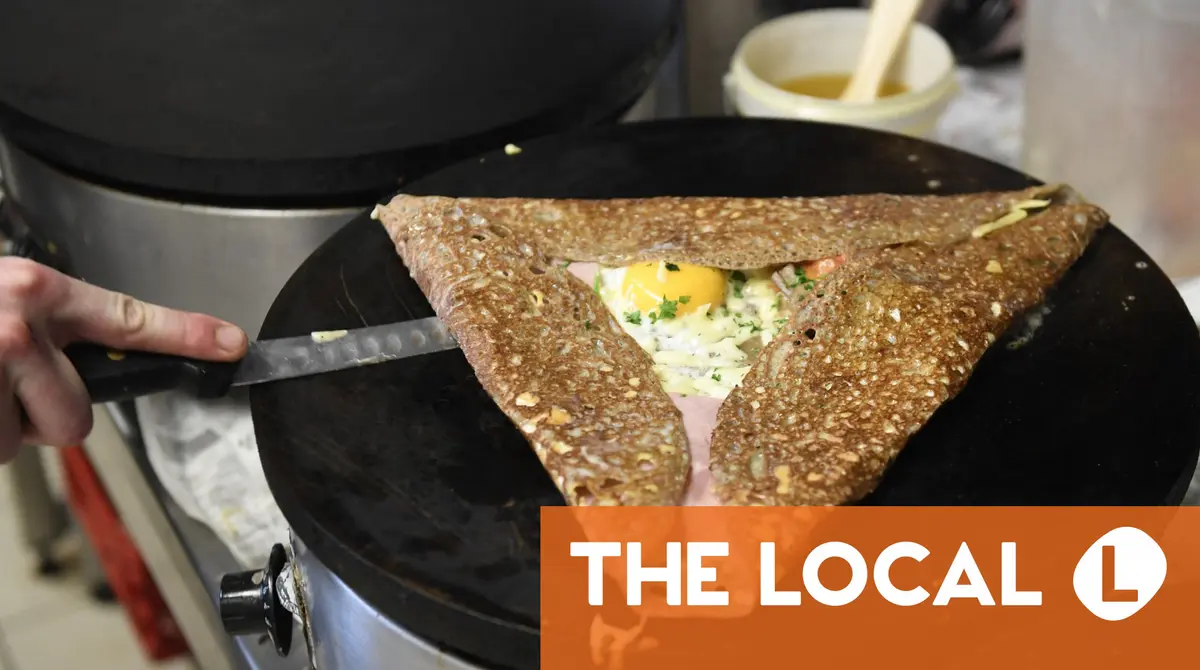
Then comes perhaps the famous filling of all – the galette complète, the traditional egg, ham and cheese filling. The egg is cracked directly onto the galette while it’s cooking, then spread to create a thin layer. Ham and cheese are then added, allowing the cheese to melt slightly. The edges of the galette are often folded over to form a square.
In the Finistère region, two variations of the Breton galette stand out: the kraz and the komplet. The kraz, which means “crispy” in Breton, is a galette cooked longer to achieve a crispier texture. It is often served plain or simply buttered.
The komplet, is the Finistère equivalent of the galette complète. It generally consists of a galette filled with egg, ham, and cheese, but can include local variations such as andouille de Guémené (pork sausage made from pigs’ intestines) or seaweed.
For sweet crêpes, it is common to find toppings such as chocolate, fruits, salted caramel, ice cream, sugar and butter.
Today, fusion cuisine has inspired new interpretations of the Breton galette. Chefs have introduced exotic ingredients or modern culinary techniques to reinvent the classic dish.
You can now enjoy galettes with curry, vegetarian versions, or even famous mountain dishes such as tartiflette (potatoes, lard, reblochon cheese) – all wrapped in a galette.
Dining and Cooking