
"Is Beaujolais part of Burgundy" is a common question that seems to confuse a lot of people. Hell, if you search for an answer you'd get like a bunch of different and conflicting answers.
- Wikipedia says yes ("Beaujolais is a French Appellation d'Origine Contrôlée (AOC) wine in the Burgundy region.")
- Wine-searcher says no ("Beaujolais, spiritual homeland of the Gamay grape and best-known for its young-release Beaujolais Nouveau red wines, is a red and white wine appellation just south of Burgundy in central eastern France")
- Wine Folly says it used to be ("The French wine region of Beaujolais has long been considered part of Burgundy, but today it charts its own course.")
The actual answer, is well, both yes and no. Let me try to maybe break it down a little bit.
1. Geographically/Politically, Beaujolais is (mostly) not Burgundy
France is divided into regions, the same way America is divided into states, or Canada is divided into provinces. Burgundy is now part of the Bourgogne-Franche-Comté region. While most of Beaujolais is Auvergne-Rhône-Alpes. There might be a few vineyards on the border who's address fall on the other side of the line though.
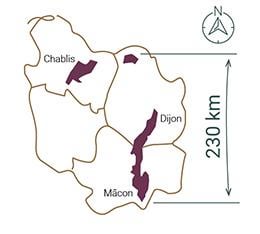
2. The BIVB, Burgundy's regulatory authority, doesn't cover Beaujolais
You can see it on the rough about us map: https://www.bourgogne-wines.com/gallery_images/site/30476/72971/72973.jpg
No Beaujolais!
3. Most of Beaujolais no longer qualifies for Bourgogne Rouge or Bourgogne Blanc appellations.
Between 1937 – 2011, Beaujolais produced had the right to sell their wines under the Bourgogne AOC. This was mostly irrelevant with regards to reds, (Bourgogne Rouge requires 85%+ Pinot Noir, Beaujolais doesn't have many Pinot Noir plantings), but it was a major point of debate with regards to Chardonnay – Chardonnay is the primary white grape in Beaujolais, and in 2011, most of Beaujolais was excluded from Bourgogne Blanc, and a new Beaujolais Blanc appellation was created. A few villages and vineyards were grandfathered in though.
4. But almost all of Beaujolais produces grapes that could qualify for "Vin de Bourgogne"
Beaujolais doesn't have a cremant or Aligote appellation. And both Cremant de Bourgogne, and Bourgogne Aligote appellations cover Beaujolais. There's also Coteaux Bourguignons, a very loose appellation that covers all of Beaujolais and almost all the grapes grown in Beaujolais.
If a Beaujolais producer produces a wine from one of these appellations in Beaujolais with grapes grown in Beaujolais, they are fully entitled to put "Vin de Bourgogne" on the bottle.
5. And then there's the weird appellation Bourgogne Gamay.
Bourgogne Gamay is the weirdest of the appellations. It is a "Bourgogne" appellation, that qualifies the wine to be labeled "Vin de Bourgogne" on it, that is 100% made from Beaujolais grapes. The area that qualifies for this appellation is 100% in Beaujolais, and not in Burgundy. So here's a Bourgogne appellation that can only be made from grapes from Beaujolais.
by Uptons_BJs
14 Comments
My personal head canon is I don’t consider Beaujolais to be part of Burgundy, but yeesh reading your write up….it kinda falls into the old “leave to to the French to make wine as confusing as possible” narrative.
No and yes but also mainly no. However, sometimes yes. Welcome to France!
WSET still classifies Beaujolais as part of Burgundy
I can guarantee you that nobody considers themselves part of Burgundy in the Beaujolais:) At least nobody that I’ve met here in three years. We do tend to accept the mâconnais as part of our team as they’re closer to us geographically and in terms of mentality than they are to the main part of Burgundy around the côte d’or.
I’m a bit surprised about number 5 as there is plenty of gamay in the Mâconnais part, in fact, reds are predominantly gamay there.
I worked for a very well known sommelier-turned-winemaker who insisted Beaujolais was in the Rhône and not Burgundy.
What’s the big deal here?
Either it’s not part of Burgundy.
Either it is, but not it’s best part.
The way I think of it is …the term Burgundy is not an official one with its own association, so it is ambiguous and not uniformly used. Bourgogne is official, and therefore more defined, and excludes Beaujolais. As you point out, the BIVB defines it as including Chablis, the Côte d’Or, Côte Chalonnaise, and Mâconnais, and not Beaujolais, which is represented by its own association, Inter Beaujolais. To your point, this is complicated by the fact that there is a bridge appelation Bourgogen Gamay that sources grapes from the 10 Beaujolais Crus, which seems to contradict BIVB’s framework. My understanding is this was created to help Beaujolais benefit from the Bourgogne AOC, but not be included in it. What’s nice about the term “Burgundy,” is it can abstract above all this, and when people use it they use it more loosely to include everythign above, including Beaujolais.
Let’s just put it like this, if you tell the sommelier you want a “Burgundy red” he’s not gonna find you a Gamay.
From a french administration perspective it is. From a wine perspective i would say keep it as a seperate wine style and region.
Yes and so is chablis
What about Chablis, then? It’s closer to Champagne than the main Burgundy area.
You must have read the discussion i had yesterday in the coteaux bourguignons post.
Haha … well, no. It’s Beaujolais!
Seriously, it’s its own region, with its own grape varieties, terroir, and style. It may have been seen as part of Burgundy in the past, but IMO it’s always deserved its own distinct identity.