
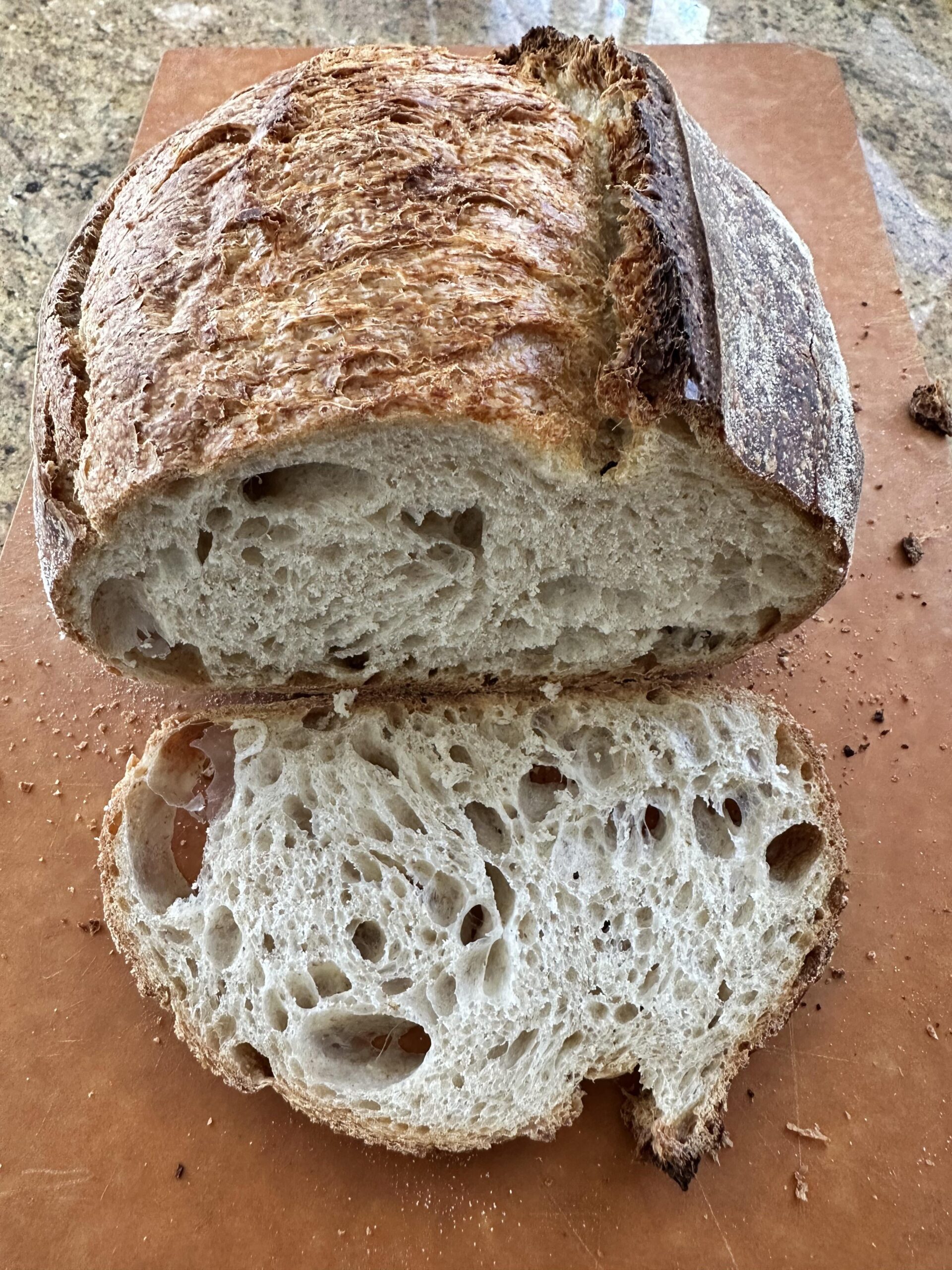
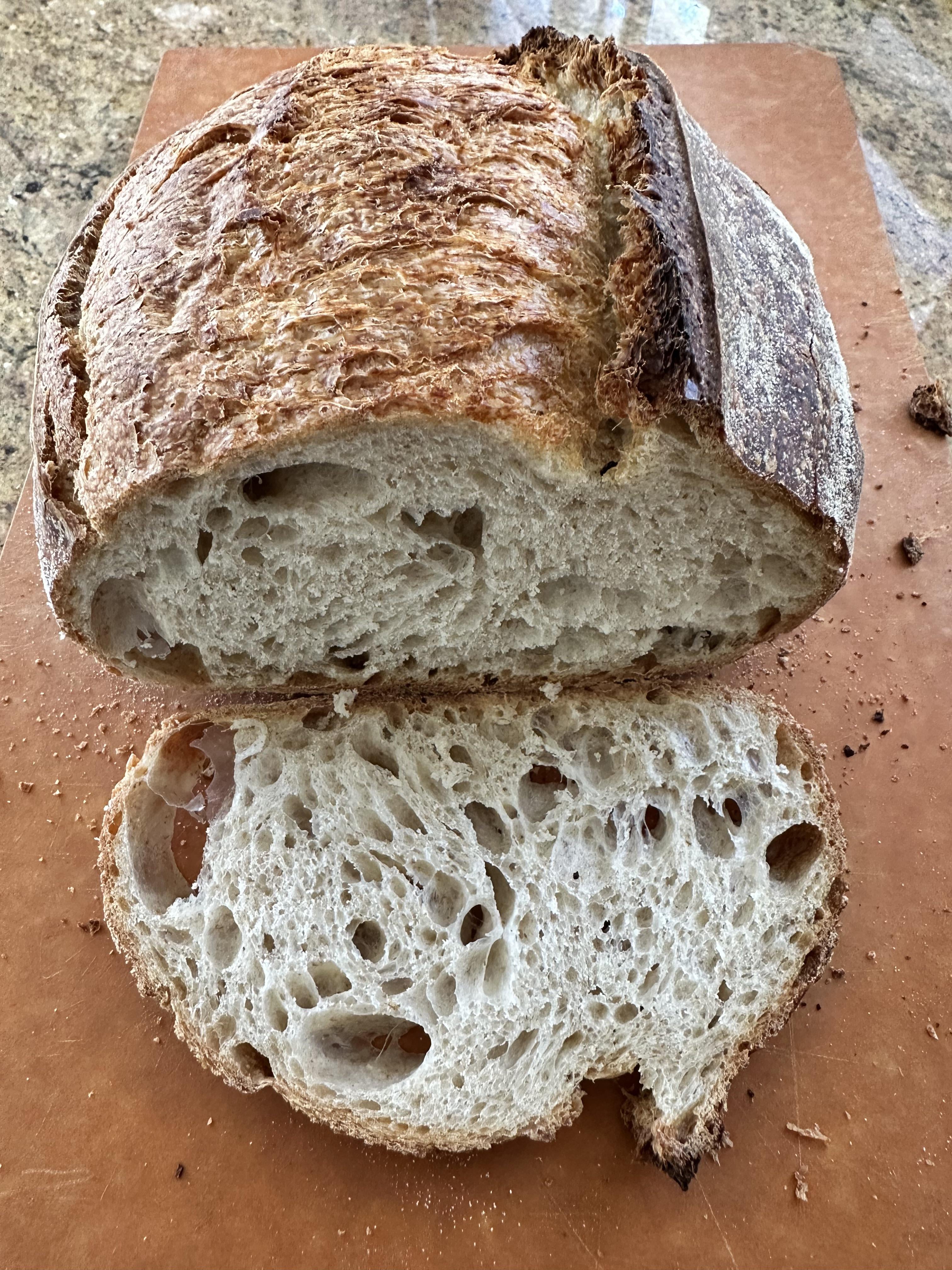
I’ve been baking sourdough loaves weekly for a few years using a friend’s starter that I keep refrigerated, taking 30g out and feeding 30/90/90 the night before. My loaves are pretty consistent and have no sourdough taste.
Recipe for 2 loaves: (Adapted from The Food Geek)
148g starter (50/50 AP WW)
535g filtered water
593g KA AP flour
148g KA WW flour
15g salt
Mix water and starter, add flour and salt. Hand mix together for a minute. Rest 1 hour, stretch and fold 4 times every 20-30 minutes. Bulk rise until risen according to temperature of dough (80°F 30% etc.)
Pre shape, rest 20 minutes, shape, banneton in bag and refrigerate 12-24 hours.
Pre heated dutch oven (450°) for 30 Minutes, remove lid and bake at 425° for 15 minutes.
I have tried changing fermentation and refrigeration times and starter strength but still no sour taste.
Does anyone have any suggestions on what to try next?
by National-Gas5796
32 Comments
The longer you cold proof, the more sour it gets. Maybe try 36 or 48 hours?
Also, do some counter feeds a couple of times before baking. Really get that yeast fermenting.
Feed your starter with rye flour. Instantly more sour.
Yeast breaks down starch into sugar, one type of bacteria breaks down sugar into alcohol, another type of bacteria breaks down alcohol into vinegar. The vinegar gives you the sour flavor. The vinegar producing bacteria might be weak or missing in your particular starter culture. One way you could improve the level of vinegar producing bacteria is to buy a bottle of organic PLAIN kombucha that you can see “strings” in, then take a few of those strings, put them in a jar with 100g water and 2g sugar. After 24 hours, add 5g of this liquid to your next starter feeding. I’d suggest splitting your starter before doing this in case you don’t like the results, so you can just switch back to your normal starter.
If your starter produces hooch in the fridge, instead of pouring it of try mixing it into the starter it apparently adds a lot of tang and sour taste to the starter. Might be worth a shot!
A little bit of rye in either your starter or your bread lends itself to a more sour flavor. I’m not a fan of acidic sourness but I’ve found that if I use a stiff starter made with BF and WW, and I make a levain with some added WW and Rye mixed in, I get a pleasing mild sour taste. I usually let the levain sit for 2 or 3 hours before adding it in. The flavor develops nicely.
Do you know what ingredients your friend used to make their starter?
The starter I made from fermented grape and flour does not make sour sourdough. No tang at all.
It was fed grape ferment liquid mixed with flour on day one. Then each day after was typical discard and feed with just flour and water.
The starter I made with grated apple, flour and water will make the bread go quite sour depending on how long I cold proof (10-56 hours), but even the 10 hour cp bread has a slight tang.
The plain flour-water starter also made bread with good tang (retired now as I had to reduce starter population in my fridge).
You could make your own traditional flour-water starter. Wait to use it until it is strong and see if it is different to the other starter. The basic starters took about 6 months to fully develop their flavor, but others get there faster.
Feed it separately from your current starter so you don’t accidentally cross contaminate them.
Are you cutting the finished load hot or cold? Needs to sit and cool down before cutting into it. Let’s the starches do its thing
My sourdough lacked the chew and sourness. I have since added high gluten flour and rye flour. I also cold proof for 36 hours.
Have you tried feeding at a 1 to 1 ratio instead 1 to 3? I’ve found that the stiffer my starter is the less sour the loaf turns out and the looser my starter the more sour the loaf.
How do you feel about “tasting” your starter? I’m not advocating eating it but I spoon out a bit and then touch my finger on the surface and put it on my tongue to check how acidic it is from time to time. Especially if I haven’t been feeding it regularly.
If your starter doesn’t have a lot of tang it’s unlikely your bread will either. The length of your cold retard should be plenty of time to build up the acids that should be detectable sourness. I’m thinking there is something funky going on with your starter.
You could try buying a dehydrated starter on line feed that a few times and bake with the exact same recipe and process and see what happens.
Over the course of a summer, I tried all these tips plus several others and can honestly say that none of them worked. No sour flavor, period. Still delicious bread, though.
Another comment already mentioned a longer fermentation/proof, I just want to confirm that’s 100% it. I made a loaf one time by letting it bulk ferment in the oven with the light at 80°F. Total prep/cook time was maybe 6 hours and it turned out beautiful, but no sour flavor
I lived in Texas for 7 years and my starter and dough would rise like crazy because I couldn’t keep my apartment under 75-80 degrees. My sourdough never tasted sour.
Moved to Washington State and suddenly it is wonderfully sour. I think because it is cold enough that I leave my starter on the counter at all times and my bulk fermentation goes slow. Then I leave in the fridge for 15-24 hours.
Longer and slower fermentation if it is cold enough seems to do the trick. Sometimes bulk fermentation takes 15-18 hours for me. Also should add that I do a low hydration dough on top of that, which gives even more sour flavor.
That looks delicioussss
Reduce starter so it ferments longer or use milk instead of water. Lactic acid produces the sour.
The flavor of your starter is a function of both your water and flour. Mine will never taste like San Francisco sourdough because both my water and local wild yeast are different regardless of what flour I use. Despite that, rye will make it taste more sour, and the sour flavor also deepens over time for my loaves so even the next day, they are a bit more sour.
I’ve been trying all sorts of things to get my bread as sour as my mother wants it, and my best advice is that there’s much stronger taste when they’re made from a whole wheat stater that smells overwhelmingly like acetone when you open it, the dough is a little overproofed, and the bead sits four a long time after baking. I let it rest on the rack until the next day before putting them in bags, one in the fridge. After sitting in the fridge a couple days it tastes like the strong sourdough i get at the store. I enjoy tasting the change as it happens.
I’m still somewhat new but the only time I had sour was when I used discard from my starter that had been in the fridge for over a week. So maybe try getting a really sour starter going, and then using the discard as your starter in your recipe if you haven’t tried that yet.
I don’t see this mentioned here so not sure if anyone else does it, but I add a bit of citric acid to my loaves and I think it makes a difference..
You can add a tiny bit of citric acid. I mix 2 g with my salt and mix them into the dough during stretch and folds. It amps up the sour factor.
Your inoculation is 25%. Try a loaf around 5% (30g starter using your quantities) and see how you like that, should taste noticeably different.
Trying to figure out the same thing here, but I’m testing out using hungrier starters than well-fed ones at the moment. The only really sour loaf I’ve had thus far was one that used a hungry, runny, starter.
I’m also trying to increase bacteria growth (rather than yeast growth) in my current starter by increasing the hydration more. Stiffer starters are nice for yeast health, but I’ve noticed my loaves having really mild flavors after using higher flour to water ratios for feeding.
It’s could the high bulk fermentation temperature. The high rate in which that proofs (at 80°) is leading the bacteria to eat through the fructose which causes more lactic acids to build and you want more acetic acid to take center stage for a more sour flavor. The dough likely just needs cooler environment for a slower fermentation time in order for the bacteria to shift to producing the acetic acids that cause the more sour flavor. Also bulk feeding the starter also lowers the acetic acid. So you could also change that by keeping more starter and feed it on a 1:1:1 a couple times naturally making more acetic. Hope this helps.
Add 3-5% honey (baker’s percentage). It seems counterintuitive but honey is super high in fructose which is used in the heterofermentative metabolism of LAB to produce acetic acid. Fructose is also generated in smaller amounts via the enzyme activity of yeast but an additional boost up front kicks things off nicely. You might be surprised by the amount of tang you end up with.
Guys, it’s Acetic acid. Try to keep a part-WW stiff dough culture in the fridge to get more tang. Lactic is yogurt. Think milk. Acetic acid think acid, vinegar
Add 1/2 tsp citric acid
I’ve had my starter change it’s aroma a few times over the last month. And I definitely noticed that if it’s smelling sweet and “bakery”-ish, it’s not going to give me much sour. It has shifted, maybe a bit more acidic, and I’ve noticed a much more prevalent sour flavor.
That being said– I have NO idea what I’m doing to shift it one way or the other…
King Arthur Flour has a “sourdough flavor enhancer” you might try. There’s extra sodium in it, so you might need to decrease the salt if you use it.
Try adding a heaping tablespoon of sugar during the initial mixing of your starter water, flour and salt. Then let the fermentation continue as usual. I was really amazed at the results.
I had my sourest loaf when I did the bulk rise at room temp overnight rather than bulk, shape and refrigerate. I use Foodgeek’s recipes, but I noticed some other guy stole his name! The original Foodgeek is Sune in Denmark. He always does a fast bulk in his Brod and Taylor proofing box. I usually do, too, but I did my bulk one time overnight at room temp and wow, sour. That was also a whole wheat loaf, with milk, so that probably made a difference.
Use a higher ratio of levain and let the levain cold ferment. Depending on how long your fridge starter has gone since the last feed you could even use that. Anything less than a week in the fridge should still work, especially if you’re upping the ratio. A little rye flour (around 5-10%) also helps to bring out sour flavours.
Sour salt