
Italian cuisine isn’t just food. It’s an integral part of the nation’s culture. Behind nearly every recipe there’s a legend. The Margherita pizza, for example, displaying the country’s colors, was devised to honor the queen. Panettone was invented by a nobleman trying to impress a young lady. And perhaps most scandalous, Spaghetti Putanesca is literally “spaghetti in the style of prostitutes.”
But pasta putanesca is not the only Italian dish that might have come out of brothels. So is tiramisu, the creamy, coffee-spiked and most famous Italian dessert and perfect for Valentine’s Day, particularly when prepared just for two. So popular has it become that it was on the menu at KFC for a time.
Some claim it was invented by an ingenious madam as a way to energize her clients. Bearing in mind that the majority of stories purporting to explain the origins of dishes are likely dubious, we should take the accounts of tiramisu’s invention, and there is more than one, with a grain of Maldon salt.
Still, it’s fun to try to track down how much truth there is to each tiramisu yarn. Some are clearly untrue while others merely strain credulity. For example, clearly false is the notion that tiramisu was devised for the Grand Duke of Tuscany back in the 17th century or in Turin for Italy’s first prime minister in the mid-19th century. Most food historians agree that it’s a much more modern dessert than that, going back only so far as the 1960s, the late ‘60s for that matter, and subsequently popularized by screenwriter Nora Ephron, who gave it something of a starring role in “Sleepless in Seattle”, which she co-wrote. Granted, precursors of the dish appeared much earlier and include zuppa inglese, a trifle-like dessert and sbatudin, a concoction of whipped egg yolks and sugar. But though these treats may have paved the way for tiramisu, they were not the real thing.
One story that seems fanciful but on reflection might have some credibility is the claim of the owner of a bakery in Baltimore’s Little Italy that he first came up with the dessert. He says before he moved to the U.S. he invented it on Christmas Eve in 1969 in Treviso, a canaled city known as the Little Venice of Italy.
Turns out that questionable claims by that Baltimore baker notwithstanding, Treviso is generally acknowledged as the birthplace of tiramisu. And it’s generally acknowledged that the best version is still made there. The general consensus seems to be that Le Beccherie, a restaurant still in business there, introduced to the world the original recipe for the dish. It was inspired by the proprietor’s wife who, after giving birth to her son, often turned to a creamy coffee-laced preparation for its rejuvenative effects.
Whatever the true story, we know tiramisu is true to its name. In Italian it means “pick me up.”
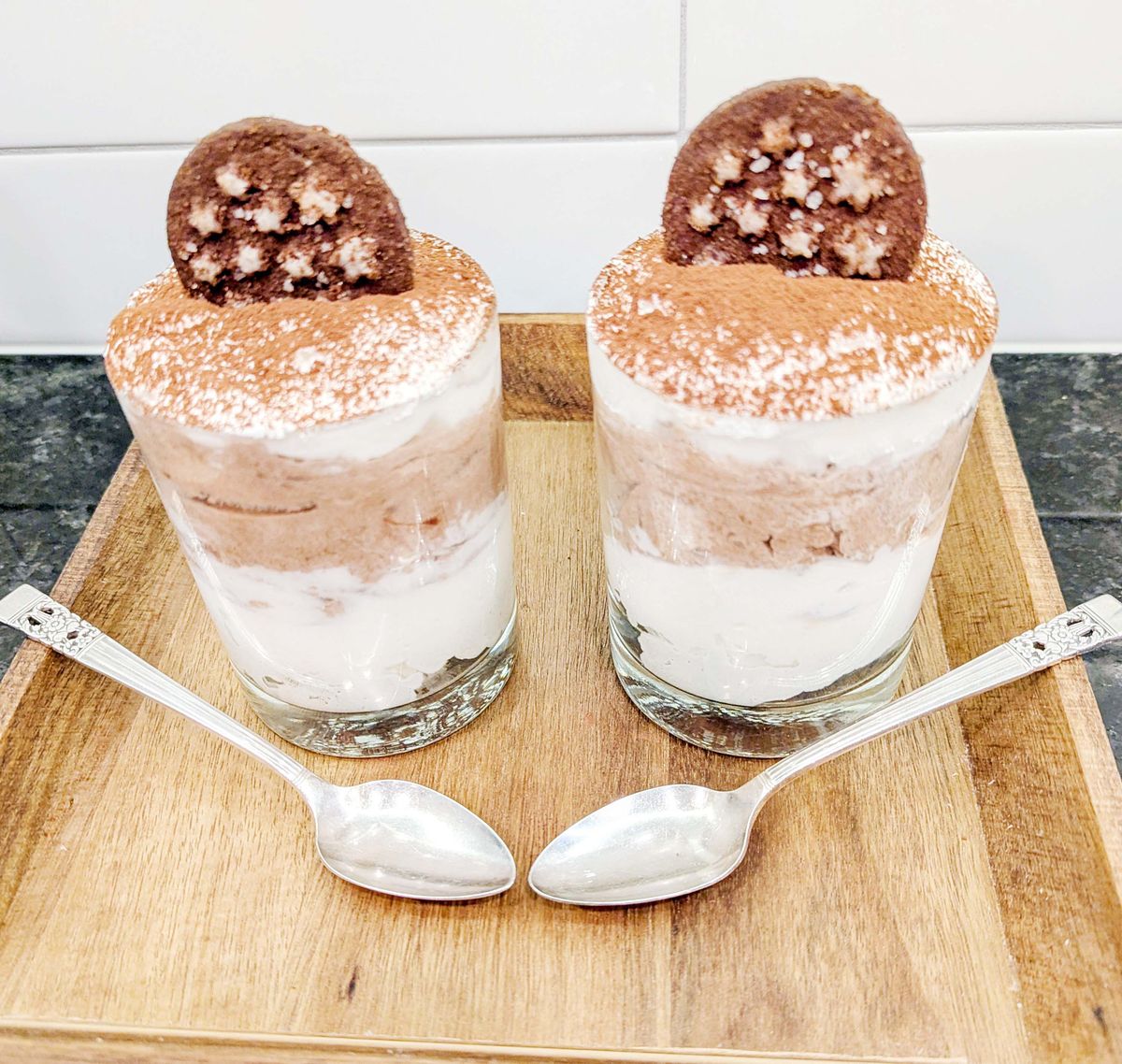
Pan di Stelle Tiramisu for Two
Though it’s heresy to many Italians, Tiramisu has many variations (The New York Times says as many as 200). This recipe, adapted from Victoria Caruso in the Washington Post, is one of my favorites. Though it hews to most traditional conventions (no booze) it swaps ladyfingers for Italian star cookies and egg yolks for Nutella.
• 1 cup cream
• 1/2 tablespoon powdered sugar
Dining and Cooking