
2. If you intend to save the stock afterward, blanch the bird first to render the blood. (Otherwise, it will coagulate and muddy the stock.) Put chicken in pot and add enough cold water to cover. Bring to a boil, remove bird instantly, and then ice it to stop the cooking. Discard blanching liquid.
3. Cut garlic bulbs in half, crosswise, and stuff them into the bird’s cavity along with rosemary and thyme.
4. Truss the bird. (You can watch a simple trussing in this video.) Trussing is optional, but I, irrationally, recommend it. Why? Because in a poach-and-roast preparation, trussing—closing up the bird’s cavity and binding its extremities against the body, with string—serves no practical purpose. (A bird roasted in a high, dry heat is different; there, both stuffing the bird and trussing it serve to slow the cooking—unfilled and untrussed, the cavity behaves like a second oven, heats up the breastbone, and dries out the meat even faster than normal.) I truss because of the aesthetically unpleasing transformation that occurs once the poaching commences: namely, that the extremities of the untrussed bird go perpendicular, as if the creature were suddenly in flight, and there is nothing you can do to make them flap back down again. The bird served thus is not the iconic dish; I truss because I’m a sap for the icon.
5. Add bird to the pot and fill with chicken stock, reserving 1 Tbsp for basting. If there is not enough stock to cover, add water. Place pot over an initial high heat. Never allow the liquid to boil. As its temperature increases, gradually reduce the heat until it approaches 154 degrees Fahrenheit (68 degrees Celsius), at which point your burner should be at its lowest setting. For poaching, a temperature between 154 and 162 degrees Fahrenheit—68 and 71 degrees Celsius—is acceptable. (I mention the centigrade temperatures to illustrate, like a mathematical graph, the modest heat of your cooking liquid. In centigrade, zero is freezing; a hundred is boiling. Our target temperature is only around two-thirds of the way toward boiling.) Your cooking liquid is not even simmering. There are no bubbles. There is a wisp of a vapor moving almost imperceptibly across the surface of the stock. The temperature will fluctuate slightly at first. (You are not using a chemistry-lab water bath—this is country cooking, not sous-vide.) Until it stabilizes, monitor the pot. It helps to have ice cubes at the ready.
6. Poach for 35 minutes, then begin checking the bird’s temperature—both the legs, by inserting a thermometer inside the inner thigh, and the breast, by poking into the meaty front. Once the bird reaches the same temperature as the cooking liquid, continue cooking for another 20 to 40 minutes, depending on the size of the chicken and allowing for possible fluctuations in the temperature. (The F.D.A., I should note, recommends cooking chicken to 165 degrees Fahrenheit, a temperature which will dry out the breast. Slow-poaching is safe at lower temperatures.) Remove chicken from poaching liquid. If serving later, chill and refrigerate. If serving right away, allow bird to rest and cool for at least 20 minutes.
7. Place a roasting tray in the oven and heat it to 450 degrees Fahrenheit.
8. Prepare the basting liquid: in a small saucepan, melt butter, then add sugar, vinegar, and a tablespoon of chicken stock. Baste the bird with some of the liquid and sprinkle the skin with sea salt.
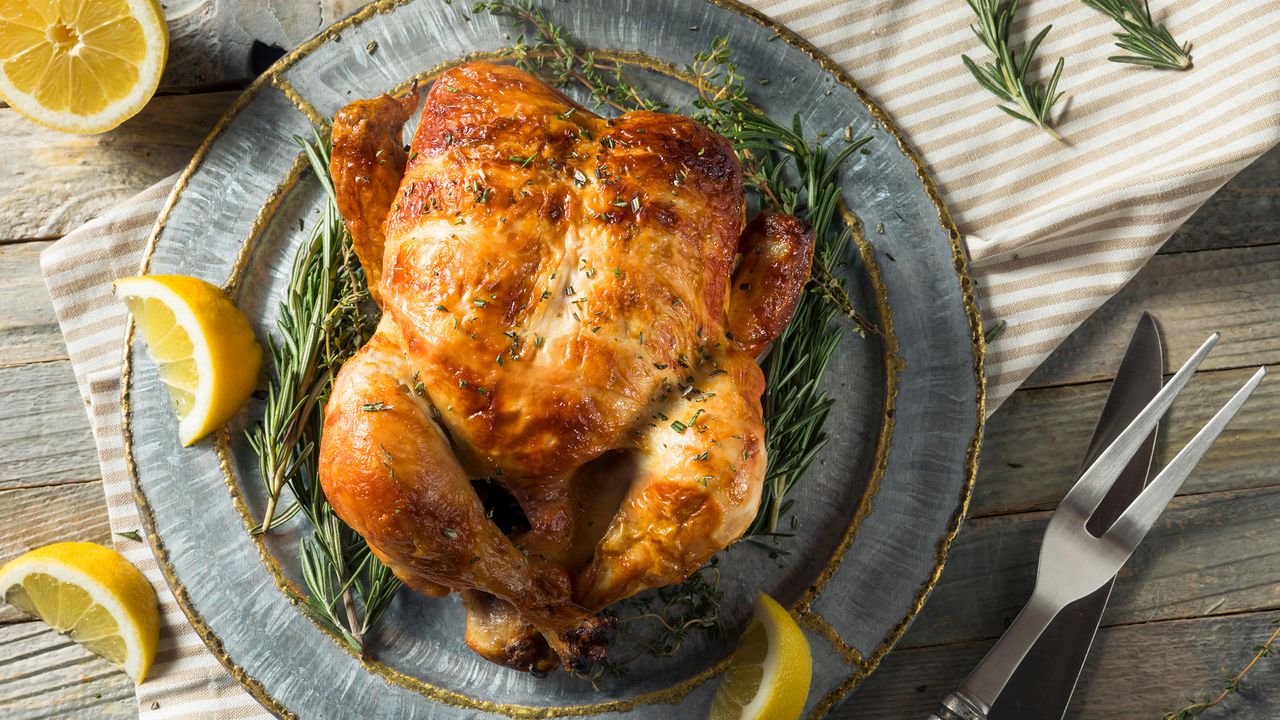
9. Place the bird on the roasting tray in the preheated oven. After 5 minutes, baste. After another 5 minutes, baste again, and reduce the oven temperature to 350. Cook for another 15 to 25 minutes, basting every 5 minutes. When the skin turns golden brown, remove it from the oven. (The objective is to brown the skin and reheat the chicken without cooking it.) Remove the bird but do not turn off the oven.
10. Put a tray in the hot oven. Let the bird rest for 10 minutes, then carve. It is not unusual for the meat nearest the breastbone or thigh to be a little pink. This is fixable. (What is not fixable is overcooking.) Splash olive oil on the tray in the oven and place the undercooked piece of meat on it, pink side down. Check after 2 to 3 minutes.
I like to serve my roasted chicken alongside a rice pilaf made with the poaching liquid. A recipe will be in my next column.
Dining and Cooking