
Breadcrumb Trail Links
EatOlympics
This remarkable designation is one for the history books
Published Feb 19, 2026 • Last updated 0 minutes ago • 4 minute read
You can save this article by registering for free here. Or sign-in if you have an account.
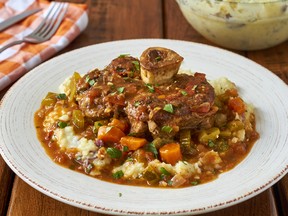 Osso buco – braised beef shank over mashed potato topped with a mixed vegetable gravy. Photo by Getty ImagesArticle content
Reviews and recommendations are unbiased and products are independently selected. Postmedia may earn an affiliate commission from purchases made through links on this page.
While the world’s attention is currently riveted to the Milano-Cortina 2026 Winter Olympics, it should be noted that Italy has already won gold in the culinary department.
Advertisement 2
This advertisement has not loaded yet, but your article continues below.

THIS CONTENT IS RESERVED FOR SUBSCRIBERS ONLY
Subscribe now to read the latest news in your city and across Canada.
Unlimited online access to articles from across Canada with one account.Get exclusive access to the Toronto Sun ePaper, an electronic replica of the print edition that you can share, download and comment on.Enjoy insights and behind-the-scenes analysis from our award-winning journalists.Support local journalists and the next generation of journalists.Daily puzzles including the New York Times Crossword.
SUBSCRIBE TO UNLOCK MORE ARTICLES
Subscribe now to read the latest news in your city and across Canada.
Unlimited online access to articles from across Canada with one account.Get exclusive access to the Toronto Sun ePaper, an electronic replica of the print edition that you can share, download and comment on.Enjoy insights and behind-the-scenes analysis from our award-winning journalists.Support local journalists and the next generation of journalists.Daily puzzles including the New York Times Crossword.
REGISTER / SIGN IN TO UNLOCK MORE ARTICLES
Create an account or sign in to continue with your reading experience.
Access articles from across Canada with one account.Share your thoughts and join the conversation in the comments.Enjoy additional articles per month.Get email updates from your favourite authors.
THIS ARTICLE IS FREE TO READ REGISTER TO UNLOCK.
Create an account or sign in to continue with your reading experience.
Access articles from across Canada with one accountShare your thoughts and join the conversation in the commentsEnjoy additional articles per monthGet email updates from your favourite authors
Article content
Just recently, the country’s cuisine was officially recognized by UNESCO with its Intangible Cultural Heritage designation – for the very first time in the organization’s history, an entire national cuisine has received such an extraordinary honour.
Article content
Article content
From a food perspective, this is a very big deal as, by acknowledging the cuisine’s global identity, this remarkable designation is one for the history books.
One doesn’t have to be Italian to appreciate this accomplishment, and we suspect athletes and visitors to the Winter games may attest to the delicious dishes they’ve been tucking into – the amazing butters and cheeses, meats, pastas and award-winning wines, not to mention soul-hugging cups of espresso coffee.

Your Midday Sun
Thanks for signing up!
Article content
Advertisement 3
This advertisement has not loaded yet, but your article continues below.
Article content
One suspects every person of Italian heritage has always understood the fact that Italian cuisine is not so much about food, but of ideology, of culture and character, of owning an identity that officially stands head and shoulders above all others.
And about a sustenance that is all about bringing people together to celebrate the earth’s bounty with its ability to create dishes with just a handful of local ingredients.

We apologize, but this video has failed to load.
Play VideoCuisine makes up country’s fabric
Italian cuisine is not just one dish but a plethora of recipes that make up the very fabric of the country. Each region, each city, each village has its own culinary cultural identity made up of the foods found on its own land.
When UNESCO initially announced this special designation in early December, Italy went gaga with immediate celebrations that took place not just in the country, but all over the world. There were emotional messages from everyone, including award-winning Massimo Bottura, considered by many as the world’s most famous Italian chef, who described Italian cuisine on his Instagram account as “a love ritual,” and a language “made of gestures, perfumes and flavours that hold an entire country together.”
Advertisement 4
This advertisement has not loaded yet, but your article continues below.
Article content
Italy’s prime minister Giorgia Meloni announced the news in an emotional message on her personal Instagram account (@giorgiameloni), in which she stated this historic recognition “honours the Italian people, celebrates our identity, and exalts a lifestyle loved throughout the world.”
Meloni described the award as “not just food or a collection of recipes…but of taking care of family, friends and guests.”
In fact, one might say Italian cuisine could be considered a global ambassador that enriches all of humanity when you delve into its history and how profound the cuisine truly is.
“This is not simply about recipes – it’s about regional identity, respect for ingredients and the transmission of values,” notes executive chef Luciano Schipano, (lucianoschipano.com), whose many hats include president of the Federazione Italiana Cuochi – the Association of Italian Chefs of Canada. “For chefs in Canada, it reinforces our responsibility to uphold authenticity while educating future generations in a global context.”
Advertisement 5
This advertisement has not loaded yet, but your article continues below.
Article content
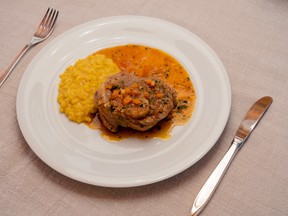 Ossobuco a la milanese with Risotto, Braised Veal Shank. (Getty Images)Not based on just one type of food
For those who are in Italy either as participants or spectators in the Olympic Games, it should be noted that Italian cuisine is not based on just one type of food, be it pasta, pizza or gelato. You’ll find the dishes of the north, where the Olympics are currently taking place (across a broad brush of the country that encompasses Milan to Cortina d’Ampezzo), completely different from, say, the dishes of the country’s centre, and those from the south, which tend to be fiery and brimming with a distinct passion.
Dishes from the north, on the other hand, tend to be rich yet delicate, beautifully balanced with flavours that reflect the land from that part of the country.
For the Olympics, regional dishes of Cortina d’Ampezzo have a decided blend of Austro-Hungarian flair as well as Venetian delicacies. Main dishes may be a celebration of wild game, polenta or ravioli stuffed with beets, known as casunziei. Dishes can be hearty with a nod to the bracing Alpine atmosphere.
Advertisement 6
This advertisement has not loaded yet, but your article continues below.
Article content
Milan’s cuisine, meanwhile, is hearty, rich and embraces traditional dishes that are known worldwide, including risotto all Milanese, with its distinct saffron hue. There’s ossobuco – braised veal shank – and cotoletta, or breaded veal cutlets, and, of course, its famous Panettone Christmas treat, not to mention the delicious Colomba, similar to Panettone but served around Easter.
Milan also has a very profound history in the aperitivo department – liqueurs and bitters that shine on the cocktail stage. Liqueurs like the ruby-red Campari, whose history dates back to the mid 1800s and is the base for such distinct cocktails, including the famed Negroni.
All food for thought next time you sit down to a traditional Italian meal.
Read More

Dina Pugliese heats up new season of ‘Bake Master Battle’

Putting your best face forward – men and women – this holiday season

New cookbook among Jamie Oliver’s latest culinary adventures
Article content
Share this article in your social network
Dining and Cooking