
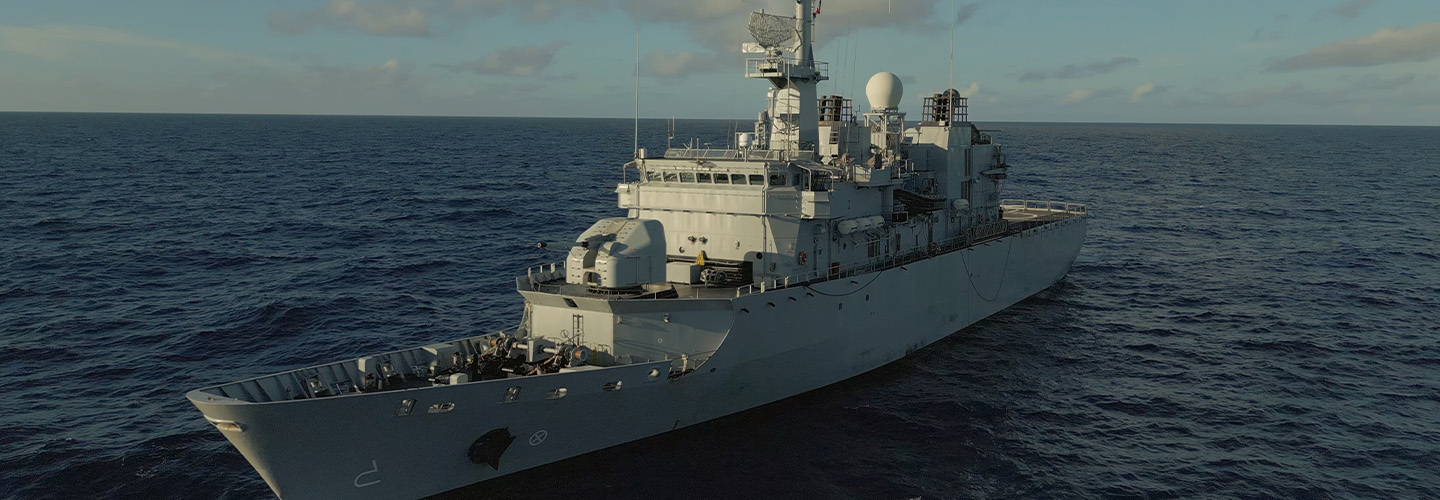
When NSRI Regional Operations Manager and Class 1 coxswain Dean Wegerle put his name forward for “a spot on a French Navy ship”, he didn’t quite expect to find himself on a 98-metre warship, eating three-course meals and learning celestial navigation in the middle of the Indian Ocean.
The opportunity was open to all NSRI Class 1 coxswains and training coxswains who had a valid passport and could spare 12 days away. Names went into a hat, and Dean’s was chosen.
First Steps on a Warship
For a civilian rescuer who spends his time on NSRI’s largest offshore rescue vessels, the idea of stepping onto a French warship felt both familiar and entirely new.
The ship itself is a far cry from any luxury liner. “It’s a purpose-built surveillance vessel for the Navy,” Dean says, “At 98 metres long and 15 metres wide, it’s quite an impressive looking machine.”
When boarding, Dean arrived two days before the vessel sailed and found an almost ghostly quiet ship, manned only by a small guard crew looking after her in port. “You’re shown the crew room, where to eat, and put in your bunk.”
Lost in Translation
If the steel and systems felt familiar, the language did not. “There was a big language barrier,” Dean says. “I learned three words: bonjour, merci, and merci beaucoup. And that’s basically what I could say to most of the crew.”
About 95% of the sailors spoke roughly as much English as Dean spoke French. Thankfully, the bridge officers and the commanding and executive officers could communicate in English, so orders and watchkeeping became a mix of short phrases, patience, and a lot of pointing. “Lots of sign language,” he adds.
A Day in the Life at Sea
Life on board followed an almost ritual rhythm. Tied alongside in port, everyone gathered on the flight deck in the morning for inspection and a briefing on the day’s jobs. “Each department then goes off to do the task on the boat, and everyone’s got a very specific task on the vessel,” Dean explains. “There’s no dawdling and walking around; they all disappear for the day and do their specific tasks.”
At sea, the pattern tightened further. Dean, who usually wakes up very early, had to adjust to the ship’s leisurely start. “The biggest challenge for me was waking up so late,” he says. “They only wake the ship up at quarter to eight.” Between the wake-up call and 09:00, the crew clean everything – bathrooms, toilets, and accommodation. Then they check in with their officers and head to their posts.
Dean’s own role was on the bridge. “I was an Officer of the Watch, and we’d navigate the vessel,” he says. “You’d only be really in command for a maximum of four hours, and then you’d hand over to the next watch.” The watch system rolls on 24/7. Sometimes you draw the eight-to-midnight shift, sometimes the dreaded midnight-to-four.
French Food and Quiet Afternoons
While the work was intense, mealtimes were anything but rushed. Dean expected basic rations between drills. What he found instead was pure French culture at sea. “Every meal is a three-course affair,” he says. “The French take their food very, very seriously.”
A full chef team feeds 98 people out of a massive industrial galley. “They’ve even got their own bakery on board,” Dean explains. “All the bread, croissants, and pastries were baked fresh. The food was just really well-prepared and cooked from raw produce.”
And after lunch? The entire ship slows down for a siesta. From 12:00 to 14:45 it is officially rest time. Crew can read in their bunks, head to the gym on board or join the steady stream of runners doing laps around the deck. There is also a large communal area with a television for rugby and cricket, as well as enough games and consoles to keep a young crew occupied on long deployments.
Training, Drills and a Sextant
For Dean, one of the most striking parts of the experience was seeing how much it aligned with NSRI practice. “There were a lot of things that we can be very proud of that we do,” Dean reflects. “I would say we are up there in terms of our quality and our skill set.”
The biggest difference lay offshore, out of sight of land. NSRI crews are coastal navigators, so there is always a headland or lighthouse to fix on. On blue water patrol, the French crew keep old navigation skills alive. “They use a sextant to get a fix,” Dean says. “I was taught how to use a sextant to find our position using the sun, the horizon and some stars, which was really, really cool.”
Drills are also a part of everyday life on the warship. “Twice a day, there’d be an emergency drill of sorts – a fire in the engine room, a man overboard, we lost steering, our GPS has failed, or we have a firing exercise that we’re being attacked,” he explains. “They’re constantly training.”
The Moment It All Sank In
It wasn’t until the very end that Dean realised quite what he’d been part of. “The last night after being at sea for the nine days, I got in the shower, and I thought, ‘Hang on, this is my last shower,’” he recalls. Back in his top bunk in a three-tiered cabin, surrounded by the men he’d shared this strange, intense world with, it hit him: “This is something quite incredible, and it’s all over.”
The next morning, he walked onto the bridge and saw Lion’s Head on the horizon. “From being in the open [ocean] all the way to your home port was something special.”
And once back on land, his body still thought it was at sea. “You get back onto land, and then you still have that same wobble,” he laughs. “You’re sitting in the shower, and you still feel yourself rocking back and forth. It’s physically impossible, but your brain is still telling you you’re at sea.”
A Once-In-A-Lifetime Opportunity
Asked to sum it all up, Dean doesn’t hesitate for long. “It was just absolutely incredible. The experience was just once in a lifetime.”
For a civilian rescuer to spend 10 days embedded on a foreign warship, standing watch on the bridge, running drills, and even playing Uno with the commanding and executive officers in off-duty moments, is not something that happens twice. As Dean puts it: “Getting to see the ins and outs of life on a warship, it’s just incredible.”
Dining and Cooking