
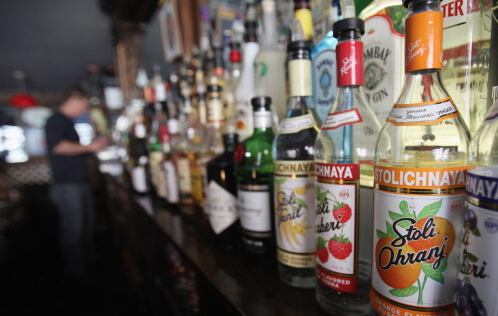
The bill, if signed by Gov. Abigail Spanberger, would change the way Virginia restaurants operate. (BizSense file photo)
It’s now up to Gov. Abigail Spanberger to potentially change the state’s long-standing “45-percent rule” for some of the state’s bars and restaurants.
The Senate of Virginia on Tuesday voted to pass a bill that would loosen the requirement of food-and-beverage establishments that serve liquor to have at least 45% of their sales come from food.
The vote marks the conclusion of the bill’s journey through the General Assembly and sends it to Spanberger’s desk for consideration.
The bill, HB975, would create a tiered system where the more food sales an establishment has, the lower its food-to-liquor ratio would have to be. If signed into law, a restaurant that has between $25,000 and $48,000 in monthly food sales would only have to have a food-to-liquor ratio of 30%, and restaurants that have more than $48,000 in monthly food sales would not have to meet a food-to-beverage ratio of any kind.
The bill spells out other stipulations for lower-volume food sales restaurants. Those that have less than $25,000 in monthly food sales would have to continue to meet the 45% rule; however, if a restaurant with that volume of food sales is physically smaller, specifically having fewer than 30 seats and an occupancy limit below 60, it would only have to meet a 30% food-to-beverage ratio.
Changing the 45% rule has been a legislative effort dating back to at least 2014, and more recent bills that would have changed it have failed to make it out of the General Assembly.
This latest bill’s patron, Elizabeth Bennett-Parker (D-Alexandria), argued in a hearing that her bill would modernize the law to match current pricing and consumer tastes.
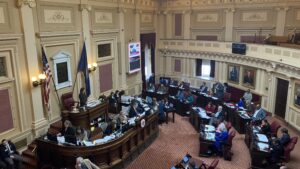
The Senate voted to approve the bill Tuesday afternoon. (Mike Platania photo)
“Today, a large number of consumers seek restaurants that specialize in craft cocktails or rare and limited-edition spirits,” Bennett-Parker said.
“For these restaurants, even with serving plenty of high-quality food, meeting the current flat 45% food ratio becomes mathematically difficult, if not impossible. For example, a $5 pour of bourbon could have the same amount of alcohol as a $25 or $50 pour of bourbon, but a restaurant would have to sell five or 10 times as much food to meet the ratio.”
Bennett-Parker patroned the bill when she was a delegate, but over the course of the bill’s life, she won a special election for a seat in the Senate that came available when former Sen. Adam Ebbin resigned to join the Spanberger administration. That resulted in the unusual situation of Sen. Bennett-Parker voting in favor of a bill that she’d written while a member of the General Assembly’s other house.
The bill is supported by the Virginia Restaurant, Lodging, and Travel Association, the statewide trade group that had previously been neutral on changing the 45% rule, but has since decided to support it. The VRLTA’s director of government affairs Tommy Herbert said they’re grateful to those who helped get the bill over the finish line.
“This is a responsible, necessary reform that will help not only Virginia’s ABC-licensed restaurants, but licensed full-service hotels as well. We will remain focused and supportive as the bill now heads to Governor Spanberger’s desk,” Herbert said.
Also making their way through the General Assembly this session are a pair of bills that would allow Virginia distilleries to serve more spirits in their tasting rooms, specifically 4.5 ounces per customer, up from the current limit of 3 ounces. Those bills are awaiting their final votes.
Print Article
Dining and Cooking