
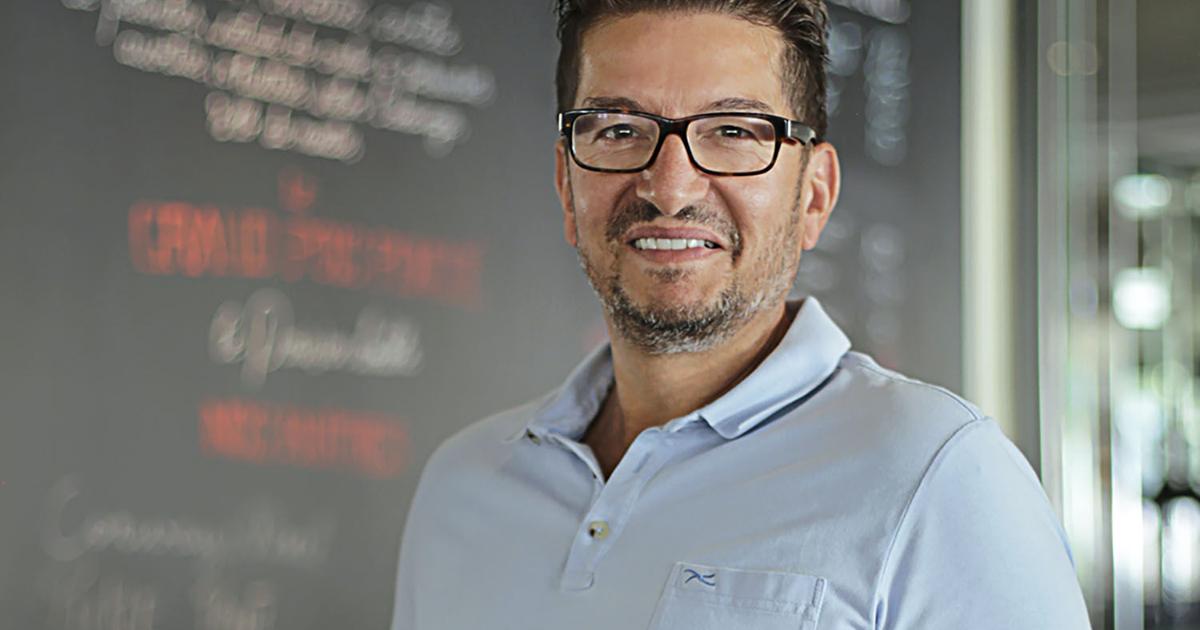
Imad Nabwani left his native Syria for Europe when he was 24 to further his education and his work experience — not a bad idea for a person establishing a career in the fine-dining industry. After his time at EHL (École hôtelière de Lausanne) in Switzerland, and working in Paris and Biarrtz, France, Nabwani came to Canada in 1993 and quickly made his name in some well-known establishments. The Suburban recently spoke to Nabwani, founder of Golden Square Mile Hospitality Group (GSMH), and owner of Le Pois Penché, a Parisian brasserie located in downtown Montreal. The conversation has been edited for length and clarity.
The Suburban: What made you leave Europe for Canada?
Imad Nabwani: My wife is Syrian-Canadian, which is one reason why I came here. Another reason is I was looking for something else, a different opportunity.
The Suburban: What did you do after you arrived?
Nabwani: I worked in the industry and eventually attended l’ITHQ (Institut de tourisme et d’hôtellerie du Québec) the premier hotel school in Quebec. After working a few more years in the industry, in 1998 I joined the group La Queue de Cheval [a high-end downtown steakhouse and seafood lounge]. Within six months I became the general manager of the restaurant, and after two years, I became the vice-president of the operation for the whole group. Over the years, I was also involved with Trinity and 40 Westt.
The Suburban: What is Golden Square Mile Hospitality Group (GSMH) and when did it get off the ground?
Nabwani: After working with La Queue de Cheval group for over 10 years, there was an opportunity for me to acquire Le Pois Penché in 2011. At that time, I also founded GSMH, hoping to acquire more businesses. Today, GSMH is a group that develops, manages and creates concepts for others. For example, we worked with Le St-Martin Hôtel Particulier and Henri Brasserie Française at the five-star Hotel Birks.
The Suburban: What inspired someone with a Syrian heritage to open a French brasserie in the heart of Montreal?
Nabwani: The first foreign city I ever visited was Paris. I was probably 17 and that first impression lasted all my life. I still remember the smell of the food, the streets, the scenery of the brasserie, the oyster shucking on those main streets… These memories stayed with me and over the years I always said, ‘One day I will open and own a French restaurant.’ Then, through my education, I learned about French food, French culture, and I became a sommelier and then a member of the Confrérie des Chevaliers du Tastevin and Coteaux de Champagne. I got really involved in that food-and-wine culture at a very deep level.
The Suburban: How do you make a good restaurant a better one?
Nabwani: My philosophy is very simple: don’t reinvent the wheel, maintain it very well, and above all, emphasize the hospitality aspect of the business. You could go anywhere and have a decent meal and decent servers, but what will last in your mind and will make you come back is the hospitality. How can we make you as a guest leave happier than when you came in? It’s a very simple formula, and we emphasize that at all levels — from managers to waiters to busboys to cooks. When you come to our establishments, specifically Le Pois Penché, once a person becomes a regular, the staff know you and address you by your name, they know what food you eat and your drinking habits. Also, we’re not following the fast trend, we’re following sustainability. We want to stay there forever, which is how a restaurant becomes an institution, connected to the city, connected to the community.
The Suburban: What do you enjoy about this industry?
Nabwani: This is a type of business that presents a different challenge every single day. If I come to work 360 days a year, the beauty is that there are no two days that are identical. Your clients are different, your challenges are different, your problems are different, the service and the people are different. That’s what probably keeps me coming. There’s so much excitement. If I take a decision along with my team, the results are seen right away. A simple example is, if you change your dish, or work with your chef on a different recipe, you will see the reaction the same day. You will see the effect on your sales, probably within a week or a month, and that would create excitement.
The Suburban: What’s the toughest part?
Nabwani: There are, of course, curve balls thrown at you every single day in the life of a restaurant. Things you don’t expect that you have to deal with. You can’t come one day not feeling good and not performing. You are on the stage, and you have to perform every single day. That’s what makes it very difficult. You want to keep people’s level of satisfaction very high all the time. And this is not easy. n
Dining and Cooking