
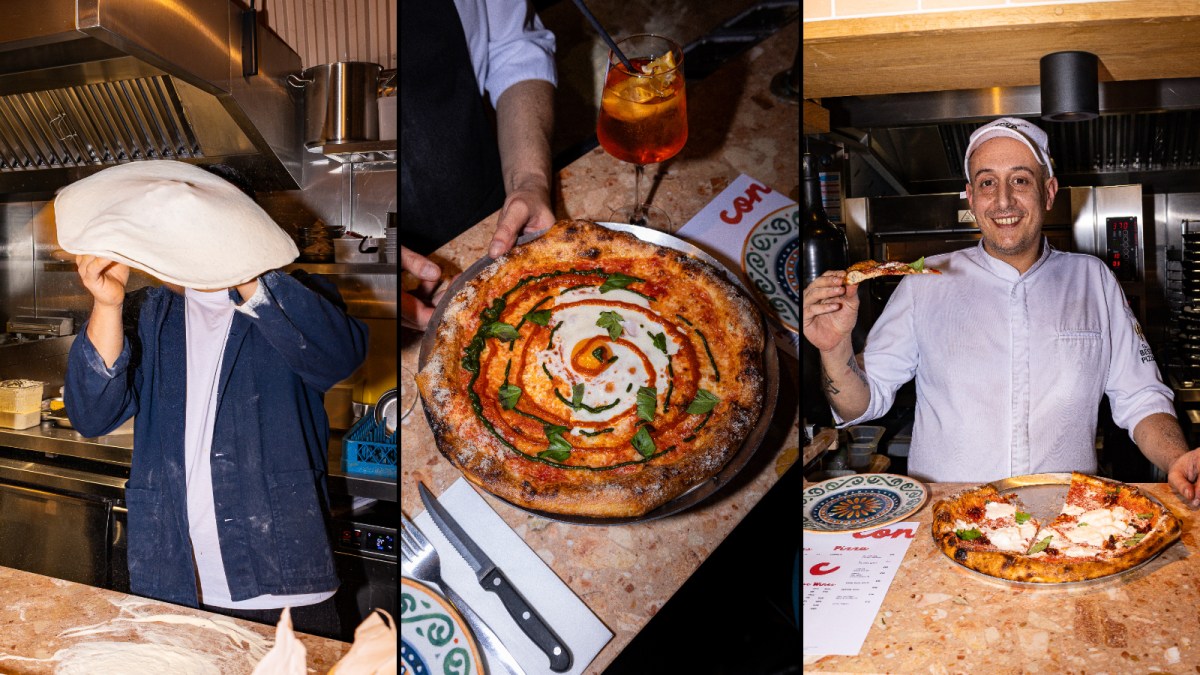
The pizza scene in London has changed a lot over the past 15 years. Firstly it was born arguably in 2008 with the arrival of Franco Manca. This brought real Neapolitan pizza to London, which introduced Brits to how pizza should taste, and subsequently started a movement. Now there are tons of authentic Italian pizzerias all over the UK.
Our collective appetite for what existed before (Pizza Express, Pizza Hut et al) waned as we realised you could get the real deal for the same price — or cheaper — at the little independent place down the road.
Now it feels like a new pizzeria opens in the capital every week. As a food journalist I’m constantly getting invites to the latest cool opening with its extra slow-fermented dough and mozzarella straight from Campanian buffalo. There is now such a wealth of good pizzerias that I can’t keep up.
But one recent invite stood out from the rest: a place serving “Bri-talian” pizza.
Being Bri-talian myself (Italian mother, English father), I was intrigued so headed down to Connie’s (named after the owner’s wife, Constanza) in the beautiful former premises of the South African restaurant Little Kudu, near Queen’s Road Peckham station.
“Bri-talian pizza is simply Italian technique meeting British taste,” explains the owner Andrea Asciuti, who is also behind the Neapolitan pizzeria 081, with sites in Peckham and Shoreditch. “Some may think it’s a gimmick or a marketing phrase but it’s genuinely my way of paying homage to my family. I moved to London when I was 20 and now I’ve spent almost the same number of years here as I did in Italy. My daughter will grow up British and Italian. Connie’s is the pizza expression of that identity.”

Connie’s occupies the former premises of the South African restaurant Little Kudu, near Queen’s Road Peckham
This manifests on the plate as a crisper slice with significantly more structural integrity. That characteristic flop of a Neapolitan pizza isn’t there and although you could fold it, you don’t need to. It’s a style that’s been bubbling up recently (slow-fermenting, if you will) and while Asciuti may call it Bri-talian, I’d call it London-style.
To create this distinctive base Asciuti uses a stronger flour, lets the dough ferment for longer and cooks the pie at a lower temperature, between 350-370F. He says the years he spent mastering the Neapolitan style gave him the skills to experiment with something new. Asciuti moved to London from his home town of Naples in 2021 to open a pizzeria in Streatham.
“At that time Neapolitan pizza was just starting to become a trend,” he says. “There weren’t many of us doing it so people were travelling from all over London just to try the pizza. It was fantastic — the golden age of pizza. The wood-fired oven was still something new for the market and customers didn’t have the knowledge they have now. Everything felt exciting and fresh.”
• I’m an olive oil connoisseur — these are the best bottles to buy
Having had huge success there, and in his subsequent 081 openings, why change it?
“With Neapolitan pizza I am a purist and I still love it deeply but Neapolitan has cultural rules that I respect too much to bend,” he says. “Connie’s gives me a platform to experiment without feeling like I’m disrespecting tradition.”
Toppings on the crisper base are more creative and novel, “combinations that would be considered controversial on a Neapolitan base”, he says. “Things like wild garlic, leeks, British sausages — flavours that reflect what’s happening in the UK rather than Italy.”
How about, dare I ask, pineapple?
“No. Pineapple is the limit of my flexibility,” Asciuti, 35, says firmly. “Sweetness can work in pizza — honey with pepperoni, for example — because it has a purpose and a balance. Pineapple often dominates instead of complementing.
“For me, pizza is about harmony. I’m happy to provoke the scene but not at the expense of balance. Creativity is important but so is knowing when to stop. Pineapple is where I stop.”
• Three low-carb Italian recipes — the top chefs’ healthy favourites
Italians are typically antsy about chefs (or anyone) breaking with tradition and messing with one of their recipes, and the Napoletani are even prouder still. What do they make of Bri-talian pizza?
“Some would hate it, and that’s fine,” Asciuti shrugs. “Naples is proud for a reason. Pizza there is like a religion. But I’m not replacing Neapolitan pizza. I still make it, I still respect it and I still believe it’s one of the greatest foods in the world.
“I think different styles exist for different moods. Neapolitan is like classical music: beautiful and precise. London or New York styles are more like jazz: still technical but with room for improvisation.”
The most important question is: how does it taste? I ordered the Connie’s, which comes with tomato sauce, aged mozzarella, spinach cream and a soft egg in the middle (a cheeky nod to the Pizza Express Fiorentina, Asciuti explains). I also went for the chef’s favourite: the vodka sauce with added stracciatella (the creamy bit inside a burrata).
The crisp base adds a moreish depth of flavour to the pizza and the toppings, particularly the creamy vodka sauce, were perfectly made. Though it’s not something I’d usually order, I even liked the translucent egg on the Connie’s because dipping a crust-end in a gooey yolk is obviously an enjoyable act.
Bri-talian pizza is undoubtedly delicious and I enjoyed it, but for me Neapolitan style wins every time. A proper margherita, made how it should be in the style of its birthplace is nothing less than a work of art. With its tangy, soft dough, burnished pillowy edge, sweet but acidic tomato sauce and fresh, milky, just-melted mozzarella with a scatter of fragrant basil, it is one of my favourite things on this earth to eat. And one of the best examples of this I’ve ever tried (here and in Italy) is at Asciuti’s other place, 081 — named after the dialling code for Naples.
• Your guide to life in London: what’s new in culture, food and property
While Bri-talian pizza will no doubt be a huge hit among those who like a crisper base and more American-style toppings (like pepperoni and hot honey), you’ll find me at the original. Maybe I’m more Italian than Bri-talian after all.
Dining and Cooking