
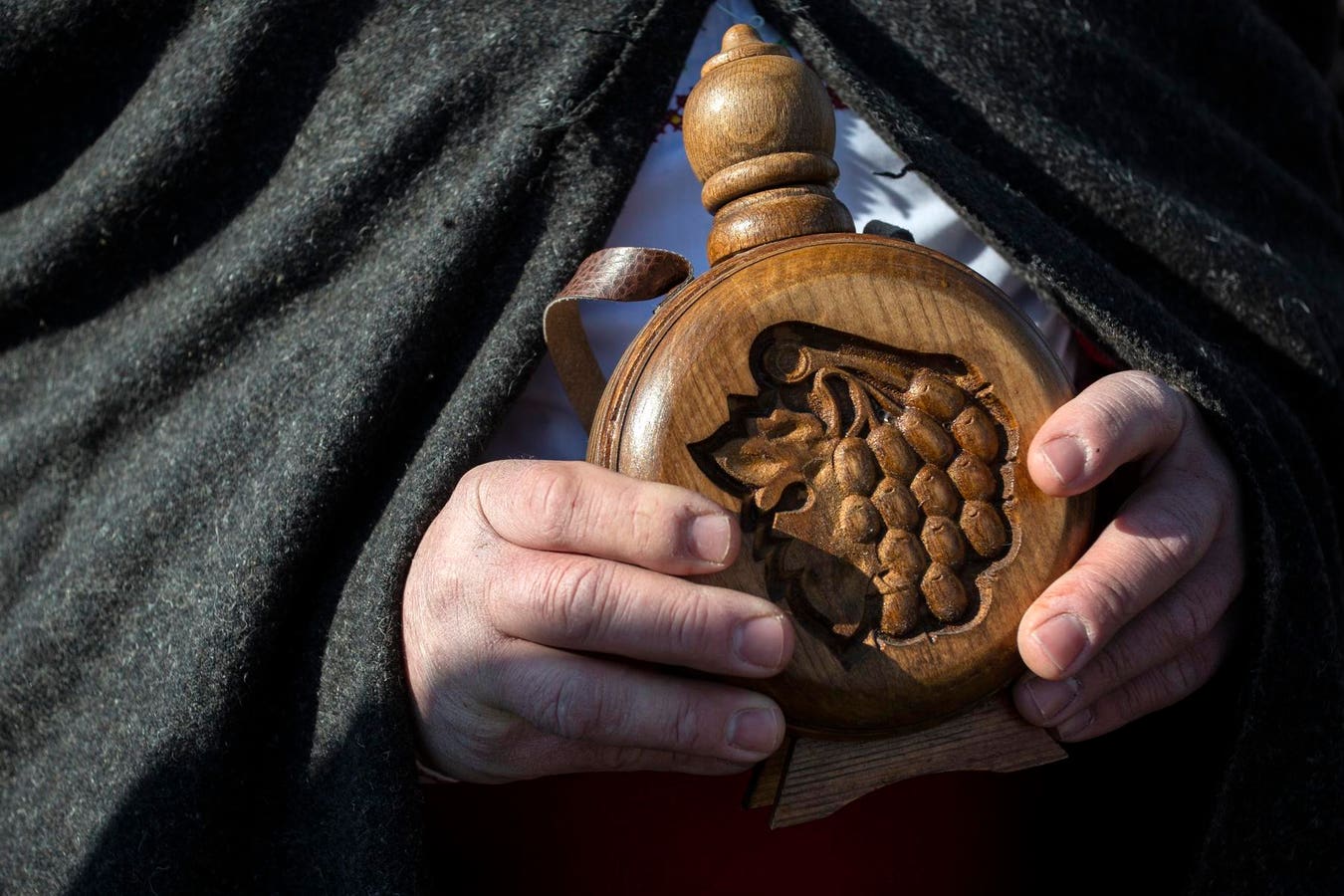
Bulgaria people celebrate the holiday of winegrowers and wine producers, known as St. Trifon (Trifon Zarezan) Photo by Hristo Vladev/NurPhoto via Getty Images
NurPhoto via Getty ImagesThe Bet To Make Bulgaria The Next Argentina
When Robert Hayk started building his Bulgarian wine import business, G&B Importers, 12 years ago, he repeated the same ambition to anyone who would listen, saying, “I want to turn Bulgaria into Argentina.”
For Hayk, ‘Argentina’ is shorthand for a credibility shift and transformation that wine people understand. Argentina, once dismissed as value-only, is now recognized for serious terroir and world-class potential. He believes Bulgaria has the raw ingredients—history, vineyards, talent—but needs the modern discipline and global narrative that can move it from overlooked to excellence.
Rough Day Cabernet Sauvignon
Rough Day
As co-founder of G&B Importers, Hayk has spent years introducing Bulgarian wines to the U.S. market through brands like Bulgariana and Rough Day Wines (carried nationally at Whole Foods), an experience he’s now channeling into the premium Hayk & Hobbs project with American winemaker Paul Hobbs. The first vintage (2024) is expected to be released in spring 2026.
Hayk & Hobbs, a single-vineyard Bulgarian Cabernet Sauvignon from the Sakar Hills of southeast Bulgaria, will debut as a small release of about 600 cases, aged in second-use French oak and positioned at roughly $45–$55 retail, with initial allocations planned for the U.S., Japan, Sweden, and Bulgaria.
The goal is bigger than a new brand. “The wine is the output, but the mission is rebuilding a region,” Hayk said.
A Personal Stake In Bulgaria
Hayk’s urgency comes from biography, not trend-chasing. “For me, this is deeply personal,” he said. He arrived in Bulgaria after leaving war-torn Armenia in the aftermath of the Soviet collapse and describes Bulgaria as the place that gave him and his family stability when it mattered most.
“Bulgarian wine hits me on two levels: identity and memory. Bulgaria isn’t my birthplace, but it became a second homeland during a formative chapter of my life. It’s a piece of my own story—something ancient, soulful, and deeply connected to the people and landscapes that rebuilt me when I was young.”
“Bulgaria… became an amazing home and a launching pad for me… and that soul connection remains. Reviving the region isn’t just business. It’s like legacy.”
Robert Hayk, Co-founder, Hayk & Hobbs
That emotional center is also why he talks about Bulgaria’s wine regions as communities under pressure, not just vineyards with potential. “When we travel through those beautiful regions… you see these desolate villages. No kindergartens, no schools. People leave,” he said.
Returning from the Grape Harvest, 1893. Anton Mitov (1862-1930). Bulgarian painter. National Art Gallery. Sofia, Bulgaria. (Photo by: PHAS/Universal Images Group via Getty Images)
PHAS/Universal Images Group via Getty Images
Many growers left, yet many stayed and tried to keep making wine. They could have taken EU subsidies to grow wheat. Hayk explained how he asked why they hadn’t done that. “And people just cried. Like, ‘I can’t do that. My great grandfather grew grapes here.’”
The “next Argentina” bet, in his telling, isn’t only about prestige. It’s about giving growers the chance to stay.
The Quality Gap Bulgaria’s Trying To Close
Hayk argues that Bulgaria’s modern wine reputation has been shaped by a structural imbalance. “In Bulgaria… volume was much more important than quality,” he said, describing how vineyard work was often treated as agriculture rather than a fine-wine craft. The result, he believes, was a tendency to rely on cellar technique instead of farming excellence. “They would just grow grapes, and then they would do magic in a winery…with expensive additives.”
Whether or not every producer fit that description, Hayk’s point is that Bulgaria doesn’t need a rebrand as much as it needs a quality system—starting in the vineyard.
A row of wine bottles are seen on display for sampling at the annual Vinaria wine fair in the southern city of Plovdiv on March 18, 2009.
AFP via Getty ImagesPaul Hobbs And The Push To Make Bulgaria The Next Argentina
When Paul Hobbs entered the scene, “Argentina” became more than a metaphor. Hobbs has a vineyard-first doctrine that can be applied across regions. “Paul’s approach is that 98% of the process is in the vineyard.”
Hayk emphasizes that Hobbs’ participation isn’t automatic. He believes Hobbs is selective because “for him, partnership is extremely important… who he works with is extremely important,” and he’s looking for teams willing to execute change rather than resist it.
One reason Hobbs ultimately leaned in, Hayk suggests, is the strength of the team on the ground—especially Nina, Hayk’s longtime manager in Bulgaria. Hayk describes Hobbs as drawn to people who combine experience with humility and curiosity, and he credits Nina—an industry veteran—with being willing to change her approach by implementing new viticulture practices. It’s a small detail, but an important signal: this isn’t a fly-in consulting story; it’s a systems story.
Winemaker Paul Hobbs at his Viña Cobos Estate in Mendoza, Argentina.
SENA Sebastian
For Hayk, the partnership also depends on faith over ego. “Whatever he says, we’re gonna do, because I believe in his expertise, I believe in his knowledge, and I see the results.”
From left to right: Robert Hayk, Paul Hobbs, and Paul’s daughter, Agustina, also a winemaker.
Robert Hayk
“Paul’s focus is precision, balance, and structure—building a wine that can stand on the world stage,” Hayk said. Rough Day and Bulgariana are the established entry points; Hayk & Hobbs is meant to be the “turning point” bottle.
“We have basically tried to create an entry premium quality brand, which is Rough Day, that is unapologetically good,” Hayk explained during an international video call. “It can compete with California $25 wines easily. The idea is to deliver tremendous value, but with that, help people understand that the region is capable of so much more.”
The early traction suggests the approach is working. The 2021 Rough Day Cabernet Sauvignon, available in the US, was awarded 92 points by Wine Enthusiast. Hayk describes it as, “clean, terroir-driven, affordable, and true to the region’s character.”
If the “next Argentina” comparison holds, it will be because the wine is good—and because the system behind it is repeatable.
Hayk is clear about what success will ultimately mean on the ground. “Every bottle supports families staying in villages that have been practically abandoned for 30 years.”
In the end, his argument isn’t that Bulgaria needs saving; it’s that it needs a proof point strong enough to reset expectations. If Argentina’s modern wine story was a shift from undervalued to internationally respected, Hayk believes Bulgaria can follow—built on vineyard precision and a personal motivation that goes beyond the bottle.
Dining and Cooking