
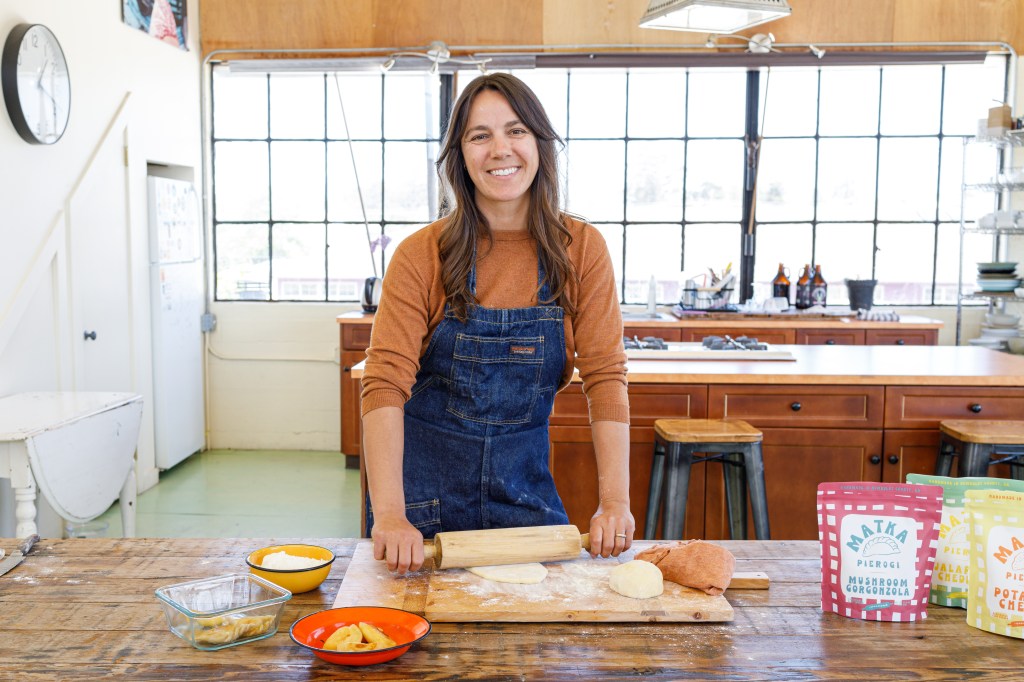
I met Theresa Dillon of Matka Pierogi in college when she cooked Sunday dinners for a rotating cast of friends — all of us HSU students missing home. She had an easy warmth that made you want to hang out in her kitchen. We called her Mama T.
It was Easter Sunday when I tried her pierogi for the first time. Her’s were boiled then fried in butter, golden and crackling on the outside, molten on the inside.
After graduation, a few of us got a house together. Theresa moved in with her newborn son, Noah. While the rest of us stumbled through the basics of adult life, Theresa was raising a child on her own.
Theresa is named after her grandmother, Theresa Marie Sable, daughter of Slovak immigrants. “She was my funny grandma. She’d tell me, bring me ice water, I’ll give you a quarter. But she never gave me a quarter.”
Grandma T never bothered with an electric mixer, instead, she’d stand at the counter and squish eggs and butter into the flour with her bare hands. Young Theresa wanted no part of it. “I thought, ‘ew!’ But I would eat everything she made because it was delicious.”
Over the holidays, the family would gather to make pierogi. Kids older than 10 were tied into oversized aprons and given a job along the assembly line. The women teased each other, “you’re not pinching them right!” while the youngest kids ran underfoot. It was a chore everyone loved doing together.
In 2022, Theresa called me for advice. I had just shut down my pandemic-era food business, and she was thinking of starting up her own. I told her to keep it simple. Don’t make the mistake I made. Stick to the thing you do better than anyone else.
She made her first batch of pierogi in her home kitchen and sold out the next day. She made double the next week and sold out again. She named the business Matka, from a Slovak expression her grandmother used to say — matka drahá, roughly, mother of god. “Matka means mother,” Theresa says. “That’s me.” Farm stands picked her up. Then grocery stores. Soon, she was rolling and pinching thousands of pierogi. “I never felt like I was forcing anything. Doors kept opening.”
“Then my carpal tunnel got so bad, I thought Matka was over.” Theresa looks down at her hands. “My customers told me: Don’t let this product go away.”
“The tradition is to make them by hand. I was worried that using a machine would change the taste.” She flew to a manufacturer anyway and had a custom machine built to her exact specifications. The recipe didn’t have to change. She thinks Grandma T would approve. “My grandma used to say, you peel your potatoes and then you rest. You make your dough and then you rest. I have a really hard time with the resting part.”
Now she runs the machine while her kids are at school, does all the deliveries, all the finances, all the social media. After she puts her kids to bed, she crawls back out to the kitchen to package frozen pierogi. Then she wakes up and does it again.
Theresa studied social work because she wanted to help people. She never expected that selling dumplings would fulfill that need. “The food holds so much. It’s storytelling. It’s comfort. You don’t need a language to share it.”
At grocery store demos, picky kids try a sample and drag their shocked parents back to the booth. Older people stop and tell stories. My parents were from Ukraine. I haven’t had these in so long. They taste like a hug from my grandma. One man told her his wife was pregnant and Polish, and pierogi were the only thing she could keep down.
“I feel like I’m doing the work I studied as a social worker.” Theresa says, “and that feels really good.”
Grandma T passed away when Theresa was just leaving for college. She never saw any of this. When I ask what she would think, Theresa laughs. She’d be shocked, probably a little confused. ‘People know who I am? What’s so exciting about me and my recipe?’ She wouldn’t have imagined there was a business there, but she’d love it.
When I ask what she’d tell someone in Humboldt who’s thinking about turning a family recipe into a business, she doesn’t hesitate. “Do it. And keep the love in it. If you can do that, people will eat it up.”
I am the Project Manager for Humboldt Commons, and when I’m not working, you’ll find me backpacking in the Trinity Alps, running local trails, lifting weights, or cooking with friends. Humboldt has always been home, and I’m excited to be part of Humboldt Made to support our local makers and help keep the small business economy thriving in the community I love.
Dining and Cooking