
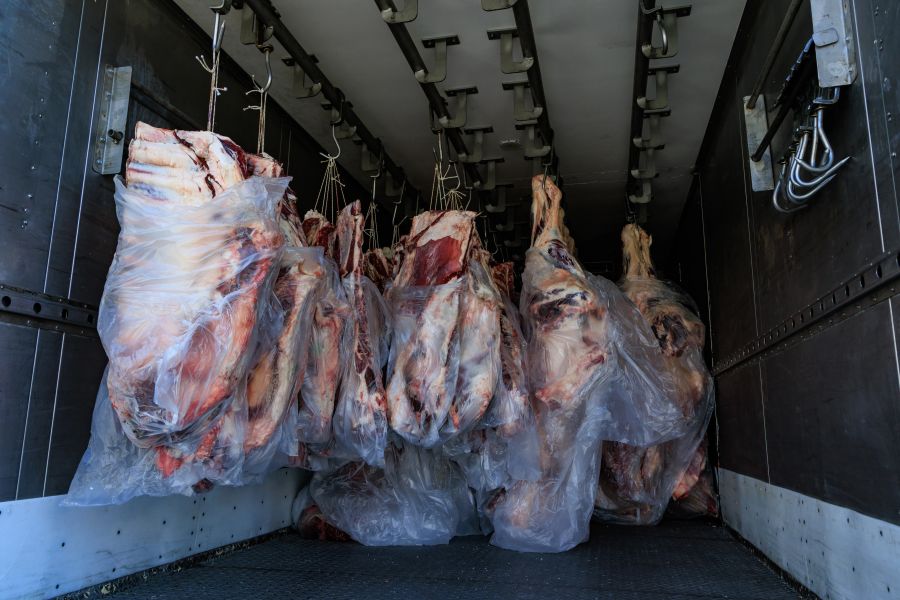
The first tariff-free shipment of British beef has arrived in the US under the UK-US Economic Prosperity Deal, entering a market where cattle herds have fallen to their lowest level in 75 years, and retail beef prices have surged 72% since 2020. The reciprocal 13,000-ton quota secured under the deal is worth up to £70 million (US$88.5 million) a year if fully utilized, according to the UK government.
UK Environment Secretary Emma Reynolds is leading the country’s first dedicated agri-food trade mission to Washington, DC, to build on the deal.
The landmark shipment was made by Foyle Food Group, Northern Ireland’s biggest red meat exporter, which employs 1,150 people in the UK. Valued at more than £190,000 (US$240,000), the consignment alone attracted nearly £50,000 (US$63,000) in tariff relief.

“This agreement provides tariff-free access to the world’s largest beef market,” says Michael Acheson, business development at Foyle Food. “Securing this dedicated UK quota for the first time also allows us to build longer-term business relationships and provide a more consistent and reliable supply into the US market.”
UK Business and Trade Secretary Peter Kyle says the deal is already delivering tangible results. “For the first time, UK beef farmers have exclusive access to a market of over 300 million people, and that is a direct result of the deal we struck with the US last year,” he says.
A market desperate for supply
The timing is significant. The US cattle herd fell to 86.2 million head as of January 1 — the lowest since 1951 — while ground beef hit US$6.69 per pound in December 2025, up 19.3% year-over-year. The USDA’s Economic Research Service forecasts wholesale beef prices to climb a further 6.9% in 2026.
The supply crunch has been compounded by the closure of the US-Mexico border to live cattle since July 2025 due to the spread of the New World screwworm, cutting off approximately 1.24 million head of annual feeder cattle imports. In response, US President Trump signed a proclamation in February temporarily quadrupling the tariff-rate quota for Argentine lean beef trimmings.
Major US packers have reported steep financial losses. Tyson Foods reported a US$319 million operating loss in its beef division in Q1 of fiscal 2026, while JBS posted a US$293 million loss at its North American beef operation in Q2 2025.
Standards held, access gained
The deal also marks a quiet resolution to one of the most contentious threads in UK-US trade negotiations. In April 2025, the White House explicitly cited the UK’s bans on chlorine-washed chicken and hormone-treated beef as justification for its tariff measures, calling them “non-science-based standards.”
At the time, NFU president Tom Bradshaw warned the US was pressuring the UK to weaken its sanitary and phytosanitary standards as a concession.
The Economic Prosperity Deal appears to have sidestepped that impasse. Tariff-free access has been achieved through a quota mechanism without any announced changes to UK food safety requirements.
“There is a growing demand in the US for a range of UK products, not least British beef but also lamb, dairy, and pork,” says Bradshaw. “We hope to build on this momentum and champion high-quality British produce in new and potential markets.”
Export ambitions
The trade mission coincides with broader ambitions to grow UK food and drink exports, which were worth over £25 billion (US$31.5 billion) globally last year — £2 billion (US$2.5 billion) of which went to the US. Reynolds is attending the US Annual Meat Conference (March 2–4) to support five of the UK’s largest meat exporters and will host a Food and Drink Showcase at the Ambassador’s Residence.
Emily Norton, chair of the Agriculture and Horticulture Development Board, says the quota builds on existing momentum. “The appetite for our world-class red meat and dairy produce was underlined last year with record values of UK exports achieved for both sectors,” she says.
Still, questions remain about the reciprocal side of the deal — namely, whether the 13,000-ton US-to-UK quota will raise the same food standards concerns that dominated negotiations. And at 13,000 tons, the UK quota represents a fraction of the supply gap left by more than a million head of lost Mexican cattle imports.
Dining and Cooking