
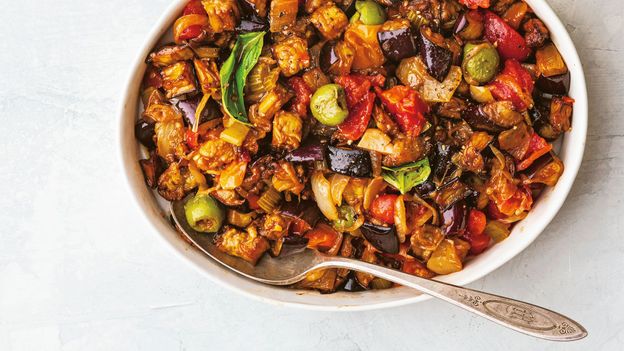
Benedetta Jasmine Guetta is a Milan-born food writer, photographer, stylist and cookbook author. Last year, she published Cooking alla Giudia: A Celebration of the Jewish Food of Italy. The book is the result of more than a decade’s worth of research into Italian-Jewish cuisine. She’s also the owner of Café Lovi in Santa Monica, California, specializing in Jewish-inspired fare. The dish on the menu perhaps most deeply rooted in Guetta’s own heritage is the caponata.
Guetta said it’s not clear precisely how aubergine, which features in the dish, became so closely associated with Jewish people. The hypothesis is that Jewish merchants traded with Arab countries and got exposed to different ingredients, like cardoons, fennel, aubergine and spices that were not well known locally at the time. Another hint, Guetta explained, is that recipes with these ingredients would be described as “alla giudia” or “Jewish style”.
Regardless of how it came to be, now dishes like aubergine parmigiana, carciofi alla romana (Roman-style artichokes), and of course, caponata, are decidedly Italian. But Guetta said that few Italians outside of the Jewish community (of which she estimates there are about 35,000 left in the country) know about this history.
Where does caponata come from? There are a number of theories ranging from potential folklore to educated guesses. Like many centuries-old dishes, it’s impossible to attach an exact date to its creation. Enrica Bruno, a guide with Sicilian Food Tours in Palermo, said that “capone” in the Sicilian dialect is a mahi mahi fish, which was originally an ingredient in caponata. Wives of fishermen would prepare the dish for their husbands, unsure of when they’d return from sea. The vinegar would help keep the dish until the fishermen returned.
But, Bruno explained, fish was expensive. So cheap aubergine eventually replaced the fish.
Dining and Cooking