
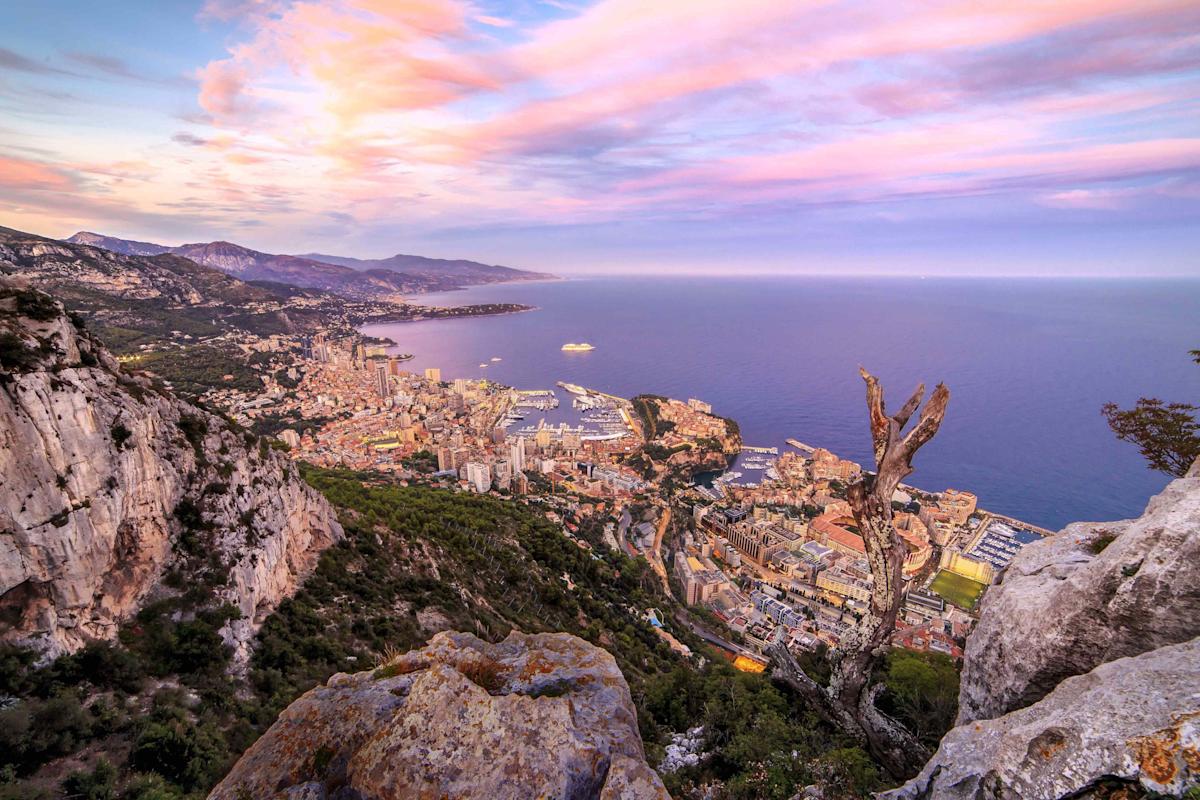
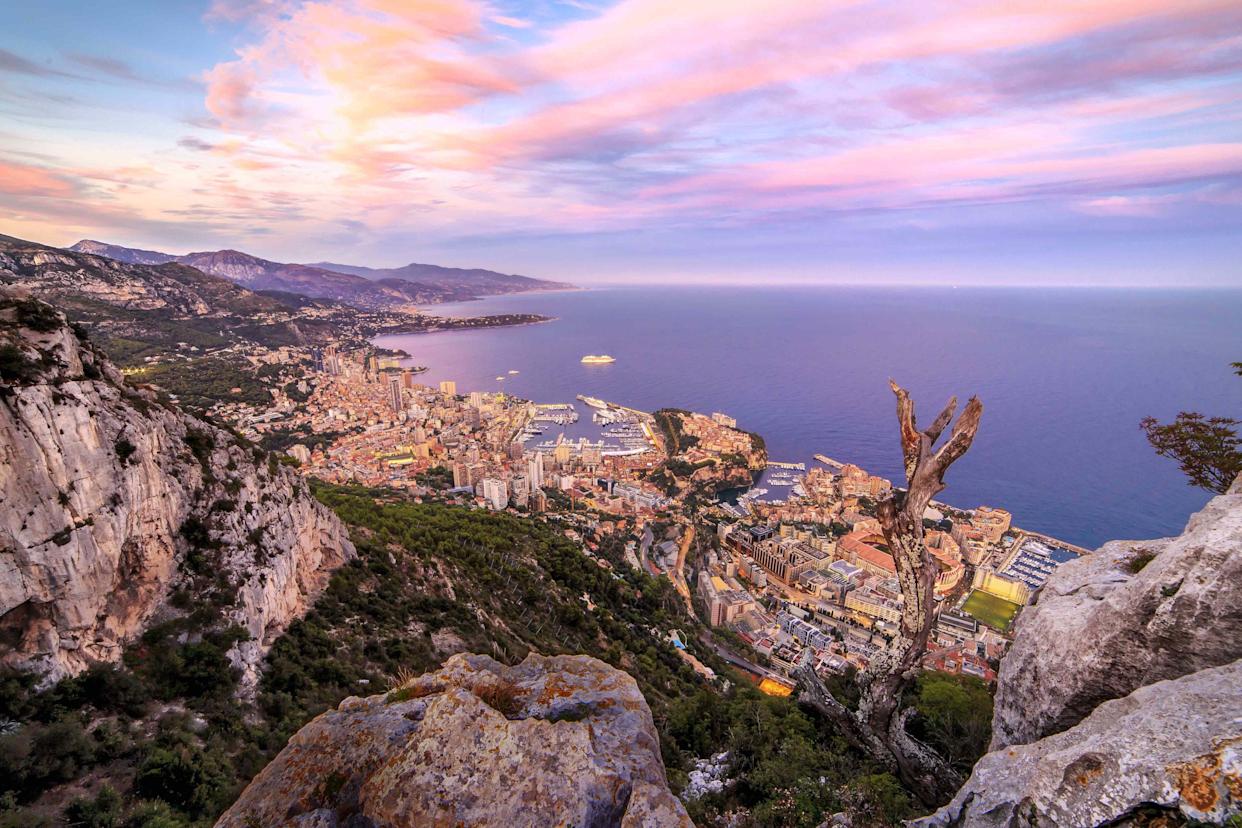
Monaco is such a small country that this sunset view of its harbor is from La Turbie, France.
Credit: Davide Bianchi/Getty Images
A plump scallop is placed in front of me at the table, set in a puree of arugula, spinach, parsley, and okra and topped with verdant greens, evoking summertime on a plate. It’s so beautiful I feel a touch guilty digging into it, a feeling I quickly suppress as I marvel at the most tender scallop I’ve ever tasted. It’s one of many exquisite bites served on the tasting menu at Blue Bay Marcel Ravin, a two-Michelin-starred restaurant in Monte Carlo.
“We poach the scallops for 30 seconds in milk and then roast them in curry butter,” says chef Marcel Ravin. Combined with a consommé of burnt bread and red mullet with tamarind, the dining experience adds up to one of the fanciest meals of my life. It’s par for the course in a place like Monte Carlo, where opulence knows no bounds.
Monte Carlo is the most famous district in Monaco, a city-state on the French Riviera, and it has always been known for excellence, lavishness, and attracting the very, very — one more very for good measure — rich. Now its culinary luminaries are pushing the boundaries even further. Some attribute it to the “pandemic revamp” — when chefs cooked up ideas for the future while restaurants were closed. Some pin it to the competitive camaraderie; if your colleagues are innovating, so must you. Others believe that striving for the next level of greatness is the only way to work.
Of course, the location helps: Nestled between Italy and France and kissed by the Mediterranean Sea, Monaco is blessed by natural beauty and access to the freshest seafood and the finest cuts of meat. Every chef I talk to in Monte Carlo believes that today, the food there must do more than simply satiate. It must leave a mark, form a memory, induce pleasure intense enough to make you want to propose to your dinner right then and there.
Ravin aims to deliver food that gives his diners that entire range of feel-good emotions. To do so, he draws inspiration from his own memories. One of his signature desserts — a spiced chocolate cracker that looks like a heap of colorful blossoms and crumbles into powder with a satisfying crunch — is inspired by his childhood experience of picking cocoa beans in his grandmother’s garden on their home island of Martinique; she turned them into a deliciously rich drink. When he remodeled Blue Bay a year ago, he added Caribbean notes to the decor and the menu, bringing in both the joy of his grandmother’s kitchen and the elegance of her preferred ingredients.
“All the recipes come from my childhood memories,” Ravin says. “Today, when I work on a recipe, I think about what created the emotion in me when I was a child.”
Just down the road at Café de Paris Monte-Carlo — a 157-year-old brasserie icon that reopened in 2023 after a two-year, more than $60 million renovation — chef Victor Marion believes that all this artfully prepared food begets these high-end sentiments.
“The emotion starts with the eyes when you see the dish coming, and at the first bite, your mouth is watering,” he says. The experience proves to be just as powerful as he says it is. In my case, the café’s lavish foie gras with fruit chutney rescues me from jet lag. By the time I am done slurping the floating island — one of my favorite desserts, with its soft, fluffy meringue bathing in crème anglaise — I’m leaning over the rail of the café’s terrace, snapping photos of the legendary Casino de Monte-Carlo, featured in two James Bond movies, feeling like 60 million bucks myself.
No luxe getaway to Monte Carlo would be complete without a meal at Pavyllon Monte-Carlo, helmed by Yannick Alléno, whose restaurants have earned 17 Michelin stars among them. The menu’s lobster in ginger butter entrée jumps off the page as the first must-try. When the dish arrives, it’s a beautiful study in color: Scarlet lobster morsels swim in a golden emulsion, a combination worthy of a Salvador Dalí painting.
I pause to appreciate it before I let myself savor the succulent, satisfying bites. A pinch of regret comes next — I’ve polished it off too soon. But that’s OK, because now I get to look forward to dessert, a crispy “meringue of incredible lightness” that resembles rose petals tossed over vanilla ice cream. The meal is an experience so swank that I’m not sure life will ever get better than this.
Then I try Venezuelan-born chef Victoria Vallenilla’s dishes at Coya Monte-Carlo, a waterfront Nikkei restaurant, where South American ingredients meet Japanese techniques. Vallenilla says she’s seen patrons become teary-eyed as they tasted dishes that reminded them of their childhood dinners at grandma’s. As much as she draws on her Latin heritage, she also loves experimenting with culturally diverse flavors and techniques, bringing them together on the plate. Who would imagine that chocolate and caviar could taste so good together? In Vallenilla’s kitchen, it’s the perfect match: a crunchy, faintly sweet chocolate tart touched with chocolate cream and topped with a specialty caviar from Greece that has notes of hazelnut and almond.
“We serve it with miso-caramel ice cream and some miso powder on top,” Vallenilla says. “That’s a dish that took us a bit of time to create. It’s really a beautiful pairing.”
Vitelio Reyes of Amazónico Monte-Carlo, which opened in 2024, is similarly fond of marrying unconventional ingredients in elevated bites. His favorite dish, tuna laqueado, consists of aged akami bluefin tuna swimming in a ponzu sauce, alongside tamarillo fruit served with crispy dehydrated pineapple chips and Amazonian cashews. “This dish represents the whole integrity of the Amazon, with a great Nikkei influence,” Reyes says.
Another treat he’s excited about is a variation of pastel de choclo, a kind of savory corn pie, topped with rillettes of local red mullet and served with mild caviar. “It makes a perfect symphony with the sweetness of the corn and the light flavor of the fish.”
There’s one more spot to book to appreciate the exquisite nature of Monte Carlo: a window table at the Michelin-starred Le Grill on the rooftop of Hôtel de Paris Monte-Carlo. Famed for its soufflés and sweeping views, it owes its existence to the opera prima donna Maria Callas, who wished to dine while overlooking France, Italy, and Monaco all at once. Clouds shroud the horizon on my visit, but a raspberry-pistachio soufflé saves the day. Soft and warm, it’s studded with crunchy, nutty bites and pierced with sweet and sour streaks of raspberry, ensuring every last crumb is transcendent.
As I lick the magenta droplets off my fork, I am once again awed by the sheer abundance of excellence in Monte Carlo’s food scene. And that’s really its secret: the utter grandeur of it all. It’s hard to forget perfection.
Where to eat in Monte CarloAmazónico
A lively rooftop restaurant, Amazónico blends Latin American flavors with Asian and Mediterranean touches. Order standout dishes like the akami tuna in ponzu and the roasted, caramel-glazed pineapple before dancing the night away to whatever the DJ is spinning, if that’s your jam.
Blue Bay Marcel Ravin
Blue Bay will transport you to the Caribbean and back in a few bites. Signature dishes like scallops in curry butter are inspired by chef Ravin’s childhood in Martinique. The waterfront spot is an idyllic destination for those who love bold flavors.
Café de Paris
The iconic Café de Paris is back, more glamorous than ever, and still serving the luxurious brasserie classics you expect, like pâté and caviar. Take in the gorgeous view of the legendary Casino de Monte-Carlo for dessert.
Coya
Seafront hot spot Coya combines Peruvian and Japanese flavors that will delight adventurous palates, with highly coveted terrace seating that delivers sunset views to linger over.
Le Grill
Le Grill serves Riviera elegance with sweeping rooftop views, complementing its renowned menu of high-end bites, including foie gras and marinated gamberoni, along with its famed soufflé menu for dessert.
Pavyllon Monte-Carlo
Located inside Hôtel Hermitage, Pavyllon offers French haute cuisine with Mediterranean flair. Lobster in ginger butter, a zucchini flower stuffed with sea bass, and Lebanese ice cream are only the beginning.
Maya Mia
For the best local pizza, ranging from a vibrant Margherita to a spicy Diavola, chef Reyes heads to Maya Mia, a modern Italian spot with yesteryear charm. The restaurant offers fresh salads, burrata, pasta, and burgers, which are served with pizza-dough buns.
Italian restaurants
Chef Alléno says you can’t go wrong with Cantinetta Antinori, offering traditional Tuscan cuisine, or Tre Scalini, which focuses on Roman recipes.
Franchin
A favorite of chef Marion, in nearby Nice, Franchin serves delicious and beautifully presented French classics in an Art Deco setting. It carries a similar spirit to Café de Paris — old-school charm infused with modernized French technique.
The Niwaki
For an indulgent take on sushi, chef Vallenilla recommends The Niwaki. The executive chef, Wagner Spadacio, was named vice world champion at the European Sushi Championship in 2018, so you’re in for a treat.
Read the original article on Food & Wine
Dining and Cooking