
Whether you follow the Nigella technique of double-buttering toast (spread a layer, wait for it to melt, then add a second layer on top) or prefer a sparser covering, butter is a daily essential for many. And as with any household staple, it’s important to get the best quality possible within your budget.
First things first: unless you’re baking, butter should be salted – unsalted adds little flavour to toast or steamed vegetables. Supermarket options vary wildly, from around 1.5 to 4 per cent salt, some with the salt evenly distributed, others with crunchy crystals.
You may well have noticed the price of butter rising dramatically of late – up to 18 per cent in a year, until mid-2025. Recently, 1kg tubs of spreadable Lurpak have been going for almost £10. Spreadable options, which are blended with oil, are best avoided, lacking the more intense, creamy flavour of proper blocks.
New FeatureIn ShortQuick Stories. Same trusted journalism.
A perfect storm has led to butter becoming so costly. Across the globe, drought, extreme heat, and heavy rainfall have contributed to its price rising by up to 15.6 per cent, according to the Energy and Climate Intelligence Unit. In the UK, poor grass growth after a hot summer has led to farmers buying more feed, which itself has risen in price. Transport, energy and packaging are all up, too.
Yet butter, perhaps unsurprisingly, never goes out of fashion. In 2022, ghastly looking “butter boards” (like a cheese board, but with butter) went viral; in another social media-driven trend, in the butter diet, whole slices of butter are consumed straight from the packet.
Whatever your reason for using butter (for me, it’s spread liberally on toast or used to coat boiled potatoes), with so many options in supermarkets, the first question is where to begin.
How to pick butter
Largely, you’ll find butter from three regions: Britain, Ireland and France. They vary greatly, says Grant Harrington, founder of Ampersand Dairy and author of Bread & Butter. Ireland’s cool and wet climate means its cattle graze outdoors for much of the year, resulting in milk that’s high in carotene and flavour, leading to a deep yellow colour and grassy sweetness.
French butters are often far paler, as the cows’ diet isn’t as centred on grass. However, French butters tend to be cultured (using cream that has been fermented with live bacterial cultures), which, Harrington explains, “gives it a refined acidity and smooth, balanced flavour that sets it apart”.
British butter is the most varied and, depending on the breed, can veer from rich, golden and intense, to light and delicate.
Harrington recommends seeking out artisan butter, which is “defined by time, attention and freshness. It’s a hands-on process that can change from fermenting the cream slowly, churning in small batches, and seasoning by taste rather than formula. Every batch reflects the milk, the day, and the maker.” By contrast, industrial butter leads to consistency and efficiency, leading to a uniform product, which Harrington describes as “reliable but unremarkable”.
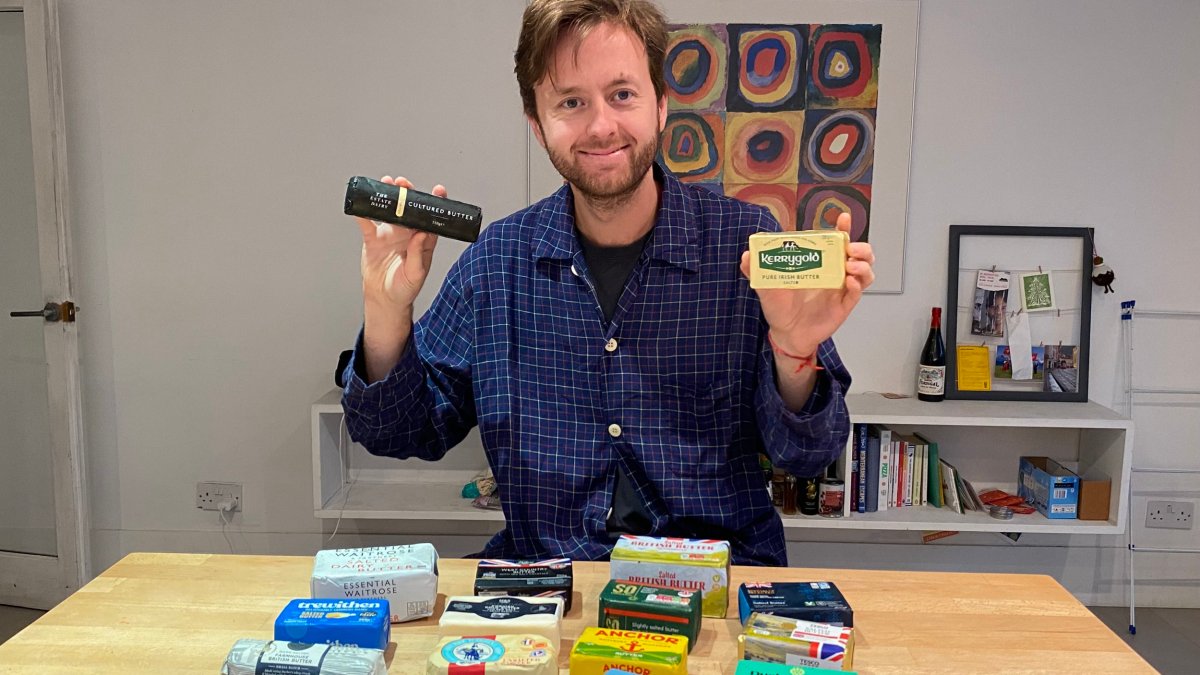
It is certainly worth finding a good local option, especially for spreading on toast. But for the vast majority of us, the local supermarket is the first port of call. And the good news is, there are some very decent-tasting options out there. I blind-tasted 16 to find the best option around.
Sainsbury’s SO British butter slightly salted
£3.15 for 250g, Sainsbury’s
A very pale ivory, almost white in colour. It’s rather sweet, a little like boiled milk, and not overly salty (just 1 per cent salt). It tasted faintly grassy, too. A decent butter.
3.5/5
Specially Selected West Country salted butter
£2.29 for 250g, Aldi
Also rather pale, this is far saltier than the above, coming in at 3 per cent, and it can be a little overwhelming – although the salt does provide a nice crunch. The milkiness is ever so slightly muddy in flavour.
2.5/5
Anchor salted butter
£2.44 for 200g, Asda
A strong and pleasing milky aroma, but the texture is a little too oily. The flavour is very creamy, like having a spoonful of double cream, and it’s not too salty. Overall, a decently balanced butter.
3.5/5
Trewithen Dairy Cornish salted butter
£3.25 for 250g, Ocado
A nice creamy yellow colour, this butter tasted of fresh milk rather than cream, which though not unpleasant, lacked the punch of some butters. A touch too salty, too.
3/5
M&S Collection Cornish Gold butter
£3.60 for 250g, M&S
More yellow than some of the paler butters, with visible darker patches from the salt. Not overly salty, but not deeply flavoursome either – a little milky.
3/5
Tesco salted butter
£1.99 for 250g, Tesco
Very pale, with a milky, grassy flavour. It’s quite clean and well-balanced, with a salty kick coming in towards the end. Not punchy, but would work well as an all-rounder.
3.5/5
M&S salted British butter
£2 for 250g, M&S
A touch of acidity, which is welcome, but it’s also a bit too sweet. Decent and balanced, but not remarkably interesting.
3.5/5
The Estate Dairy salted cultured butter
£3.50 for 250g, Ocado
Log-shaped which, at least in theory, denotes quality. It has a more intense aroma than most – slightly cheesy – from the use of starter cultures. There were nice grassy notes. A very nice butter, let down only by being a touch too salty.
4/5
Duchy Organic English salted butter
£3.75 for 250g, Waitrose
Apart from salt, I found this quite bland, with little discernible flavour coming through. Not offensive by any means, just not very interesting.
2.5/5
Lurpak slightly salted butter
£2.70 for 200g, Morrisons
Rather pale, it tastes nice and clean, with a decent level of salt and a mild, creamy sweetness. This won’t ruffle any feathers, which is perhaps why it’s one of Britain’s bestselling butters.
4/5
Sainsbury’s British butter, salted
£1.99 for 250g, Sainsbury’s
It smells like fresh milk, and is pretty sweet and salty, but they’re decently balanced, so neither overwhelms. I found the texture a little oily, which of course doesn’t matter if spreading on toast.
3.5/5
Kerrygold salted pure Irish butter
£2.60 for 200g, Morrisons
An alluring creamy yellow colour, this has a nice, bright, lemony acidity, a good level of salt (1.8 per cent) and is not too sweet. One can even detect grassy notes, which is rare for mass-produced butter.
4.5/5
Waitrose Essential salted butter
£4.40 for 500g, Waitrose
Pearly white, with darker yellow spots – likely from the salt – providing a nice visual contrast. Overall it’s a bit too sweet, tasting essentially like cream. The salt is a bit overpowering.
2.5/5
M&S Collection farmhouse British butter
£3 for 200g, M&S
A warm yellow with plenty of salt running through it, which provides a nice crunch and, despite being a touch too strong, doesn’t overwhelm the flavour. It smells cultured, with cheesy tones, and delicately acidic, too.
4/5
Tesco Finest West Country butter
£2.90 for 200g, Tesco
Nice dark yellow spots marble this butter, which provides a nice textural counterpoint and goes very well on toast. It is rather salty, but the butter is well-balanced, a nice milky sweetness tempered by a slight fermented flavour.
4.5/5
Lidl Deluxe West Country butter
£2.29 for 250g, Lidl
Plenty of salt crystals and a pleasing, delicately sweet, grassy aroma. Everything is well-balanced, which makes this a great overall effort.
4/5
Dining and Cooking