
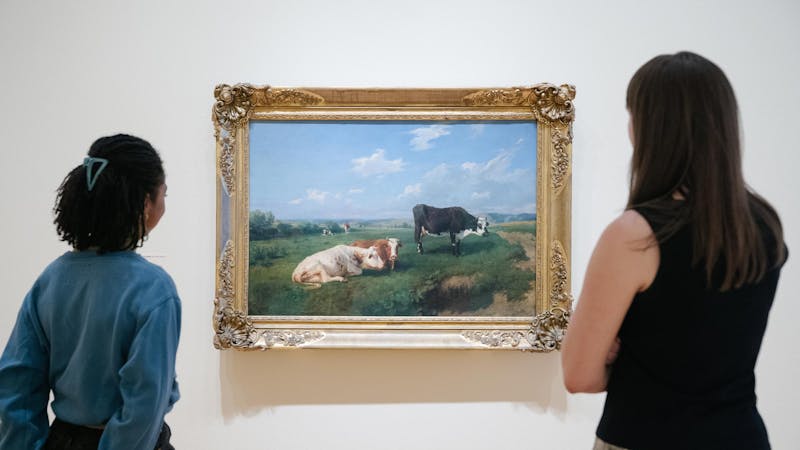
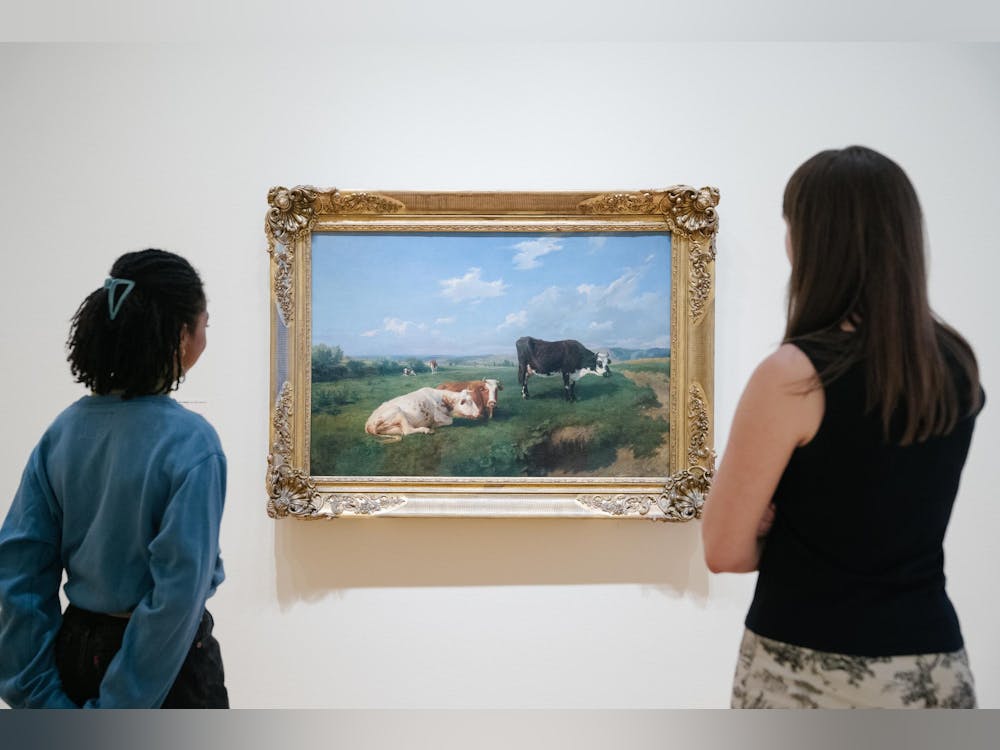
Press Preview for special exhibition ‘Farm to Table: Art, Food, and Identity in the Age of Impressionism’ at Seattle Art Museum on Oct. 21, 2025. Courtesy of Seattle Art Museum.
The glory of France is on Paris’ tables, rooted in its soil, and brought to fruition by its workers. Seattle Art Museum’s (SAM) “Farm to Table” highlights the notion of French excellence through its cuisine in the years following the Franco-Prussian War in the late 19th century.
Following its occupation by Prussian forces, France was looking to solidify its identity as a gastronomic capital, turning to food as a focal point for French artists.
“It needed a reminder of what makes France great in a very grim time of its history,” SAM’s American art curator, Theresa Papanikolas, said when speaking about the gallery.
Featured in the exhibition are the great names of Paul Gauguin, Claude Monet, Camille Pissarro, and others whose use of impressionist techniques provides a realistic lens into French food culture in the 1870s and 1880s.
The Impressionist era is characterized by its straying from classic allegorical and biblical themes, towards accuracy and objectivity. The use of visible brush strokes and bright colors to accurately define lighting and movement showcases these impressionist values.
The gallery grapples with themes of class inequality, colonialism, gender, and industrialization, all through painting and sculpture, depicting scenes ranging from agricultural production to consumption.
The 50 works are divided between five sections, the first titled “On the Farm,” and the last, “On the Table.” “On the Farm” serves as an ode to French tradition and nostalgia amidst the chaos of modernity brought about by the Industrial Revolution.
The rural poor, previously demonized before the war, were iconized as a symbol of French nationalism. This notion is brought to life most notably through “The Gleaners” (1887) by Léon Augustin Lhermitte. Part of the “On the Farm” section, the painting portrays three women collecting leftover grain, their posture and the sheer magnitude of the harvest suggesting pride and resilience.
The metaphorical heart of the exhibition, as suggested by Papanikola, is the somewhat gruesome “A Rat Seller During the Siege of Paris in 1870” by Narcisse Chaillou. A butcher dressed in France’s blue, white, and red prepares to slice open a rat, a necessity during the food scarcity of wartime, with a shy grin on his face.
Serving as an intermission between sections is “Food for Thought,” an interactive space intended for museum-goers to share their experiences and connect over food-related prompts. The section features a beautifully adorned dining table intended to mimic one of the still lives of section four, and invites guests to sit and converse. The museum also collaborated with Seattle Public Library in creating a book nook catered to the thematic qualities of “Farm to Table.”
Advertisement

Seattle is the final stop on “Farm to Table’s” national tour, and the only location on the West Coast. Seattle Art Museum will offer guided tours at 1:15 p.m. on Saturdays and Sundays, and every second Thursday evening of the month, “SAM Talks” will be hosted to talk about the works’ themes and history.
The exhibition is scheduled to remain until mid-January.
Reach writer Macey Wurm at arts@dailyuw.com. X: @maceyw_TheDaily. Bluesky: @maceywurm.bsky.social.
Like what you’re reading? Support high-quality student journalism by donating here.
Dining and Cooking