
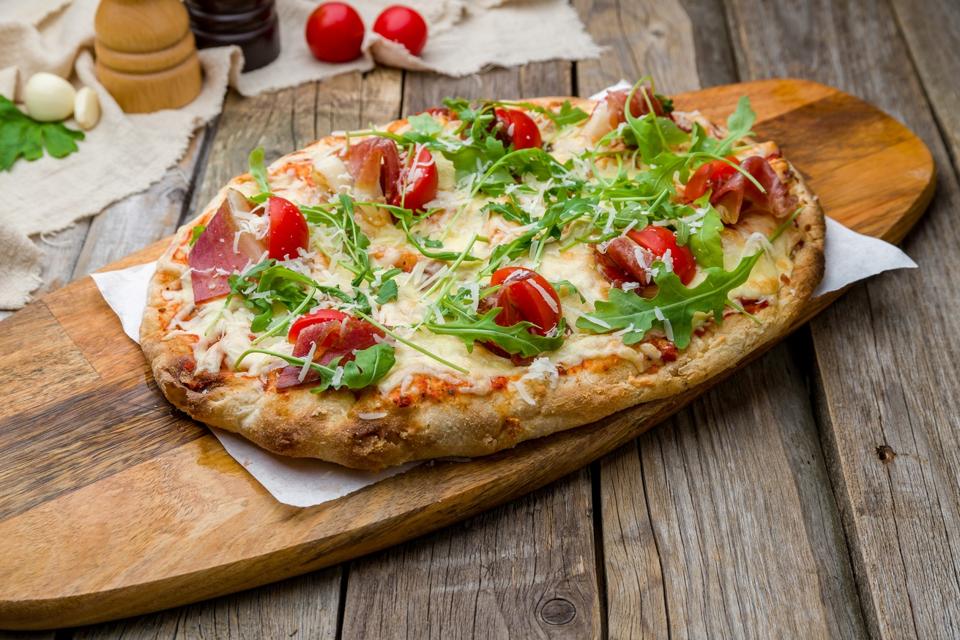
A new “Made in Italy” product, Di Marco Pinsa Romana, will be arriving at specialty food stores across the U.S. this year.
I first tasted Pinsa Romana, a dish I initially thought was a rare Ligurian specialty, during a lunch with friends several years ago in Laigueglia, a small seaside town in Italy. We ate at a relaxing eatery overlooking the coast, and although the menu featured mostly locally sourced fish and seafood, I chose this unfamiliar dish.
I fell in love with the taste and texture. At the time, I wasn’t aware that Pinsa Romana was actually part of a widespread food trend popping up on menus all across Italy.
The Revival Of A Roman Tradition
For the uninitiated, Pinsa Romana is a flatbread with a light, airy crust, finished with many of the same toppings as traditional pizza. Yet, it has a distinctly different shape and texture. It is oval (almost like a French batard) and tends to be softer in the center and crispier on the outside than standard pizza.
Whereas pizza dough is often just a vehicle for various toppings, the dough of Pinsa Romana is the star of the dish, usually prepared with simpler, seasonal ingredients.
One legend suggests that this ancient Roman staple was so delicious that it was offered to the gods. Its name is derived from pinsere, which in Latin means to press or flatten.
The Product Of A Romance Between Baking And Nutrition
But it was Corrado Di Marco, a Roman baker, who had the moxie to conceptualize a new dough category to challenge pizza—inarguably one of the most popular Italian food exports worldwide.
Starting in the early 1970s, this patriarch of Pinsa Romana began experimenting with a product that, while easily mistaken for pizza, offered a more flavorful and healthier option.
When Di Marco met and married his wife, Benilde, a nutritionist, the collaboration proved fruitful in more ways than one. Not only did the baker-nutritionist team have three sons—Alberto, Enrico, and Francesco (all of whom are active in the family business)—but their partnership led to the launch of a revolutionary brand.
Pinsa Romana: The Healthier Alternative to Pizza
With its short fermentation time, conventional Roman pizza al taglio (sold in square or rectangular slices) is a convenient and popular street food, but it is often laden with sugars and fats, and sometimes lard.
In 1981, the Di Marcos created the exclusive recipe for Pizzasnella (“slim pizza”). This unique dough, which combines wheat, rice, and soy flours (rather than refined wheat flour alone), allows for a longer leavening time without the need for added fats or sugars.
This longer rise, in which fermentation occurs primarily before baking rather than later in the stomach, makes Pinsa Romana highly digestible. With a much higher water concentration (around 80%), the dough tastes incredibly light and airy. It is also lower in gluten, lower in calories, and higher in protein than traditional pizza.
Until 2012, Di Marco developed his flour blends strictly for commercial kitchens and baking experts, building a robust B2B infrastructure to supply restaurants.
To protect the quality and authenticity of the dough and his brand, Di Marco founded the Associazione Originale Pinsa Romana, which certifies establishments that can call themselves pinserie.
It can be challenging to introduce new food products in Italy, a culinary culture so deeply rooted in history and tradition. But tying the recipe to what may or may not have actually been an ancient Roman legend helped dramatically expand consumer interest in and acceptance of Pinsa Romana.
The Road To Success
Since Di Marco expanded its market directly to consumers in 2020, the popularity of Pinsa Romana has soared. Recent company data indicate sales of over 40 million pinsas per year and exports to more than 60 countries, with gross revenue of $60 million. In addition, there are now more than 7,000 accredited pinserie around the world.
In 2021, the company launched an innovative gluten-free dough for people with intolerances and allergies. The timing of this couldn’t have been more fortuitous, as younger generations in particular have become highly focused on gut health and are actively seeking alternatives to ultra-processed foods.
In 2024, the company created its first U.S. subsidiary under an agreement with the French private equity fund Abenex, whose minority stake will enable further expansion in Italy and abroad. All Di Marco products will continue to be produced in Italy, with the ready-made bases distributed through U.S. food retailers such as DeCicco & Sons and Nicholas Markets.
Coinciding with the modern recipe’s 25th anniversary, the Italian Ministry of Agriculture, Food Sovereignty and Forests included Pinsa Romana among the Traditional Agri-food Products (PAT) of the Lazio region.
“For us, Pinsa Romana’s inclusion in the PAT isn’t a point of arrival, but a new beginning, which encourages us to continue to proudly preserve the identity of a product that is, now more than ever, a symbol of tradition, creativity, and Italianness,” CEO Alberto Di Marco told Italia a Tavola when commenting on the recognition.
Finding Pinsa Romana Closer To Home
Americans have had an enduring love for pizza ever since waves of Italian immigrants brought it to the U.S. in the late 19th and early 20th centuries. By the 1990s, pizza parlors were the second most popular type of restaurant in the country.
According to early 2026 industry reports, however, that landscape is rapidly changing. Pizzerias have slipped in national chain rankings, and legacy brands are feeling the shift. Even the 70-year-old chain Pizza Hut recently announced it would be closing an estimated 250 restaurants this year due to declining sales.
As consumers shift away from traditional fast food toward healthier, more authentic options, Di Marco Pinsa Romana is perfectly positioned to capture a new audience of Italian food enthusiasts. I couldn’t be happier because I’ll be able to find the dough at the local DeCicco supermarket near my home.
Dining and Cooking